Why We Tell Homeowners to Ignore the Aux Heat Light During the First Frost
Facing the First Frost: Why That 'Aux Heat' Light Isn't an Emergency
The first fall frost in Western PA usually arrives overnight, dropping temperatures rapidly and leaving many homeowners wondering why heat pump auxiliary heat turns on so suddenly. You wake up to a chilly house, check the thermostat, and see the dreaded "Aux Heat" or "Emergency Heat" indicator glowing on the screen. The sudden transition from mild, fifty-degree fall days to freezing nights catches many homeowners off guard, leading to a frantic search for an HVAC technician.
As you evaluate your system's performance, learning about professional heat pump installation can help you avoid heat pump emergency heat mode issues later in the season.
In our experience serving local communities, this sudden indicator light is rarely a sign of catastrophic failure. Modern heat pumps are incredibly resilient pieces of technology with built-in mechanisms designed specifically to handle freezing outdoor air. When the temperature plummets, your system automatically adjusts its operation to bridge the heating gap between what the outdoor air can provide and what your indoor comfort requires. Before you assume the worst, it helps to understand the difference between standard operation, supplemental heating, and actual system failures.
The Initial Panic vs. System Reality
It is completely natural to feel a sense of panic when your heating equipment starts behaving differently. We see this pattern every autumn. However, what looks like an emergency is typically just your system doing exactly what it was programmed to do. Heat pumps are designed to keep you warm, and they have multiple stages of heating to accomplish that goal efficiently. The appearance of the auxiliary heat indicator simply means your system has shifted into its next gear.
What 'Auxiliary Heat' Actually Means for Your System
To understand why your system shifts gears, you have to look at how heat pumps generate warmth. Unlike a traditional gas or oil furnace that burns fuel to create heat, a heat pump extracts existing heat energy from the outside air and moves it inside your home. Even when the air feels cold to your skin, there is still thermal energy present. However, as the temperature drops, extracting that heat becomes progressively harder.
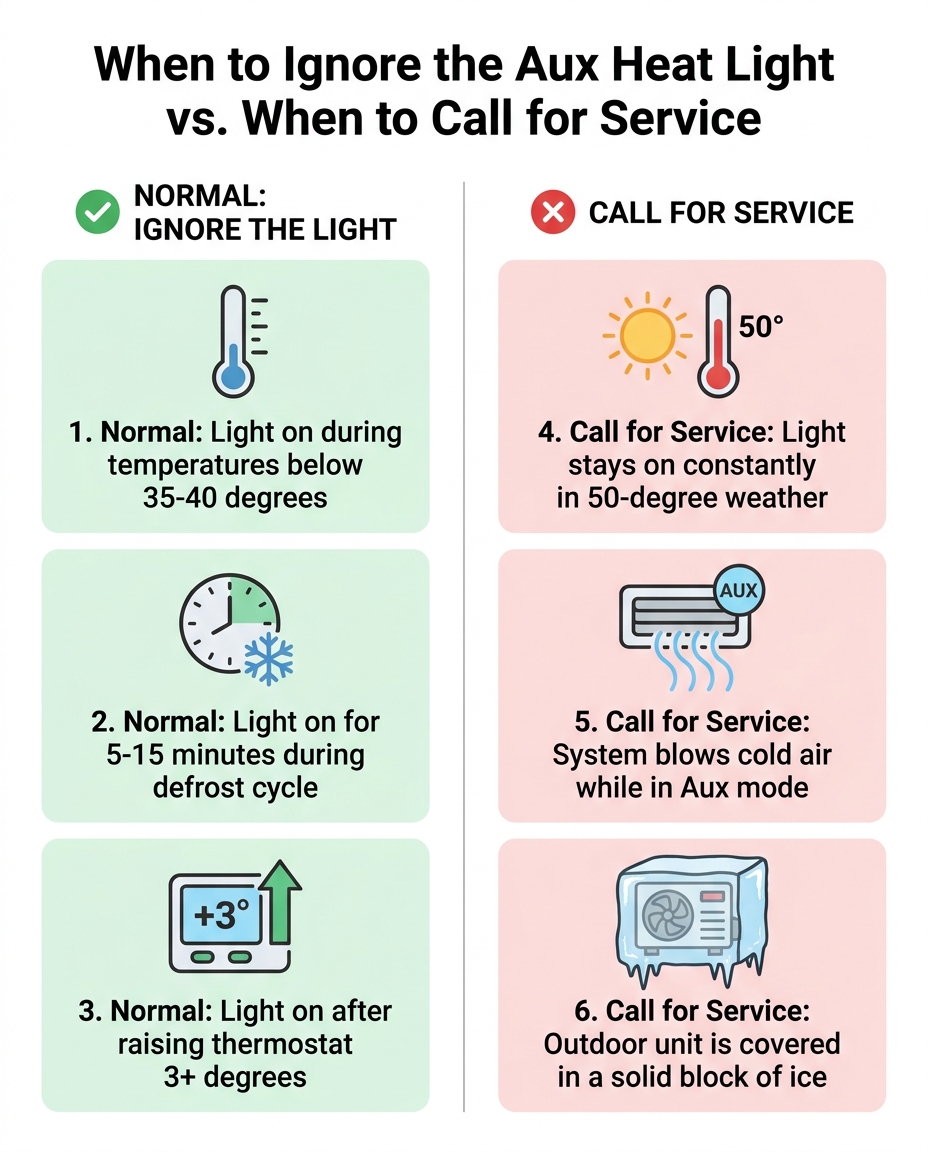
This brings us to a critical technical concept known as the Balance Point. The balance point is the specific outdoor temperature—typically between 35 and 40 degrees Fahrenheit—where your heat pump can no longer extract enough heat from the air to maintain your indoor temperature entirely on its own. It needs help to keep up with the heat loss of your house.
When the outdoor temperature dips below this threshold, the system activates its Supplemental Heat. Auxiliary heat is a secondary heat source, usually in the form of electric resistance heating strips located inside your air handler. These strips automatically kick in to make up the difference between what the heat pump can produce and what your thermostat demands. We see this precise, automated hand-off functioning beautifully in modern Trane and Daikin heat pumps.
Comparing Primary and Auxiliary Heating Modes
• Heat Source — Primary Heat Pump Mode: Extracts ambient heat from outdoor air — Auxiliary Heat Mode: Electric resistance strips inside the air handler
• Activation Trigger — Primary Heat Pump Mode: Normal heating demand above 35-40°F — Auxiliary Heat Mode: Temperatures below the balance point or high demand
• Efficiency Profile — Primary Heat Pump Mode: Highly efficient heat transfer — Auxiliary Heat Mode: Standard electric heating efficiency
• Thermostat Indicator — Primary Heat Pump Mode: Standard "Heat" icon — Auxiliary Heat Mode: "Aux Heat" or "Supplemental" light
Why Heat Pump Auxiliary Heat Turns On During Sudden Cold Snaps
The activation of auxiliary heat is deeply tied to localized weather patterns. In areas like Jeannette and Murrysville, late fall weather is famously unpredictable. You might experience a pleasant, sunny afternoon in the mid-fifties, only to have the temperature plummet to below freezing by two in the morning. This rapid overnight temperature drop forces your heat pump to work significantly harder in a very short amount of time.
During a gradual winter cooling trend, your home's thermal mass loses heat slowly, and the system can often keep up with steady, low-level operation. However, a sudden freeze creates an immediate, severe shift. The outdoor unit crosses the balance point threshold abruptly, and the indoor temperature begins to drop faster than the primary heat pump cycle can replenish it. The system senses this rapid deficit and immediately calls for auxiliary heat to stabilize the indoor climate.
The Impact of High Humidity and Wind Chill
Temperature is not the only factor that triggers this response. The weather during a sudden cold snap often brings high humidity and biting winds.
• High moisture content: Damp, freezing air causes frost to form much faster on outdoor equipment, which impedes heat transfer.
• Wind chill factor: Strong winds strip heat away from your home's exterior walls rapidly, increasing the overall heating load your system must overcome.
• Thermal shock: The sudden shift from a warm day to a freezing night leaves your system with no time to ease into its heavy-duty heating cycle.
Your heat pump is simply adapting to this fast-changing outdoor environment. It uses every tool in its arsenal to ensure your living room stays at the temperature you requested.
The Defrost Cycle: A Built-In Protection Feature
There is another major reason you might see that indicator light, and it has nothing to do with the balance point. When temperatures hover near freezing and there is moisture in the air, frost naturally accumulates on the outdoor unit's coils. If left unchecked, this frost would build into a solid block of ice, suffocating the system and preventing any heat transfer.
To prevent this, systems like Trane and Daikin heat pumps feature an automated defrost cycle. When the system detects frost buildup, it temporarily reverses its operation. It switches into cooling mode for a few minutes, sending hot refrigerant back outside to melt the ice off the coils. Because the system is technically in cooling mode during this process, it would normally blow cold air into your home. To prevent you from feeling a sudden icy draft, the system automatically turns on the auxiliary heat strips to warm the air before it reaches your vents.
Understanding protecting your heat pump compressor from early frost is crucial for system longevity, but the defrost cycle itself is a normal, healthy function.
What to Expect During a Defrost Cycle
1. The fan stops: The outdoor fan will shut off to allow the heat to build up and melt the ice.
2. A whooshing sound: You may hear a loud whoosh as the reversing valve shifts the flow of refrigerant.
3. Steam rising: As the ice melts, you will likely see steam rising from the outdoor unit. This is not smoke; it is just water vapor.
4. The Aux light appears: The thermostat will indicate auxiliary heat is running to keep your indoor air warm.
5. Return to normal: After 5 to 15 minutes, the valve shifts back, the fan restarts, and normal heating resumes.
If you notice the light come on, simply wait a few minutes before assuming something is wrong. A normal defrost cycle is brief and highly effective.
Thermostat Habits That Accidentally Trigger Supplemental Heating
Sometimes, the weather is not the culprit at all. Many homeowners in Jeannette and Murrysville inadvertently force their systems into auxiliary mode through their daily thermostat habits. Heat pumps operate best when they are allowed to maintain a steady, consistent temperature. When you treat a heat pump thermostat like a traditional furnace thermostat, you can accidentally trigger the supplemental heating strips.
If you come home to a cold house and bump the thermostat up by four or five degrees all at once, you are sending a "high demand" signal to the control board. The system calculates that the primary heat pump cycle cannot raise the temperature that quickly on its own. To meet your rapid demand, it immediately turns on the auxiliary heat to reach the new set point faster.
Best Practices for Thermostat Management
• Make gradual adjustments: If you need to warm the house, raise the temperature by only one degree at a time. Wait for the system to satisfy that demand before raising it again.
• Avoid deep setbacks: Do not drop the temperature by ten degrees when you leave for work. A setback of two to three degrees is the maximum recommended for heat pump efficiency.
• Trust the current setting: Pushing the thermostat to 80 degrees will not heat the house any faster than pushing it to 72 degrees; it will only force the auxiliary strips to run longer.
• Use a smart thermostat: Modern smart thermostats are designed with "adaptive recovery" features that learn how long your home takes to heat up, bringing the temperature up gradually without triggering the auxiliary strips.
How Proper Setup Minimizes Auxiliary Heat Usage
The frequency with which your system relies on supplemental heat is directly tied to the initial sizing and setup of the equipment. A properly sized system will only rely on auxiliary heat when absolutely necessary—during extreme cold snaps or brief defrost cycles. However, incorrect sizing or poor initial setup can cause a heat pump to struggle, forcing it to rely on expensive supplemental heat even in relatively mild weather.
When installing robust equipment like Trane and Daikin heat pumps, a professional load calculation (known as a Manual J) is required. This calculation takes into account your home's square footage, insulation levels, window quality, and the local climate. It ensures that the heat pump's balance point aligns correctly with your home's actual heat loss.
If a system is undersized, its balance point will be artificially high. It might start relying on auxiliary heat at 45 degrees instead of 35 degrees, simply because it lacks the capacity to move enough heat. Conversely, proper ductwork sizing and airflow calibration ensure that the heat the system does produce is distributed efficiently. A thorough heat pump installation process is the strongest defense against overactive auxiliary heating.
Frequently Asked Questions About Heat Pump Auxiliary Heat
During the first fall frost in Western PA, our phones ring constantly with questions about thermostat indicators. What we typically see is that a little bit of knowledge goes a long way in providing peace of mind. Here are the most common questions we receive, answered directly.
Is it bad if auxiliary heat comes on?
No, it is a completely normal and necessary function of your heating system. Auxiliary heat is designed to bridge the gap when outdoor temperatures drop below freezing or when the system needs to run a defrost cycle. It only becomes a problem if the indicator stays on constantly during mild weather, which could indicate a refrigerant leak or a failing compressor that requires professional attention.
At what temperature should auxiliary heat come on?
Typically, auxiliary heat should activate when outdoor temperatures drop between 35 and 40 degrees Fahrenheit. This specific threshold is known as the balance point, and it varies slightly based on your home's insulation, the size of your house, and the specific capacity of your HVAC equipment. In properly insulated homes with high-efficiency units, the balance point might be even lower.
How do I stop my heat pump from using auxiliary heat?
You generally shouldn't try to stop it during freezing weather, as your home needs that supplemental warmth to maintain a safe and comfortable indoor temperature. However, you can minimize its use by avoiding large thermostat jumps—never raise the temperature more than two degrees at once. Ensuring your air filters are clean and your outdoor unit is clear of debris will also help the primary heat pump run as efficiently as possible.
Why does my auxiliary heat keep coming on?
It may be running frequent defrost cycles in cold, damp weather, or the outdoor temperature might be consistently below your system's balance point. If the weather is bitterly cold, frequent cycling is expected. If this happens in mild, fifty-degree weather, you likely have an underlying issue such as a malfunctioning reversing valve, low refrigerant charge, or a failing outdoor fan motor.
Does auxiliary heat cost more to run?
Yes, because it typically uses electric resistance heating strips, which are inherently less efficient than the heat pump's primary heat transfer cycle. A heat pump moves existing heat, while auxiliary strips must generate heat from scratch using electricity. While it does use more energy, it is a necessary function for your comfort and safety during extreme cold snaps, and the overall seasonal efficiency of the heat pump still outweighs the temporary use of supplemental heat.
When the Aux Light Means It's Time to Call an Expert
While we want to reassure you that the auxiliary light is usually normal, there are specific times when it indicates a genuine problem. We want to save you the cost of an emergency service call when your system is actually working perfectly fine. As an honest, local company, our goal is to empower Jeannette and Murrysville homeowners to know the difference between a normal defrost cycle and a true mechanical failure.
If you notice any of the following warning signs, it is time to bring in heat pump installation experts to diagnose the issue:
1. Continuous operation in mild weather: If it is 50 degrees outside and the auxiliary light has been on for hours, the primary heat pump has likely failed.
2. Blowing cold air in Aux mode: If the thermostat says auxiliary heat is on, but the air coming from your vents is cold, the electric heat strips or the sequencer may be broken.
3. A solid block of ice: While a light coating of frost is normal, an outdoor unit encased in a thick, solid block of ice indicates the defrost control board or reversing valve has failed.
4. Skyrocketing energy consumption: If your energy usage suddenly spikes dramatically during a mild month, your system may be stuck in auxiliary mode without you realizing it.
5. Strange noises: Grinding, shrieking, or heavy vibrating sounds from the outdoor unit while the auxiliary light is on suggest a compressor issue.
Diagnosing these specific failures requires professional tools, electrical meters, and proper licensing. A quick professional inspection can easily distinguish between a normal defrost cycle and a failing component, ensuring your home stays warm all winter long.
Rest Easy and Stay Warm This Season
When the first fall frost in Western PA arrives, seeing the auxiliary heat indicator is usually just your system doing exactly what it was designed to do. Whether it is bridging the gap during a sudden temperature drop or running a brief cycle to melt frost off the outdoor coils, your heat pump is working hard to keep your living space comfortable. If you see the light, observe the system for a few hours before assuming the worst. By understanding how your equipment responds to the cold, you can rest easy knowing your home is prepared for the winter months ahead. If you do notice the true warning signs, reach out to a professional to ensure your system is ready to handle whatever the season brings.