Why Ignitor Failure is the Most Common November Furnace Breakdown
Waking Up to a Cold House: The November Furnace Lockout
If you are shivering over your morning coffee, you are probably wondering why ignitor failure is the most common November furnace breakdown. That strange clicking noise from your basement, followed by absolute silence and a blast of cold air from the vents, is a frustrating way to start the day. Your thermostat says it is calling for heat, but your house remains freezing. You walk over to the wall, turn the system off, wait a few seconds, and turn it back on. The system tries to start again, but ultimately gives up. When the first sustained November cold snaps in Western PA finally arrive, this is the exact scenario we see play out in homes across the region.
If you need immediate help getting your system back online, our comprehensive residential HVAC services cover everything you need to restore your comfort safely.
Most homeowners assume that a total loss of heat means the entire furnace has failed. In reality, modern heating systems are designed with strict safety protocols that shut the equipment down at the first sign of a specific component failure. This protective shutdown is known as a lockout. During the late fall, the most frequent culprit behind a sudden morning lockout is a cracked hot surface ignitor. Understanding how this small but critical component works will help you see why it tends to break right when you need it most, and why getting professional help is the fastest way to get your home warm again.
The Anatomy of a Furnace Lockout
A furnace lockout is not a glitch; it is a deliberate safety mechanism. When your thermostat calls for heat, the furnace runs through a sequence of safety checks before it ever opens the gas valve. If the system cannot confirm that a flame will be safely ignited, it aborts the process.
Here is the thing: if the gas valve opens but there is no heat source to ignite the fuel, raw natural gas would simply pump into your ductwork and your home. To prevent this, the furnace relies on a flame sensor and an ignitor. If the ignitor fails to glow, the system enters a hard lockout, refusing to operate until the underlying issue is resolved. This leaves you with a cold house, but it keeps your family entirely safe from gas buildup.
What is a Silicon Carbide Hot Surface Ignitor?
To understand why this breakdown happens, you first need to know what a hot surface ignitor actually is. In older furnaces, a standing pilot light burned continuously, waiting to ignite the main burners. Modern high-efficiency furnaces did away with pilot lights to save energy. Instead, they use electronic ignition systems, the most common of which relies on silicon carbide hot surface ignitors.
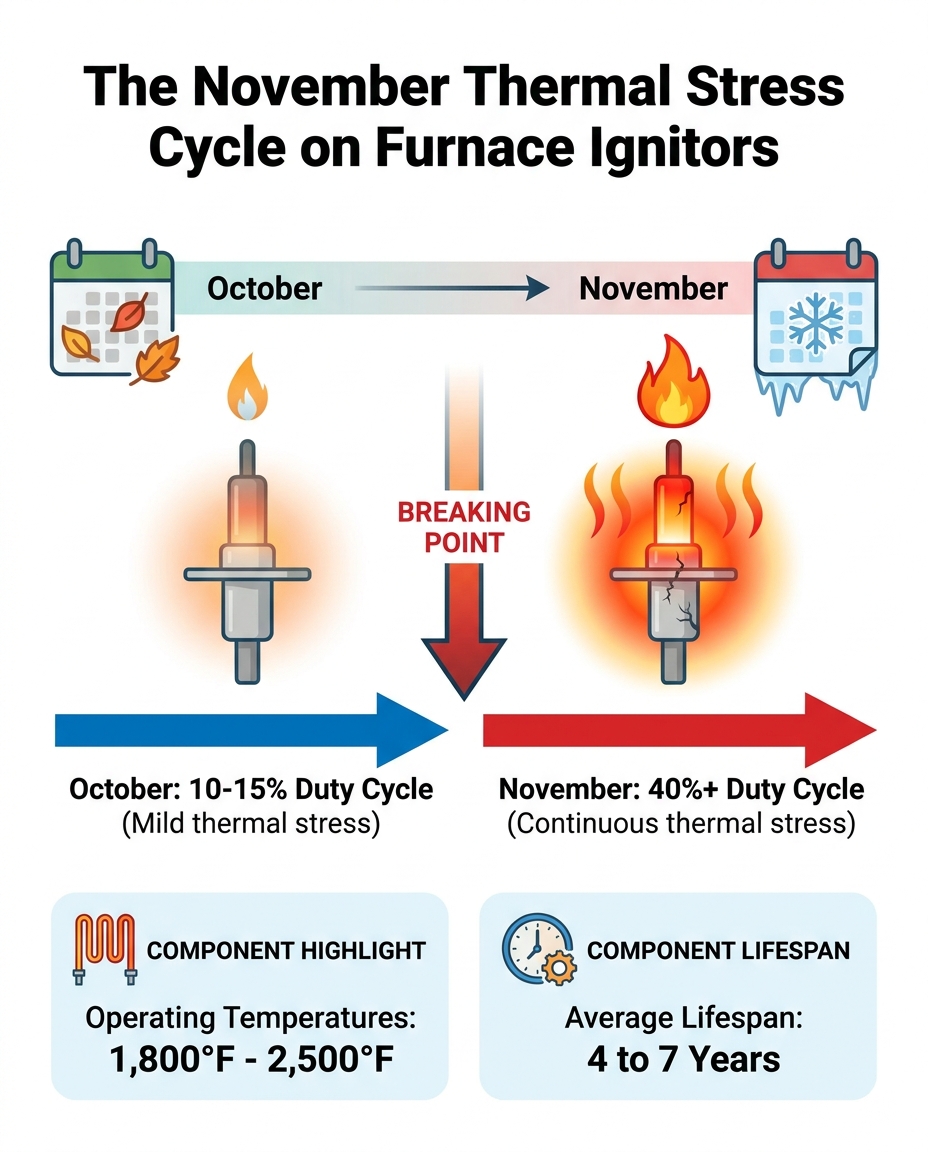
An ignitor functions very much like the filament in a traditional incandescent lightbulb or the glowing coils in a toaster. When the thermostat calls for heat, the furnace sends an electrical current through the ignitor. Because silicon carbide has high electrical resistance, the component rapidly heats up, glowing bright orange or white-hot. Within seconds, it reaches extreme temperatures—typically between 1,800 and 2,500 degrees Fahrenheit. Once it is hot enough, the gas valve opens, the gas hits the glowing ignitor, and the burners safely light.
The Trade-Off: Extreme Heat vs. Extreme Fragility
Silicon carbide is a ceramic material chosen specifically because it can withstand massive temperature spikes without melting. However, that heat resistance comes with a significant structural drawback: it is incredibly brittle. The material is delicate, porous, and highly susceptible to physical shock and thermal wear.
Because of the intense environment inside the combustion chamber, these components do not last forever. The typical lifespan of a hot surface ignitor is between 4 to 7 years. This lifespan is not measured strictly in time, but rather in heating cycles. Every time the ignitor heats up to 2,500 degrees and cools back down to room temperature, it experiences microscopic wear and tear.
• Energy Efficiency — Hot Surface Ignitor: High (Only uses power when heating is required) — Traditional Pilot Light: Low (Burns gas 24/7, even in summer)
• Safety — Hot Surface Ignitor: High (Tied to electronic lockout controls) — Traditional Pilot Light: Moderate (Can blow out, relying on a basic thermocouple)
• Operating Temperature — Hot Surface Ignitor: 1,800°F - 2,500°F (Electric heat) — Traditional Pilot Light: Approx. 3,500°F (Open flame)
• Lifespan — Hot Surface Ignitor: 4 to 7 years (Requires periodic replacement) — Traditional Pilot Light: 10+ years (But wastes significant fuel over time)
The Thermal Shock of Late Fall Temperature Drops
If ignitors wear out over time, why do they seem to break in a concentrated wave during the late fall? The answer comes down to thermal shock and a sudden shift in how your heating system operates. During the mild weeks of October, your furnace might only run on a 10% to 15% duty cycle. It kicks on briefly in the early morning to take the chill out of the air, and then sits dormant for the rest of the day.
With Westmoreland County's rapid late-fall temperature drops, that mild usage pattern disappears overnight. When the first sustained November cold snaps in Western PA hit, temperatures can easily plunge below freezing and stay there. Suddenly, a furnace that was lightly jogging is forced into a full sprint. The duty cycle jumps from 15% to 40% or more, meaning the ignitor is rapidly heating up and cooling down over and over again, all day and all night.
The Physics of Micro-Cracks
This sudden transition from intermittent use to continuous, heavy cycling is what finally destroys an aging component. Over its 4 to 7 years of life, the silicon carbide develops microscopic stress fractures from the constant expansion and contraction of heating and cooling.
During a mild fall, these micro-cracks hold together. But when the furnace is subjected to the heavy thermal shock of a freezing November night, the rapid, repeated expansion forces those microscopic cracks to widen. Eventually, the structural integrity of the ceramic fails entirely, and the ignitor physically snaps. Once the electrical circuit is broken, the component can no longer heat up. The next time the thermostat calls for heat, the furnace will try to send voltage through the broken ignitor, register a failure, and immediately trigger a safety lockout.
If you have ever noticed your furnace running constantly on the first cold night, you are witnessing the exact thermal stress that pushes older ignitors past their breaking point.
Identifying the Symptoms of a Failed Ignitor
When you wake up to a freezing house, it helps to know what to look and listen for. While only a professional can safely open the combustion chamber to confirm a cracked ignitor, your furnace will give you several distinct clues from the outside. What our technicians see in Jeannette and Greensburg area homes is that a failed ignitor follows a very specific sequence of events.
The Ignition Sequence Explained
To spot a failure, you have to know what a normal startup sounds like. First, the thermostat clicks. Then, the draft inducer motor starts humming (this clears out leftover combustion gases). Next, you should hear a soft click as the ignitor receives power, followed a few seconds later by the "whoosh" of the gas burners lighting. Finally, the main blower fan kicks on to push that warm air into your rooms.
If your ignitor is broken, that sequence gets interrupted. Here are the symptoms you will likely notice:
• The inducer motor starts, but there is no ignition: You hear the initial humming of the draft motor, and you might hear a click from the control board, but the familiar "whoosh" of the gas burners never happens.
• Cold air blowing from the vents: In some furnace models, the system will eventually turn on the main blower fan even if the burners fail to light, circulating unheated air throughout the house.
• Repeated clicking and shutting down: The furnace may attempt the ignition sequence three or four times. You will hear the system start, pause, click, and then shut down completely as it fails to light.
• A flashing diagnostic LED light: If you look through the small sight glass on your furnace's bottom door, you will likely see a blinking LED on the control board. This light flashes in a specific pattern (like two short blinks and one long blink) to indicate an ignition lockout code.
If you notice these signs, the safest next step is to schedule furnace repair and troubleshooting so a professional can accurately read the diagnostic codes and inspect the physical components.
Why Ignitor Replacement is Strictly for the Professionals
Because an ignitor is a relatively small part, some homeowners are tempted to look up a video and attempt the repair themselves. This is a dangerous mistake. Replacing silicon carbide hot surface ignitors requires specific training, precision handling, and a thorough understanding of gas appliance safety.
The foremost issue is the extreme fragility of the replacement part. Silicon carbide is so sensitive that simply touching the grey heating element with your bare hands will ruin it. The natural oils from human fingers transfer to the porous ceramic surface. When the ignitor is installed and heats up to 2,500 degrees, those microscopic oil deposits create localized hot spots. These hot spots cause the ceramic to heat unevenly, leading to a catastrophic structural failure. A brand-new, mishandled ignitor can shatter within minutes of its first use.
Secondary Failures and Voltage Spikes
Beyond the fragility of the part, opening the combustion chamber of a gas appliance without proper licensing poses severe safety risks to your home. Improperly seated components can lead to gas leaks, delayed ignition (which causes a dangerous miniature explosion inside the furnace), or carbon monoxide exposure.
Furthermore, a professional technician does more than just swap a part. They must verify exactly why the component failed. While age and thermal shock are the most common causes, an ignitor can also blow out due to a failing control board sending incorrect voltage, or a severe electrical spike in the home. If you replace the ignitor without testing the incoming voltage, the new part will immediately fry. Finally, attempting DIY repairs on internal furnace components instantly voids manufacturer warranties, leaving you financially responsible for any subsequent damage.
Honest Diagnosis: Avoiding the Push for Unnecessary Upgrades
One of the most stressful parts of a sudden heating breakdown is the fear that you will need to buy an entirely new system. Unfortunately, some less scrupulous contractors use a morning lockout as an excuse to condemn the entire unit. They may point to a snapped ignitor and claim that the furnace is "unsafe" or "beyond repair," pressuring you into a massive purchase.
The truth is that a cracked ignitor is a routine maintenance item. It is a consumable part, much like a burnt-out headlight on a car or a spent spark plug. Replacing it does not mean your furnace is failing; it simply means a brittle component reached the end of its natural lifespan.
Cochran Heating & Cooling's commitment to honest, transparent troubleshooting means that our technicians focus on diagnosing the actual problem to protect homeowners from being oversold. When we visit Jeannette and Greensburg area homes for a lockout, our goal is to test the system, safely replace the broken component, and restore your heat as efficiently as possible.
When Does a Breakdown Actually Mean Replacement?
A trustworthy technician will always explain the difference between a minor component failure and a critical system hazard. You should only consider a professional furnace replacement if the system has suffered a catastrophic failure—such as a cracked heat exchanger, which leaks carbon monoxide—or if the unit is well over 15 years old and requiring constant, expensive repairs across multiple different components. A snapped silicon carbide stick is never a reason to replace a furnace on its own.
Extending Ignitor Lifespan Through Routine Care
While you cannot stop thermal expansion and contraction entirely, you can take proactive steps to ensure your ignitor lasts as long as possible. The harder your furnace has to work to push air through your home, the longer its heating cycles become. Longer heating cycles mean the ignitor is subjected to sustained extreme temperatures for extended periods, accelerating its wear and tear.
To protect your silicon carbide hot surface ignitors and the rest of your system, follow a consistent seasonal care routine:
1. Change your air filters regularly: A clogged filter chokes the airflow, causing the furnace to run longer cycles to reach the set temperature. Check your filter every 30 days during the heavy winter months and replace it when it looks gray and dusty.
2. Keep the vents clear: Ensure that rugs, furniture, and curtains are not blocking your supply or return registers. Proper airflow keeps the internal temperatures of the furnace regulated.
3. Schedule professional preventative care: The most effective way to prevent a November lockout is to have the system inspected in September or October.
The Resistance Test: Predicting Failure Before It Happens
During preventative HVAC maintenance, a professional technician does more than just clean the burners. They use a specialized multimeter to test the electrical resistance (measured in ohms) of the ignitor. As silicon carbide degrades and micro-cracks form, its electrical resistance changes. By reading these measurements, a technician can often predict that an ignitor is on the verge of snapping and replace it proactively—saving you from waking up to a freezing house weeks later.
Restoring Your Heat with Straightforward Professional Help
Waking up to a cold house is stressful, but understanding the mechanics behind the breakdown can offer significant peace of mind. Why ignitor failure is the most common November furnace breakdown simply comes down to the physics of thermal shock. The sudden transition from mild fall weather to heavy, continuous winter operation places immense stress on aging ceramic components, causing them to finally snap.
The good news is that this is a highly common, easily solvable issue. It is not a sign that your heating system is doomed, and it is not a reason to panic. What our technicians see in Jeannette and Greensburg area homes every fall is that a cold house is usually just one quick professional visit away from being warm again. By relying on a trusted local team for an honest diagnosis and a safe, precise repair, you can get your system back online and face the rest of the winter with confidence.
Frequently Asked Questions
What causes a furnace ignitor to fail?
A furnace ignitor typically fails due to age and thermal stress. Because it heats up to 2,500 degrees Fahrenheit and cools back down repeatedly, the ceramic material develops microscopic cracks over time. Eventually, the constant expansion and contraction cause the component to snap, breaking the electrical circuit.
How do I know if my furnace ignitor is bad?
You will usually notice the furnace attempting to start but failing to produce heat. The inducer motor will hum, and you may hear a click, but the gas burners will not ignite. Additionally, the furnace control board will likely display a flashing LED light indicating an ignition lockout code.
Can a furnace run with a bad ignitor?
No, a modern furnace cannot run with a bad ignitor. Built-in safety mechanisms require the ignitor to reach the proper temperature before the gas valve is allowed to open. If the ignitor is broken, the system enters a safety lockout to prevent raw gas from flooding your home.
How often do furnace ignitors need to be replaced?
Most hot surface ignitors need to be replaced every 4 to 7 years. The exact lifespan depends heavily on how often the furnace cycles on and off. Homes that require the furnace to run continuously during harsh winters will wear out ignitors faster than homes in milder climates.
Why do ignitors seem to break specifically in late fall?
Ignitors often break in late fall due to the sudden shift in thermal stress. During mild weather, the furnace only runs occasionally, but when the first major cold snap hits, the system shifts to heavy, continuous use. This sudden increase in heating cycles forces existing micro-cracks in the ignitor to expand until it breaks.
Is a cracked furnace ignitor dangerous to my home?
A cracked ignitor itself is not dangerous because your furnace's safety controls will immediately shut the system down. The danger lies in attempting to bypass the safety controls or trying to replace the component without proper training, which can lead to gas leaks or carbon monoxide exposure.