The Truth About Closing Vents in Unused Rooms to Save Heating Costs
When Winter Hits: The Temptation to Close Vents in Unused Rooms
Before the first major freeze of the season arrives, many homeowners start looking for ways to prepare their homes and lower their upcoming utility bills. At Cochran Heating & Cooling, our technicians frequently hear questions about the truth about closing vents in unused rooms to save heating costs, especially from customers living in older, multi-story homes built between 1970 and 2000. If you have a guest bedroom that stays empty or a basement that rarely gets used, shutting off the airflow to those spaces seems like logical common sense. After all, if you turn off the lights in an empty room to save electricity, shouldn't you stop pumping warm air into a room nobody is sitting in?
If you are dealing with a struggling system, exploring furnace troubleshooting and repair or considering a professional furnace replacement is a much safer path than restricting your home's airflow.
The reality is that your home's central heating system does not operate like a light switch. Closing supply registers does not tell your furnace to produce less heat or burn less fuel. Instead, it acts as a physical roadblock within a finely tuned mechanical system. During a peak Western Pennsylvania winter, the severe cold makes homeowners desperate for efficiency, leading many to try this DIY trick. Unfortunately, shutting those grilles disrupts the precise airflow your equipment was designed to move, setting off a chain reaction of pressure imbalances.
Common reasons homeowners close vents:
• Perceived energy savings: The belief that blocking air to one room forces the furnace to run shorter cycles.
• Redirecting airflow: Attempting to push more warm air into a drafty master bedroom or living room.
• Temperature control: Trying to cool down a room that naturally stays too warm.
While the intention is good, the outcome is often disastrous for your HVAC equipment. What begins as an attempt to lower your monthly energy consumption frequently ends in premature system failure and the need for major, complex repairs.
Understanding Forced-Air Physics and the Role of Static Pressure
To understand why blocking a register is harmful, you have to look at how modern forced-air systems are engineered. When a heating system is installed in your home, technicians calculate the exact volume of air—often between 1,000 and 1,600 cubic feet per minute (CFM) for a standard residential unit—the blower motor needs to move to keep the equipment running safely. This calculation relies on a delicate balance of supply vents (which push conditioned air into your rooms) and return vents (which pull air back into the system to be heated).
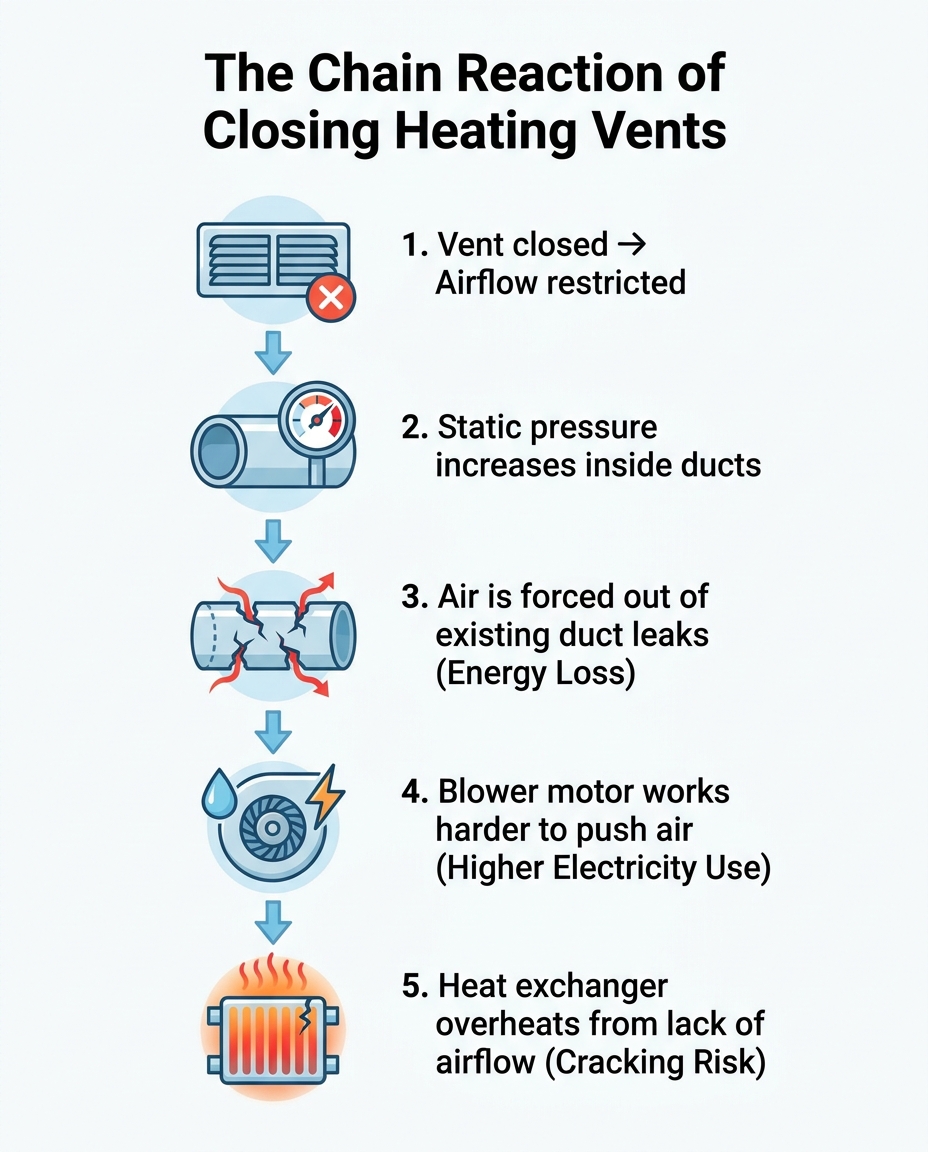
When you shut a register, the furnace still produces the exact same volume of heated air. However, you are now forcing that massive volume of air through fewer openings. This creates a condition known as excessive static pressure. When our team measures static pressure during a routine tune-up, we look for a balanced reading, typically around 0.5 inches of water column (in. w.c.). You can think of it like human blood pressure: a certain amount of pressure is necessary to keep things circulating, but when the pressure spikes too high, the system is in danger.
If you have ever tried breathing heavily through a narrow drinking straw, you know how quickly your lungs have to overwork to get enough air. Your furnace experiences the exact same strain when vents are closed off. The blower motor pushes against a wall of trapped air, and that resistance throws the entire equilibrium out of balance. This is a primary factor in how airflow restrictions damage blower motors over time.
How Your Ductwork Breathes
Your ductwork is the respiratory system of your house. It requires a continuous, unobstructed loop to function properly.
1. The Return Phase: The system pulls cold air from your home through the large return grilles.
2. The Heating Phase: The air passes through the filter and over the heat exchanger, where it absorbs warmth.
3. The Supply Phase: The blower motor pushes the newly heated air out through the network of supply ducts and into your living spaces.
When you interrupt the supply phase by closing vents, the air has nowhere to go. It backs up inside the sheet metal, increasing the excessive static pressure and drastically altering the speed and temperature of the air moving over the internal components.
The Real Danger: Why Closed Vents Crack Heat Exchangers
While high energy bills are frustrating, the most critical reason to leave your vents open comes down to the safety of your family. At the core of your gas or oil furnace is a component called the heat exchanger. This is a series of metal tubes or coils that safely transfer the heat created by combustion gases into the air that circulates through your home. The heat exchanger keeps the toxic exhaust gases—including carbon monoxide—completely separate from your breathing air.
The heat exchanger gets incredibly hot while the burners are firing. It relies entirely on a steady, strong flow of return air blowing over it to keep the metal from overheating. When you close vents and cause excessive static pressure, the airflow slows down dramatically. Without enough cool air washing over the metal, the heat exchanger begins to bake.
In our experience diagnosing furnaces in Westmoreland County homes, the team at Cochran Heating & Cooling regularly sees heat exchangers destroyed by this exact myth. During long, heavy-duty heating cycles in the sub-freezing stretches of January and February, the lack of airflow over the heat exchanger accelerates the wear and tear on the metal. The repeated, intense overheating causes the metal to expand further than it was designed to. When the cycle ends, it rapidly contracts. Over time, this extreme thermal stress causes the metal to fatigue, warp, and eventually crack.
The consequences of a cracked heat exchanger:
• Carbon Monoxide Leaks: A crack allows deadly, odorless combustion gases to mix with the air being blown into your living spaces.
• Mandatory System Shutdown: By law, a technician must condemn and shut down a furnace with a cracked heat exchanger due to the severe safety hazard.
• Costly Replacements: Heat exchangers are the most expensive component in a furnace. Often, replacing the entire furnace makes more sense than replacing just the cracked part.
Managing the temperature in a spare bedroom should never come at the cost of destroying your heating system's most vital safety component.
Blower Motor Strain and Duct Leakage: The Hidden Efficiency Killers
Beyond the heat exchanger, closing vents wreaks havoc on the electrical and structural efficiency of your system. Many homeowners are surprised to learn that closing vents often results in higher utility bills, completely defeating the original purpose of the exercise.
Modern furnaces—like high-efficiency 95% AFUE models—are typically equipped with Electronically Commutated Motors (ECM), also known as variable-speed blower motors. These advanced motors are programmed to maintain a specific volume of airflow regardless of the conditions. When you close a vent and excessive static pressure builds up, an ECM motor detects the resistance. Thinking there is a problem, the motor automatically ramps up its speed and torque to push past the blockage. Our service technicians frequently replace burned-out ECM motors that have spent three to five winters fighting against closed vents. This causes the motor to consume significantly more electricity, driving up your power bill while simultaneously burning out the motor's internal components prematurely. If you notice your system constantly struggling, it might be time to schedule a heating repair service to assess the damage.
The Cost of Wasted Energy
The increased pressure inside the ductwork has another costly side effect: it magnifies duct leakage. No residential duct system is perfectly airtight. Tiny gaps at the seams, joints, and connections are common. Under normal operating pressures, the amount of air lost through these small gaps is minimal.
However, when you block a vent, the trapped air looks for the path of least resistance. The high pressure forces your freshly heated air out through those tiny seams. Because ductwork is frequently routed through unconditioned spaces like attics, crawlspaces, or unfinished walls, you end up paying to heat the inside of your walls rather than your living space.
• Blower Motor — With Vents Open (Normal Operation): Operates at designed speed, standard electricity use. — With Vents Closed (Restricted Airflow): Ramps up to fight resistance, high electricity use, risk of burnout.
• Heat Exchanger — With Vents Open (Normal Operation): Cools properly, metal remains structurally sound. — With Vents Closed (Restricted Airflow): Overheats, metal expands and stresses, high risk of cracking.
• Ductwork — With Vents Open (Normal Operation): Air flows freely to living spaces. — With Vents Closed (Restricted Airflow): Pressure spikes, forcing heated air out of structural leaks into the attic.
• Energy Bills — With Vents Open (Normal Operation): Predictable and aligned with outdoor temperatures. — With Vents Closed (Restricted Airflow): Often higher due to wasted heat and overworking electrical motors.
The Collateral Damage: Freezing Pipes in Unused Rooms
The damage caused by closing vents isn't limited to the HVAC equipment itself; it can also threaten the structural integrity of your home. When you completely shut off the heat supply to a spare bedroom, guest bathroom, or basement, you drastically lower the ambient temperature in that specific zone.
Interior walls and floors are not insulated to the same degree as exterior walls. They rely on the ambient heat of the house to maintain a stable temperature. In Western Pennsylvania, temperatures frequently stay below freezing for extended periods during the winter months. When a room is intentionally left unheated during a peak Western Pennsylvania winter, ambient temperatures in that space can easily drop 15 to 20 degrees below the rest of the house, plummeting dangerously close to freezing inside the walls.
The risks to your home's infrastructure include:
• Frozen Water Pipes: Plumbing lines routed through or adjacent to unheated rooms become highly susceptible to freezing. We've responded to emergency plumbing calls where a burst pipe caused catastrophic water damage in a matter of minutes.
• Mold and Mildew Growth: Cold air holds less moisture than warm air. When warm, humid air from the rest of the house seeps into the cold, closed-off room, condensation forms on windows and walls, creating the perfect breeding ground for mold.
• Damaged Finishes: Extreme temperature fluctuations can cause drywall to crack, hardwood floors to warp, and paint to peel.
Keeping the vents open ensures that the entire thermal envelope of your home remains stable, protecting your plumbing and your indoor air quality.
Safe Alternatives for Balancing Comfort and Efficiency
If closing vents is off the table, how do you manage temperatures in rooms you rarely use without wasting energy? The good news is that there are safe, mechanically sound ways to balance your home's climate without risking the health of your furnace.
Our comfort specialists at Cochran Heating & Cooling believe in a transparent approach: prioritizing the long-term health of your system and providing honest advice over quick DIY tricks that ultimately cost you more. Here are the correct ways to manage your home's efficiency in Westmoreland County homes:
1. Invest in a proper HVAC zoning system: A true zoning system uses automated dampers installed inside the ductwork, communicating with a central control panel and multiple thermostats. When a zone doesn't need heat, the dampers close, but the system automatically adjusts the blower motor speed and heat output to maintain safe static pressure.
2. Upgrade to a smart thermostat with remote sensors: Modern thermostats can link to wireless room sensors placed throughout the house. This allows the system to average out the temperature or focus on the rooms you are actively occupying, reducing hot and cold spots naturally. This is a great step toward solving uneven heating issues.
3. Improve the home's thermal envelope: Often, a room feels too cold because it is losing heat to the outdoors, not because the furnace isn't working. Adding R-38 to R-49 insulation in your attic, applying weatherstripping to windows, and using heavy thermal curtains can drastically reduce heat loss, allowing the furnace to run less frequently.
4. Keep all vents fully open and unobstructed: Ensure that every supply and return vent in the house is fully open. Check that heavy furniture, thick rugs, or long curtains are not blocking the airflow path.
Frequently Asked Questions About Home Airflow and Heating Efficiency
Does closing vents in unused rooms save money?
The short answer is no; closing vents usually ends up costing you more money. When you block a vent, you create excessive static pressure inside the ductwork, which forces your blower motor to work harder and consume more electricity. Additionally, the trapped pressure forces heated air out of tiny duct leaks into unconditioned spaces like your attic, meaning you are paying to heat the outdoors.
Is it bad to close heating vents in your house?
Yes, it is highly detrimental to your HVAC system. Modern heating systems are calibrated to move a specific volume of air. Closing vents restricts this airflow, which can cause the furnace's heat exchanger to overheat, stress the blower motor, and lead to premature breakdowns and expensive repairs.
How many vents can I safely close without damaging my furnace?
HVAC professionals strongly recommend keeping 100% of your vents fully open. Even closing just one or two vents alters the delicate balance of excessive static pressure in the system. If you must adjust airflow for comfort, never close a vent more than 20% of the way, but leaving them completely open is always the safest option for system longevity.
What happens if you close too many vents?
If you close too many vents, the furnace will likely overheat and shut itself down on a safety limit switch. Repeatedly triggering this safety switch due to restricted airflow will eventually crack the heat exchanger, which is a severe carbon monoxide hazard that requires the entire furnace to be condemned and replaced.
Will closing basement vents push more heat upstairs?
While it might seem like closing basement vents redirects air upstairs, it actually just increases the excessive static pressure in the entire duct system. The increased pressure causes more air to leak out of the duct seams before it ever reaches the second floor. If your upstairs is cold, you likely need duct balancing or a zoning system, not closed basement vents.
How can I safely reduce heat in a room I don't use?
The safest way to manage temperatures room-by-room is by installing a professional HVAC zoning system with automated dampers and bypass ducts. Alternatively, you can focus on insulating the unused room better so it retains heat naturally, or use a smart thermostat with occupancy sensors to optimize the whole-home heating schedule without restricting airflow.
Protect Your Furnace and Stay Warm This Winter
Maintaining clear, open airflow is the absolute best way to ensure your furnace lasts for its full expected lifespan while operating at peak efficiency. While the temptation to shut off a spare bedroom is understandable, managing your comfort should never come at the cost of a cracked heat exchanger or a burned-out blower motor.
As we head into another peak Western Pennsylvania winter, the team at Cochran Heating & Cooling recommends taking a walk through your home and ensuring every supply and return register is fully open and free of obstructions. If you are struggling with high energy bills or uneven temperatures across different floors, don't rely on damaging DIY myths. Reach out to a professional to explore proper airflow balancing, zoning, and comfort solutions that keep your home warm and your equipment safe.