
How Airflow Restrictions from Heavy Winter Filters Damage Blower Motors
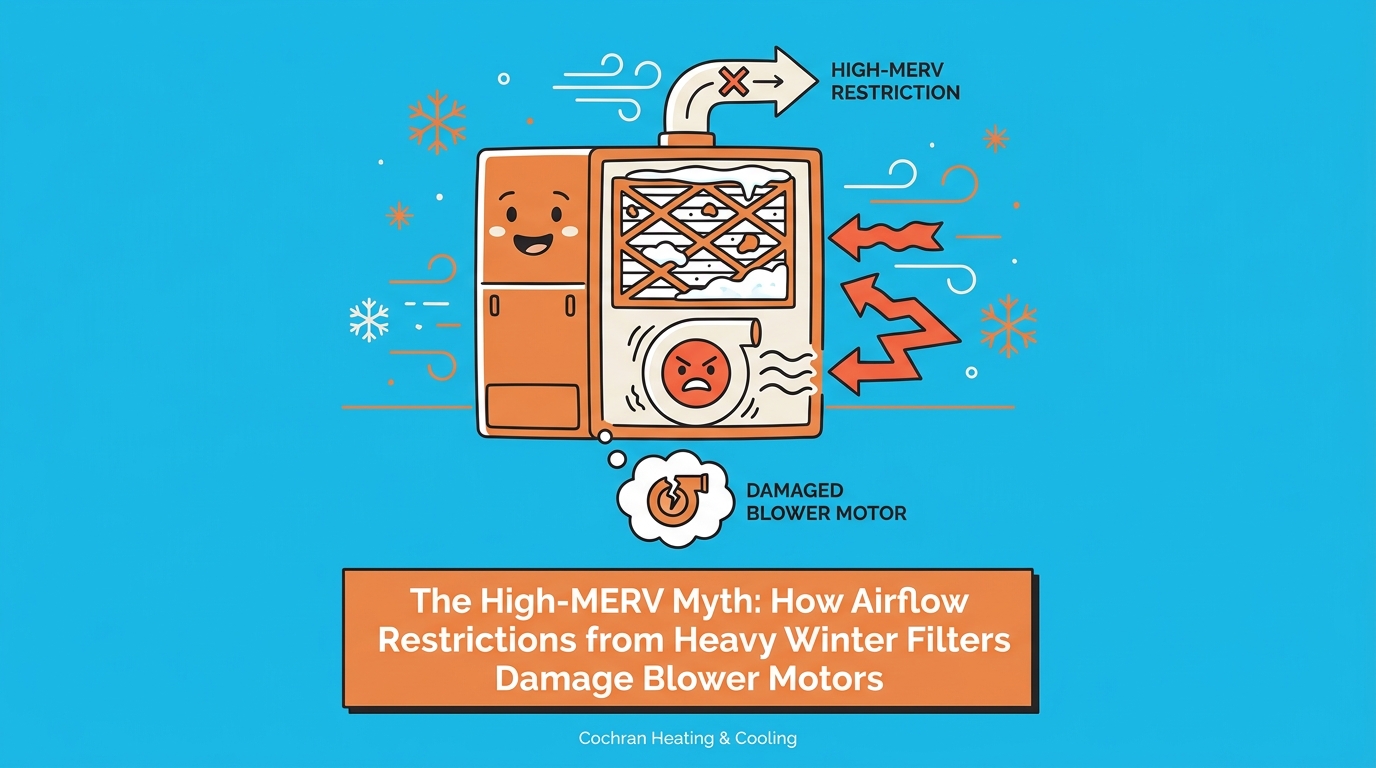
The Big-Box Store Myth: Why Thicker Isn't Always Better for Your Furnace
Buying the thickest, most expensive air filter at the hardware store doesn't guarantee better indoor air quality—in fact, understanding how airflow restrictions from heavy winter filters damage blower motors is one of the most important lessons a homeowner can learn. Most homeowners naturally want to protect their families from dust, dander, and allergens. When standing in the filter aisle, the marketing on the packaging makes a compelling case: the higher the rating, the better the protection. However, during the critical mid-fall heating startup (October), installing an overly restrictive filter is a common and costly mistake that sets your system up for failure before the snow even begins to fall.
If you are concerned about your home heating systems, ensuring proper furnace performance starts with choosing the right filter for your specific equipment.
The misconception that "thicker is always better" stems from a misunderstanding of how residential heating systems are engineered. High-MERV (Minimum Efficiency Reporting Value) filters are incredibly dense. They are designed to trap microscopic particles, but in doing so, they also block the very air your furnace needs to function. This decision point dictates whether home heating systems run efficiently or struggle all winter long.
To understand the disconnect between filter marketing and mechanical reality, it helps to look at what these labels promise versus what actually happens inside your ductwork.
• "Traps 99% of microscopic particles and viruses." — The HVAC Mechanical Reality: The dense media also traps the return air, starving the blower motor of the volume it needs to circulate heat.
• "Lasts up to 90 days for continuous protection." — The HVAC Mechanical Reality: High-MERV filters clog much faster than standard filters, often reaching critical restriction levels in just 30 to 45 days.
• "The ultimate choice for whole-home comfort." — The HVAC Mechanical Reality: High restriction leads to uneven heating, leaving some rooms freezing cold while the furnace overheats in the basement.
High-MERV filters can inadvertently suffocate older blower motors, compromising overall furnace performance. A furnace is not an air purifier; it is a temperature control device. When you force it to act as a hospital-grade filtration system without modifying the ductwork to handle the pressure, the mechanical components bear the brunt of the damage.
The Physics of Airflow: Pushing Dense Winter Air
To fully grasp why heavy filters cause so much trouble, we have to look at the physics of airflow, particularly in cold climates. Air density increases significantly as temperatures drop, changing the physical demands on HVAC equipment. Cold air is literally heavier and more tightly packed with molecules than warm summer air.
In our years of servicing homes across the Jeannette PA and Western PA region, our technicians at Cochran Heating & Cooling routinely see how average winter lows in the 20s create dense, heavy air that naturally taxes older furnace blowers, making airflow restrictions even more damaging. Heating systems inherently have to work harder to pull this dense air through the return ducts, push it across the heat exchanger, and distribute it throughout the home.
Understanding Static Pressure:
In the HVAC industry, resistance to airflow is called static pressure. You can think of static pressure like blood pressure for your ductwork. Every component in the air stream—the duct walls, the bends in the sheet metal, the evaporator coil, and the air filter—adds resistance. Every furnace is manufactured to operate within a specific static pressure range, usually measured in inches of water column (in. w.c.).
When you take a system that is already working hard to push dense Western PA winter air and slap a highly restrictive MERV 13 filter over the return drop, you drastically spike the static pressure. Exceeding a system's design limits causes immediate strain. The blower motor is suddenly trying to breathe through a thick wool blanket instead of a breathable cotton sheet. Combining heavy air with heavy filtration creates a compounding burden on the mechanical components, forcing the system to operate outside of its safe engineering parameters.
How Airflow Restrictions from Heavy Winter Filters Damage Blower Motors
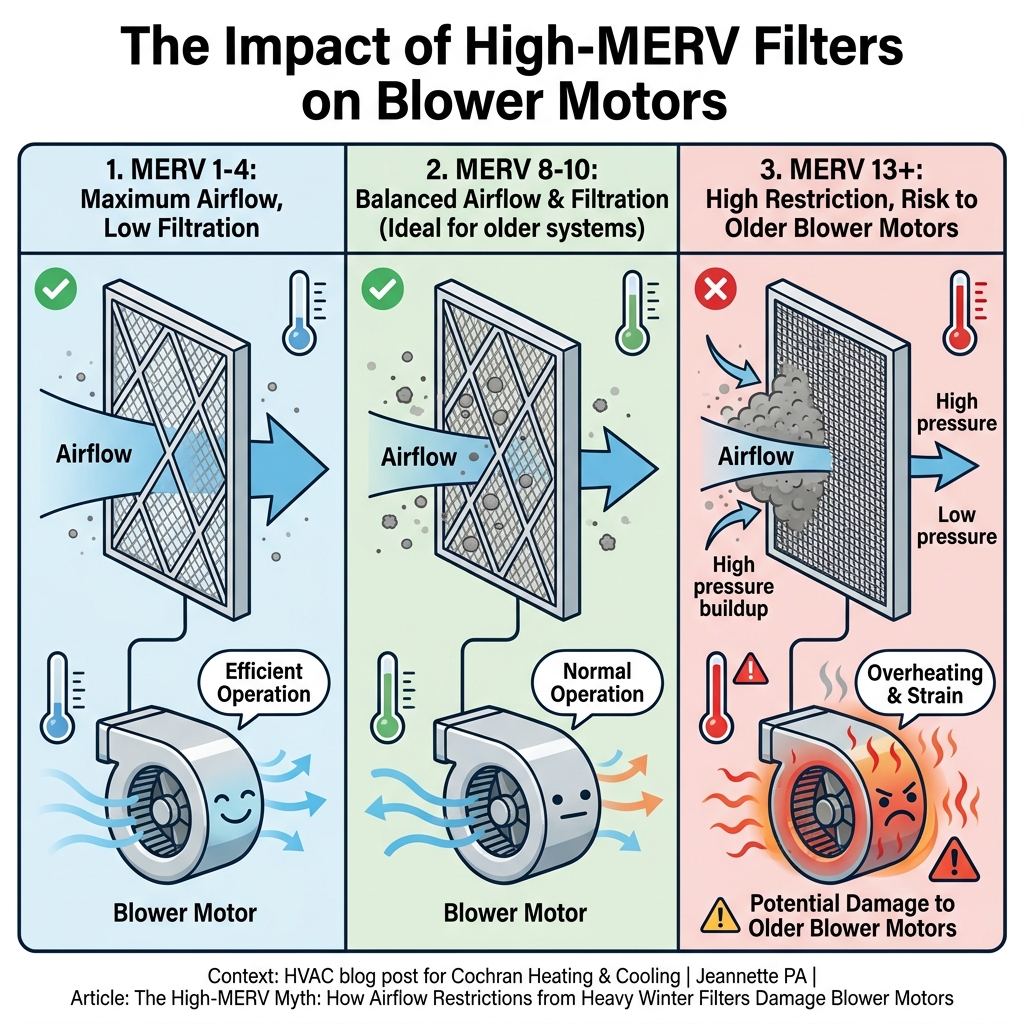
The core issue with high-efficiency filters (MERV 13+) is that they significantly increase the static pressure drop across the return duct. When the return air is blocked, the blower motor is forced to overwork in an attempt to pull enough air through the dense filter media. This is where the mechanical breakdown begins.
Older furnaces typically use PSC (Permanent Split Capacitor) blower motors. When a PSC motor faces high static pressure, its fan blades spin against a vacuum. It works harder, draws more electrical current, and generates excess heat. Newer systems might use ECMs (Electronically Commutated Motors), which are designed to ramp up their speed to overcome resistance. While an ECM might successfully push air through a thick filter, it will run at maximum RPMs constantly, burning through electricity and drastically shortening its own lifespan.
Regardless of the motor type, this continuous overexertion leads to overheating within the motor itself. Blower motors actually rely on the cool return air passing over their casing to keep their internal components from melting. When the filter blocks that airflow, the motor loses its only cooling mechanism.
The Chain Reaction of Overheating
The damage doesn't happen overnight, but rather through a compounding chain reaction of thermal stress:
• Lack of cool return air passing over the motor: Without sufficient air volume moving across the motor housing, the internal temperature begins to climb rapidly during every heating cycle.
• Electrical components operating beyond rated temperatures: The capacitor, bearings, and copper windings inside the motor bake in the trapped heat. Lubrication dries up, causing metal-on-metal friction.
• Eventual thermal overload and motor burnout: Eventually, the motor's internal thermal overload switch will trip to prevent a fire. Over time, these repeated thermal events will cause the motor windings to short out completely, resulting in total failure.
Furthermore, restricted airflow also causes the heat exchanger to retain too much heat. The heat exchanger is the metal chamber where the actual combustion happens. The blower motor's job is to strip the heat off that metal and push it into your home. If the air isn't moving fast enough, the heat exchanger gets dangerously hot, triggering safety limits and risking premature system failure, including cracked metal that can leak carbon monoxide.
This is why adhering to the manufacturer's MERV rating limits is not just a suggestion—it is a critical requirement for the safety and longevity of the equipment.
Warning Signs Your Furnace is Suffocating
Recognizing the symptoms of airflow restriction early in the season can prevent a mid-winter breakdown. During our October mid-fall heating startup visits, a pattern we see often is homeowners ignoring the early warning signs of a struggling system. Pay close attention to how your system sounds and behaves during its first few cycles. If you have recently installed a premium, thick pleated filter, watch for these clear warning signs that your furnace is suffocating.
• Short cycling: The furnace shuts off prematurely because the heat exchanger gets too hot. If your furnace runs for only three to five minutes, shuts down before the house is warm, and then immediately tries to start again, it is likely tripping its high-limit safety switch due to lack of airflow.
• Unusual noises: A strained blower motor may produce a loud humming, whining, or rattling sound. You might also hear a loud "whump" or whistling noise from the return ductwork as the system struggles to pull air through the restricted filter media.
• Weak register flow: Rooms take longer to heat up due to diminished air volume reaching the vents. If you hold your hand over a vent and barely feel a breeze, but the furnace sounds like it is running at full capacity, the air is being blocked at the filter. This is a common culprit if you are wondering why your heating vents blow cold air or no air at all.
• Hot cabinet exterior: The metal casing of the furnace in your basement or utility room should never be too hot to touch. If the cabinet is radiating excessive heat, the thermal energy is not making it into your ductwork.
If you notice any of these symptoms, the first and easiest troubleshooting step is to turn off the thermostat, remove the heavy filter, and replace it with a standard fiberglass or low-MERV pleated filter to see if the system recovers its normal operation.
Finding the Right MERV Balance for Older Systems
Protecting your equipment doesn't mean you have to breathe dusty air. It simply means finding the correct balance. Every furnace has a maximum static pressure rating and recommended MERV rating limits outlined by the manufacturer in the installation manual. Exceeding these limits is a guaranteed path to mechanical failure.
For many older residential systems, a MERV 8 to 10 filter provides the ideal balance of dust capture and breathability. A MERV 8 filter is highly effective at capturing pollen, dust mites, and pet dander without acting like a brick wall in your ductwork. It allows the blower motor to pull the necessary volume of air to keep the heat exchanger cool and the home comfortable.
As a family-owned company serving our community, our team at Cochran Heating & Cooling believes in honest advice over quick upsells. We prioritize your system's longevity over pushing the most expensive, thickest filters on the market. We would rather see your older furnace run safely and efficiently through the harshest winter months than watch an overly restrictive hardware store filter destroy a blower motor.
Checking the filter monthly during peak heating season is more effective than buying a thicker filter and leaving it in all winter. A clean MERV 8 filter will always outperform a clogged MERV 13 filter in both air quality and system efficiency. Routine professional check-ups, such as a routine maintenance plan, ensure the system is calibrated for the filter being used and that the static pressure remains within safe operational limits.

Safe Alternatives for Improving Indoor Air Quality
If allergies, asthma, or excessive dust are a major concern in your home, relying solely on a 1-inch furnace filter is the wrong approach. The 1-inch filter slot on a standard furnace was originally designed just to protect the equipment from large debris, not to purify the air for the occupants. Fortunately, homeowners in the Jeannette PA and Western PA region have access to advanced indoor air quality solutions that clean the air without destroying the heating system.
Whole-Home Media Cabinets
Whole-home filtration systems can be installed, but they require proper duct modifications to accommodate thicker media cabinets safely. A 4-inch or 5-inch media cabinet filter might have a high MERV rating, but because it is pleated so deeply, it has vastly more surface area than a 1-inch filter. This massive surface area allows air to flow freely while still capturing microscopic particles, drastically lowering the static pressure drop.
Dedicated Air Purifiers
Dedicated air purifiers operate independently without adding static pressure to the HVAC system. Standalone HEPA purifiers placed in bedrooms or main living areas can scrub the air of fine particulates without forcing your furnace blower to do the heavy lifting.
UV Light Purification
UV lights and advanced IAQ integrations neutralize airborne contaminants without restricting physical airflow. Installed directly inside the ductwork or over the evaporator coil, ultraviolet germicidal irradiation (UVGI) neutralizes bacteria, mold spores, and viruses as they pass through the light field. Because light has no physical mass, it adds zero static pressure to the system, keeping the blower motor completely safe while vastly improving the air you breathe.
Frequently Asked Questions About Winter Filters and Furnace Airflow
Can a high MERV filter damage my furnace?
Yes, installing a filter with a MERV rating higher than your system's design limits can cause significant damage over time. High-MERV filters restrict the volume of air passing through the return ducts, which forces the blower motor to overwork and overheat. This lack of airflow also causes the heat exchanger to retain dangerous levels of heat, which can lead to cracked metal, tripped safety limits, and complete system failure.
What MERV rating is best for older furnaces?
For most older residential furnaces, a MERV 8 to MERV 10 filter is the safest choice. These ratings provide an excellent balance by capturing common household allergens like pet dander, dust mites, and pollen without creating dangerous levels of static pressure. Always check your manufacturer's manual for specific MERV rating limits, as every system is engineered differently.
How do I know if my furnace filter is too restrictive?
The most common signs of a restrictive filter include the furnace shutting off prematurely (short cycling), a lack of strong airflow coming from your supply vents, and unusual whining or humming noises from the blower motor. If the metal cabinet of your furnace feels excessively hot to the touch while running, the filter is likely trapping the heat inside the system instead of letting it flow into your home.
Will a thicker air filter restrict airflow?
It depends on the design of the filter and the slot it fits into. A dense 1-inch MERV 13 filter will severely restrict airflow. However, a 4-inch or 5-inch media filter of the same MERV rating actually improves airflow because the deep accordion pleats provide much more surface area for the air to pass through. Thicker filters are only safe if your ductwork has been modified with a proper media cabinet to house them.
How often should I change my filter during a Western PA winter?
During the peak heating season, you should inspect your filter at least once a month and replace it every 30 to 60 days. Because furnaces run almost constantly during cold weather, the filter catches debris at a much faster rate. A clean, lower-MERV filter changed frequently is far better for your system's health than a high-MERV filter left in place for months.
Protect Your System with Proper Fall Maintenance
Choosing the right filter rating is the first step in protecting your blower motor from premature failure. As we approach the mid-fall heating startup (October), taking the time to evaluate your filtration strategy can save you from unexpected breakdowns when the freezing weather arrives. Balancing air quality with system breathability ensures efficient, reliable heating all winter long.
Remember that your furnace is a complex mechanical system that requires proper airflow to survive. If your system sounds strained, if your vents feel weak, or if you are unsure about your filter compatibility, a professional assessment can provide peace of mind. Taking proactive steps now ensures your home stays warm, your air stays clean, and your equipment runs safely for years to come.