Why Does My Upstairs Stay Cold Even When the Furnace is Running Non-Stop?
Is Your Furnace Running Constantly But the Upstairs Is Still Freezing?
At Cochran Heating & Cooling, we frequently hear Jeannette homeowners ask, "why does my upstairs stay cold even when the furnace is running non-stop?" If you are dealing with a persistently freezing second floor while your downstairs living room feels perfectly warm, you are not alone. It is incredibly frustrating to hear your heating equipment running continuously, consuming energy and driving up utility bills, without actually achieving whole-home comfort. You end up wearing extra layers in your own bedroom while the first floor feels like a sauna.
In our years of experience diagnosing two-story homes across Westmoreland County, our technicians have found this specific uneven heating problem usually boils down to a core decision point: determining whether the issue is caused by inadequate attic insulation allowing heat to escape, or an actual HVAC airflow issue preventing the warm air from reaching the second floor in the first place. Diagnosing this correctly is essential before you invest in comprehensive heating services or assume you need a complete furnace repair and installation.
During the mid-fall heating startup, this temperature differential between floors becomes highly noticeable. As October overnight lows drop, it is the ideal time to test your system's balance. Identifying and fixing the root cause now will save you from uncomfortable nights before the freezing Western Pennsylvania winter hits full force.
The Physics of a Two-Story Home: Building Envelope vs. Airflow
Most homeowners know the basic scientific principle that heat rises. Because of this, a cold upstairs can seem completely counterintuitive. If hot air naturally floats upward, why are the second-floor bedrooms freezing while the basement and first floor stay warm? The answer lies in the physics of your home's building envelope and how it interacts with your mechanical heating system.
As a family-owned local business, the team at Cochran Heating & Cooling understands the specific layouts, aging ductwork, and architectural quirks common to Jeannette and surrounding Westmoreland County two-story homes. Older houses in our region were often built before modern insulation standards were established. When our technicians evaluate a home, we separate the symptoms into two distinct categories: building envelope issues (heat escaping through the roof) and mechanical distribution issues (warm air never reaching the second floor at all).
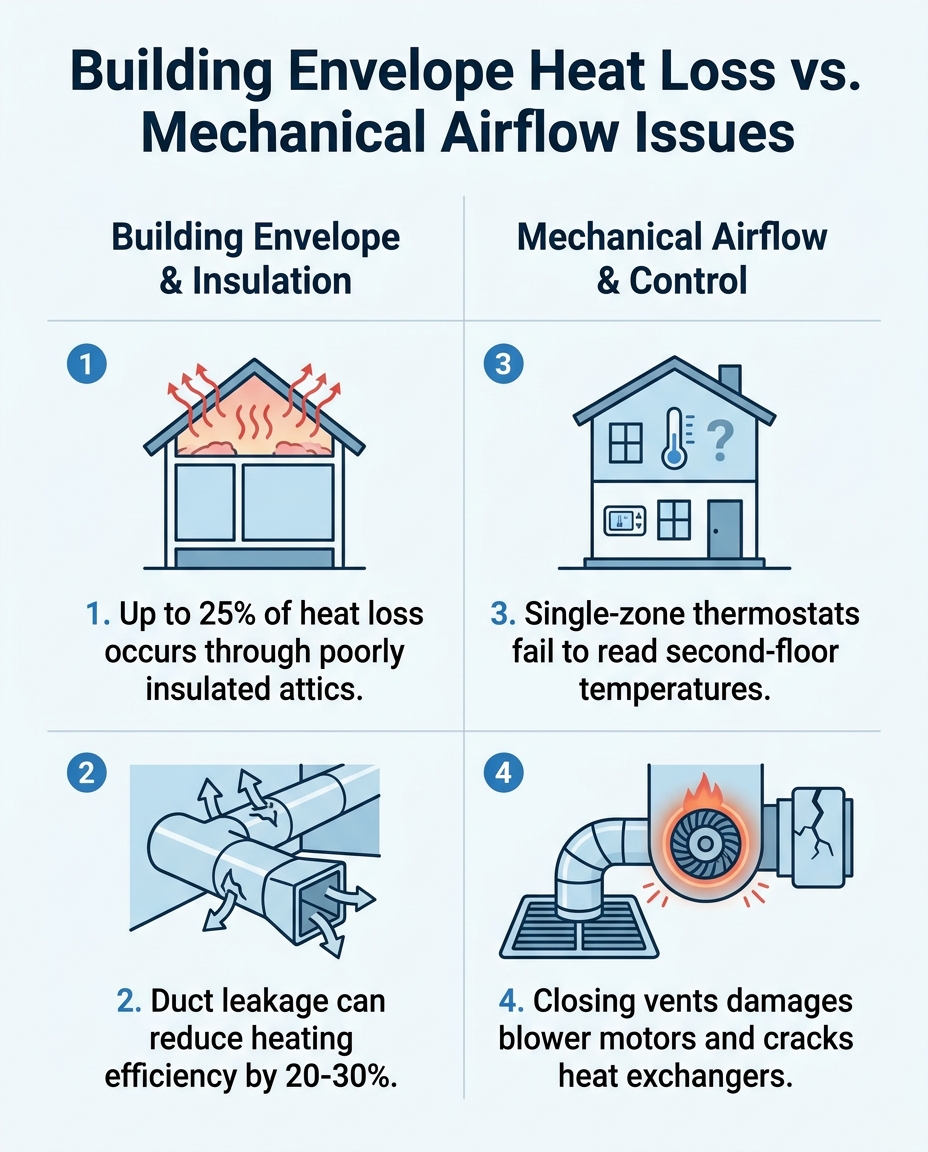
According to U.S. Department of Energy data, uninsulated or poorly insulated attics account for up to 25% of a home's total heat loss. If your furnace is pushing plenty of warm air upstairs, but that heat immediately escapes through the ceiling, you have an envelope problem. If the air coming out of the upstairs registers is weak or non-existent, you have an airflow problem.
Identifying Attic Heat Loss
One of the primary culprits behind a cold upstairs is a phenomenon known as the "stack effect." In a multi-story home, warm air naturally rises to the highest point. If your attic lacks proper insulation, that warm air seeps right through the ceiling drywall, recessed lighting fixtures, and attic hatches, escaping into the cold outdoors. As this warm air leaves the top of the house, it creates negative pressure that pulls freezing drafty air into the lower levels of the home.
How to tell if insulation is your primary issue:
• Rapid heat loss: The upstairs rooms get comfortably warm while the furnace is actively running, but they lose their heat almost immediately after the system cycles off.
• Drafty upper ceilings: You can feel cold air radiating downward from the ceiling in second-floor bedrooms.
• Uneven snow melt: During winter, the snow on your roof melts rapidly in patches, indicating where heat is escaping from the house.

Why a Bigger Furnace Won't Solve an Uneven Heating Problem
A pattern we see often during our fall heating inspections is homeowners assuming that their furnace is simply "too small" or underpowered to push heat all the way up to the second floor. It is a logical guess, but in the vast majority of cases, upgrading to a larger capacity furnace will not solve an uneven heating problem. In fact, it usually makes the situation much worse.
The physics of heating a home dictate that a larger furnace produces more heat in a shorter amount of time. If your ductwork is unbalanced or your home lacks adequate insulation, a bigger furnace will not magically force air through restrictive ducts or seal up attic leaks. Instead, an oversized furnace will blast the downstairs area with intense heat, satisfying the first-floor thermostat in a matter of minutes.
This leads to a destructive mechanical cycle known as short-cycling. Because the downstairs heats up so rapidly, the thermostat shuts the furnace down long before the warm air has a chance to slowly circulate up to the second-floor bedrooms. The upstairs stays freezing, while the downstairs becomes uncomfortably hot. Furthermore, short-cycling causes extreme wear and tear on the furnace components, leading to premature breakdowns and a shortened system lifespan.
If you notice that your system runs for very brief periods, or if you are trying to understand why your heating vents blow cold air during parts of the cycle, an oversized unit or a severely restricted airflow system is often to blame. Proper heating requires the right amount of airflow delivered consistently over a steady cycle, not a massive burst of heat that shuts off prematurely.
Mechanical HVAC Issues That Restrict Airflow to the Second Floor
If your attic insulation is sufficient but the upstairs remains cold, the issue is almost certainly mechanical. Aging single-zone ductwork systems were often not designed to handle the sharp winter temperature drops we experience efficiently. When our team investigates airflow restrictions, we look for several specific failures in the distribution system.
1. Failing Blower Motors: The blower motor is the heart of your HVAC distribution system. If the motor is aging, covered in dust, or failing electrically, it simply will not have the power to push air up the vertical duct runs to the second floor.
2. Clogged Air Filters: A dirty air filter acts like a brick wall in your return duct. It starves the furnace of air, meaning there is very little air volume available to be heated and pushed upstairs.
3. Deteriorating Duct Connections: Over decades, the tape and mastic sealing your ductwork can dry out and crack, allowing heated air to spill into unconditioned spaces like basements or crawlspaces.
Routine professional maintenance is the best way to catch these mechanical restrictions early. A comprehensive HVAC maintenance plan ensures your blower motor is operating at peak static pressure and your filters are optimized for maximum airflow.
Single-Zone Thermostat Limitations
One of the biggest hurdles to heating a two-story home is a single-zone thermostat setup. In most older homes, there is only one thermostat, typically located in a first-floor hallway or living room. This device only measures the temperature of the air immediately surrounding it. It cannot accurately read or respond to the temperature in a second-floor bedroom. If the downstairs reaches 70 degrees, the thermostat shuts off the furnace, completely unaware that the upstairs is still sitting at 60 degrees.
Leaky or Undersized Ductwork
Duct leakage is a massive hidden energy drain. According to Energy Star data, leaky ductwork can reduce heating system efficiency by up to 20-30%. When warm air travels through long duct runs from the basement to the second floor, air pressure naturally drops due to friction. If those ducts are also leaking, or if they were undersized when the house was originally built, the furthest upstairs bedrooms are left with nothing but a weak trickle of airflow by the time the air reaches the register.
The Dangers of Closing Downstairs Vents to Force Heat Up
When faced with a freezing upstairs and a roasting downstairs, homeowners frequently try a common DIY workaround: closing the first-floor supply registers. The logic seems sound—if you block the air from entering the downstairs, it will be forced to travel upstairs. Unfortunately, modern HVAC systems do not work this way, and this practice is highly dangerous to your equipment.
Your furnace blower motor is calibrated to operate against a specific amount of air resistance, known as static pressure. Think of your ductwork like a person breathing through a wide tube. If you close off half the vents in your home, it is the equivalent of forcing that person to breathe through a tiny cocktail straw. The pressure inside the ductwork skyrockets.
Why closing vents causes severe damage:
• Blower motor burnout: The motor has to work twice as hard to push air against the closed vents, causing it to overheat and fail prematurely.
• Cracked heat exchangers: Because airflow is restricted, the heat generated by the furnace cannot escape into the home fast enough. The internal temperature of the furnace spikes, which can cause the metal heat exchanger to crack—a dangerous situation that can leak carbon monoxide.
• Increased duct leakage: The excess pressure forces heated air out through tiny seams and gaps in the ductwork, wasting energy in your basement or walls.
We strongly advise against any DIY ductwork modification. Airflow balancing requires professional measurement tools to ensure the system maintains safe static pressure levels while delivering comfort.
Targeted Solutions: Dampers, Zoning, and Supplemental Heating
Fortunately, a cold upstairs is a highly solvable problem, and it rarely requires tearing out your entire central heating system. Once our technicians determine that insulation is not the primary culprit, we look toward professional HVAC interventions that specifically address two-story airflow imbalances without damaging the equipment.
Manual and Automated Duct Dampers:
Dampers are metal valves installed directly inside the main trunk lines of your ductwork near the furnace. Unlike closing a register at the floor level, adjusting a damper near the source safely redirects air volume before it travels through the house. A professional can adjust manual dampers seasonally to push more air upstairs in the winter and downstairs in the summer. Automated damper systems can even adjust themselves based on temperature demands.
True Zoned HVAC Systems:
Upgrading to a zoned HVAC system involves installing multiple thermostats throughout the house (e.g., one downstairs, one upstairs) wired to a central control panel. This panel operates motorized dampers in the ductwork. When the upstairs calls for heat but the downstairs does not, the system directs warm air exclusively to the second floor, solving the single-thermostat limitation.
Supplemental Ductless Solutions:
For chronically cold upstairs rooms in older homes where ductwork modification is impossible or cost-prohibitive, supplemental heating is often the ideal solution. In our experience, multi-head ductless mini-splits and zoned damper systems provide the most reliable comfort. A ductless mini split system can be installed directly in a cold bedroom, providing targeted, independent temperature control without requiring any connection to the existing central ductwork. As an added benefit, generic energy rebates or federal tax credits may apply to qualifying high-efficiency heat pump installations (we advise verifying current programs with your utility or a tax professional).
Frequently Asked Questions About Cold Upstairs Rooms
Understanding home heating physics can be complex. Here are the most common questions our local team receives from homeowners struggling with uneven temperatures.
Why is my upstairs so cold in the winter?
A cold upstairs is typically caused by a combination of heat escaping through poor attic insulation and weak airflow from aging, single-zone ductwork. Because heat naturally rises, a cold second floor usually means the warm air is either leaking out of the roof or failing to reach the rooms entirely.
• Attic heat loss: Inadequate insulation allows warm air to escape into the freezing outdoors.
• Ductwork friction: Long duct runs lose air pressure before reaching the second floor.
• Thermostat placement: A first-floor thermostat shuts off the heat before the upstairs is warm.
Does closing downstairs vents help heat the upstairs?
No, closing downstairs vents does not effectively push air upstairs, and it actually harms your heating system. Blocking vents increases the static pressure inside your ductwork, which severely restricts overall airflow.
• Equipment damage: High static pressure can burn out the blower motor.
• Overheating risks: Restricted airflow causes the furnace to overheat, potentially cracking the heat exchanger.
• Energy waste: The increased pressure forces warm air out through tiny leaks in the ductwork behind your walls.
How do you balance heat in a two-story house?
Balancing heat requires professional adjustments to safely redirect airflow without exceeding the system's static pressure limits. The most effective methods involve modifying the ductwork near the furnace or adding independent heating zones.
• Installing dampers: Metal valves in the main duct trunks manually or automatically direct air to the second floor.
• Sealing ductwork: Repairing leaks ensures warm air actually reaches the upstairs registers.
• Adding zoning: Installing a second thermostat and motorized dampers allows independent control of the upstairs.
• Supplemental heating: Adding a ductless unit provides heat exactly where it is needed.
Why is my furnace running but the house is cold?
If your furnace is running constantly but the house remains cold, it usually indicates a severe airflow restriction, leaky ductwork losing heat to unconditioned spaces, or a failing blower motor. The system is generating heat, but it cannot distribute it.
• Clogged filters: A dirty filter blocks air from entering the system to be heated.
• Broken blower: A weak motor cannot push the air through the vents.
• Open duct seams: Heated air is dumping into your basement or crawlspace instead of your living areas.
Is a ductless mini-split a good idea for a cold upstairs bedroom?
Yes, a ductless mini-split is highly effective because it provides targeted, independent temperature control without requiring modifications to your existing central ductwork. We frequently recommend it as the most cost-effective way to solve a single stubborn room.
• Independent control: You can set the bedroom temperature independently from the rest of the house.
• No ductwork needed: It bypasses the limitations of leaky or undersized central ducts.
• High efficiency: Modern mini-splits use variable-speed technology to provide highly efficient supplemental heat.
Get Professional Help Balancing Your Home's Heat Before Winter
A persistently cold upstairs is a highly solvable problem. Whether the root cause lies in necessary building envelope insulation upgrades or professional HVAC airflow adjustments, you do not have to spend another winter shivering in your own bedroom while the furnace runs non-stop.
Our team at Cochran Heating & Cooling highly recommends taking action during the mid-fall heating startup. Addressing these imbalances now, before the freezing Western Pennsylvania winter hits its peak, will save you from months of discomfort and spiked energy bills. If you are tired of uneven temperatures, let us help you determine exactly what your two-story home needs. Schedule a thorough inspection or a furnace repair and installation consultation today, and restore true whole-home comfort.