Balancing Your HVAC Load Before the Thanksgiving Cooking Heat Hits
Preparing Your Home for the Holiday Heat Load
Late November is quickly approaching, and the Thanksgiving hosting season brings a unique set of challenges to maintaining a comfortable home. You are already juggling grocery lists, guest accommodations, and a precise cooking schedule. The last thing you need is a house that feels like a sauna in the kitchen and an icebox in the guest bedrooms. Balancing Your HVAC Load Before the Thanksgiving Cooking Heat Hits is a critical step that many homeowners overlook until their guests are already shivering upstairs. Here at Cochran HVAC, our team has spent years servicing homes around Westmoreland County, and this drastic temperature imbalance is one of the most common emergency calls we receive during the late fall holidays.
The core problem stems from a localized heat load. When you have a hot oven running for hours and a house full of relatives, the main floor of your home rapidly warms up. Your central thermostat senses this heat, assumes the entire house is perfectly comfortable, and shuts down the furnace. Meanwhile, the upstairs bedrooms, lacking that artificial heat source, begin to freeze. If you want to keep everyone comfortable this holiday, you need a proactive strategy. For comprehensive support, exploring residential HVAC services is a great first step toward solving uneven heating problems before your guests arrive.
Understanding how your home's thermal dynamics shift during a large gathering is the key to preventing this issue. It is not simply a matter of turning the thermostat up or down; it is about managing airflow, understanding how your system reads temperatures, and recognizing the limitations of a single central sensor. By taking a few strategic steps now, you can ensure that every room in your home remains welcoming and comfortable, regardless of how much cooking is happening in the kitchen.
The Science Behind the Thanksgiving 'Thermostat Trick'
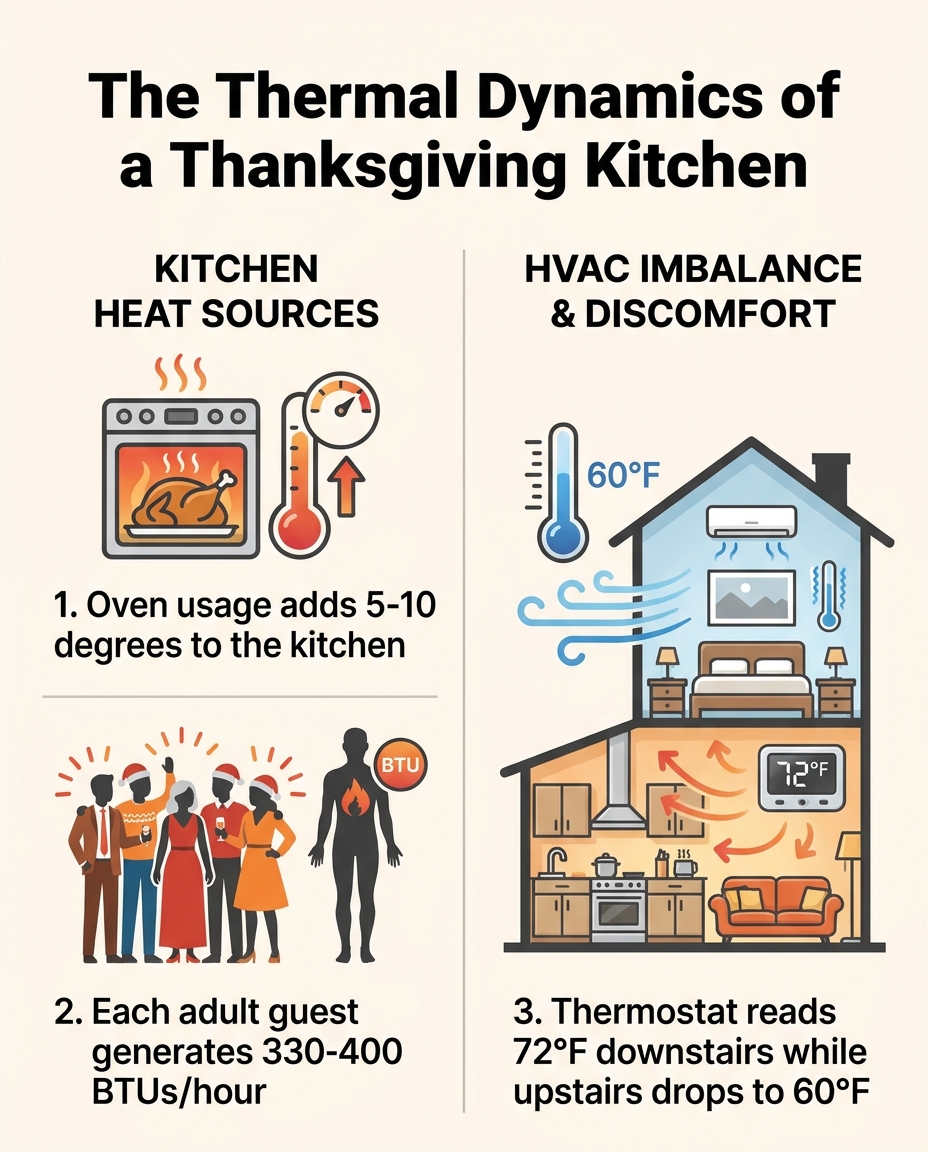
To effectively manage your home's comfort, it helps to understand the physics of what happens during a large holiday gathering. Based on what our technicians observe in the field, this phenomenon is essentially a mechanical trick played on your heating system by internal heat gains. When you are cooking a turkey, baking pies, and boiling side dishes, a running oven and stovetop can easily raise your kitchen temperatures by 5 to 10 degrees over the course of a few hours. This is a massive injection of thermal energy into a single zone of your house.
Furthermore, you have to account for the human heat load. Every person is essentially a walking space heater. An adult guest at rest generates approximately 330 to 400 BTUs (British Thermal Units) of heat per hour. If you have ten guests mingling in your living room and kitchen, that is an extra 3,300 to 4,000 BTUs of heat being pumped into your main floor every single hour. This combination of culinary and biological heat creates a localized microclimate.
Standard central thermostats are designed to act as a single point of truth for the entire house, but they only read the temperature in the immediate hallway or living room where they are mounted. Because of this localized heat, you end up with a stark contrast: a thermostat reading 72°F downstairs while bedrooms drop to the low 60s. The furnace control board receives a signal that the home has reached its target temperature and shuts down the heating cycle. If you have ever wondered why your upstairs stays cold even when the furnace is running, this sensory limitation is often the primary culprit.
How Localized Heat Confuses Central Sensors
When the main floor heats up artificially, the thermostat signals the furnace to stop producing heat. It does not know that the upstairs bedrooms are rapidly losing warmth to the cold outdoor air. The system operates under the assumption that the temperature at the thermostat represents the temperature everywhere. Once the furnace shuts off, the blower motor stops circulating air. Without that continuous circulation, the artificial heat stays trapped downstairs, and the upstairs rooms depend entirely on their ambient insulation to hold onto whatever warmth they have left.
Why Traditional Two-Story Homes Are Especially Vulnerable
The architectural layout of a home plays a massive role in how it handles temperature distribution. In our local service area, our technicians at Cochran frequently work in traditional Greensburg and North Huntingdon two-story homes that feature a single, centrally located thermostat on the main floor. These homes often have complex ductwork systems that must push conditioned air up through interior walls to reach the second floor. When the system is running smoothly, this setup works adequately. However, during a holiday gathering, the vulnerability of this design becomes glaringly obvious.
We know that heat naturally rises, which leads some homeowners to assume the upstairs will stay warm even if the furnace shuts off. However, convective heat transfer requires active airflow. Without the furnace blower running to actively push that warm air through the supply vents, the heat simply pools at the ceiling of the first floor. It does not effectively migrate through the floorboards to warm the bedrooms above. The upstairs rooms are left completely cut off from the home's heating source.
This structural vulnerability is severely compounded by our regional weather. Late November average low temperatures in Western PA frequently drop into the 30s. When it is freezing outside, any interruption in upstairs heating is immediately felt by your guests. The heat loss through the roof and exterior walls happens much faster than any residual heat can rise from the kitchen below. This localized heating problem can also trigger broader system issues, which is why addressing heating system short cycling becomes necessary when the thermostat gets confused by rapid temperature swings.
To visualize how these homes react during a holiday gathering, consider the environmental differences between the two floors:
• Main Floor (Kitchen/Living) — Heat Sources: Oven, stovetop, body heat from guests — Airflow Status: Stagnant (Thermostat satisfied) — Resulting Temperature: 72°F - 76°F (Warm/Stuffy)
• Second Floor (Bedrooms) — Heat Sources: None — Airflow Status: Stagnant (Blower off) — Resulting Temperature: 60°F - 64°F (Cold/Drafty)
Immediate Fixes to Keep Guests Comfortable on Turkey Day
If you are reading this on the morning of your gathering, you need actionable, safe, and temporary solutions that you can implement right now. You cannot redesign your ductwork while the turkey is basting, but you can manipulate your existing system to better handle the localized heat load. The goal is to equalize the air pressure and temperature throughout the house as much as possible.
When local homeowners call us in a panic on Turkey Day, here is the checklist of immediate steps our team recommends to balance comfort levels:
• Switch the thermostat fan setting: Change your thermostat's fan setting from "Auto" to "On." In "Auto" mode, the blower only runs when the furnace is actively heating. By switching it to "On," the blower fan will run continuously. This constantly pulls the hot air out of the kitchen and redistributes it through the ductwork to the colder upstairs rooms, helping to equalize the temperature even when the burners are off.
• Utilize kitchen exhaust fans: Turn on your oven hood or kitchen exhaust fan while cooking. This helps pull excess radiant heat and steam directly out of the house before it can drift into the hallway and trick the thermostat. Make sure the fan vents to the outside rather than just recirculating the air.
• Manage window blinds strategically: If you have large south-facing windows in your living room, close the blinds during the peak afternoon sun to prevent solar heat gain from adding to the indoor temperature. Conversely, open the blinds in the upstairs bedrooms to let the natural sunlight help warm those spaces.
• Make slight vent adjustments: You can slightly adjust the louvers on the supply vents in the main living areas to direct airflow away from the thermostat. However, do not close them entirely. You want to gently redirect the air, not block it.
These temporary adjustments can make a significant difference in how your home feels during a high-traffic event. If you notice your system struggling to keep up even after making these changes, it may be time to look into furnace troubleshooting to ensure there isn't an underlying mechanical issue hindering your airflow.
What Not to Do: Avoiding Costly DIY Heating Mistakes
While it is tempting to take drastic measures when half your house is freezing and the other half is sweltering, some common DIY fixes can actually cause severe damage to your heating system. It is vital to establish boundaries between safe homeowner adjustments and dangerous attempts to force the system to do something it wasn't designed to do.
Over our years of replacing damaged furnaces, the most common and destructive mistake our team sees homeowners make is aggressively closing supply vents. You might think that shutting all the vents on the first floor will force all the warm air upstairs. However, your furnace blower is calibrated to push a specific volume of air against a specific amount of resistance. If you close off more than 20% of your home's vents, you drastically increase the static pressure inside the ductwork. Think of it like putting your thumb over the end of a garden hose; the pressure builds up backward. This restricted airflow can cause the furnace heat exchanger to overheat. When a heat exchanger overheats repeatedly, the metal expands and contracts beyond its tolerances, eventually leading to stress cracks—a major safety hazard and an expensive repair.
Additionally, you should never block return air grilles with furniture, luggage, or holiday decorations. The return vents pull air back into the system to be conditioned. If they are blocked, the furnace cannot breathe, which also leads to overheating and short cycling. Finally, we strongly advise against attempting to manually adjust internal duct dampers located in your basement trunk lines unless you are a licensed professional. Balancing airflow with internal dampers requires specialized equipment to measure static pressure and airflow volume; guessing can severely choke your system.
Permanent Upgrades: Moving Beyond the Temporary 'Fan On' Trick
While flipping your thermostat fan to "On" is a great strategy for a single afternoon, relying on continuous fan operation all winter long is a band-aid, not a cure. Running a standard blower motor 24/7 can increase your electricity bills and put unnecessary wear and tear on the motor bearings. If you frequently host gatherings, or if your upstairs is consistently colder than your downstairs throughout the winter, you need a structural airflow solution. As your local Westmoreland County HVAC experts, our team at Cochran has spent years designing whole-home comfort solutions—such as zoning and dampers—to prevent hot and cold spots permanently.
Here are the most effective permanent upgrades our team recommends to solve uneven heating:
1. Install a Whole-Home Zoning System: HVAC zoning is the ultimate solution for two-story homes. This involves installing multiple thermostats throughout the house and placing motorized dampers inside the ductwork. The system divides your home into distinct climate zones (e.g., upstairs and downstairs).
2. Professional Airflow Balancing: Sometimes the ductwork is simply unbalanced. A professional technician can measure the airflow at every register and adjust the internal trunk line dampers to ensure the right volume of air is reaching the second floor, permanently correcting the distribution.
3. Add Ductless Mini-Splits: If you have a specific guest suite or a bonus room over the garage that never gets warm enough, a ductless mini-split heat pump is a fantastic targeted option. It provides independent heating and cooling to a single space without requiring you to modify your central ductwork. Additionally, federal tax credits and utility incentive programs may apply to qualifying heat pump installations, making this a smart investment. (We advise readers to verify current programs with their utility or a tax professional.)
How Professional Zoning Solves the Problem
Zoning completely eliminates the "thermostat trick" caused by holiday cooking. Because zoning allows multiple thermostats to control different areas independently, the system operates with much greater precision. If the kitchen gets hot from the oven, the downstairs thermostat tells the downstairs zone to stop calling for heat, and the motorized dampers for the first floor close. However, the upstairs thermostat will recognize that the bedrooms are still cold. The furnace will continue to run, and the dampers will direct all of that warm air exclusively to the upstairs zone until it reaches the desired temperature. In our professional experience, it is the absolute most effective way to guarantee comfort in every room.
Frequently Asked Questions About Holiday Heating Dynamics
Why is my upstairs cold when the furnace is running?
The short answer is that heat naturally rises, but forced-air heating requires active airflow to push warm air to the second floor. If your ductwork is poorly balanced, or if your central thermostat on the main floor shuts off prematurely due to localized heat (like an oven), the blower stops running before the upstairs reaches a comfortable temperature. Without continuous circulation, the upstairs rooms rapidly lose heat to the cold outdoors.
How can I balance my home's heating system for guests?
You can balance your system temporarily by switching your thermostat fan setting from "Auto" to "On" to keep air circulating constantly. Additionally, keep internal doors open to promote better return airflow, and utilize kitchen exhaust fans to remove excess cooking heat. For a permanent balance, a professional must adjust internal duct dampers or install a zoning system.
How does cooking a large meal affect indoor temperature?
Cooking a large meal introduces a massive amount of thermal energy into your main living area. A running oven can easily raise the kitchen temperature by 5 to 10 degrees. This artificial heat spike tricks your central thermostat into thinking the entire house is warm, causing the heating system to shut down while the rest of the house remains cold.
Will running my thermostat fan continuously damage my HVAC system?
Running your thermostat fan continuously for a day or two during a holiday gathering will not damage your system. It is a safe and effective way to equalize temperatures. However, doing so constantly throughout the entire winter can increase your electricity usage and accelerate wear on older, non-variable speed blower motors.
What is the difference between manual vent adjustments and professional zoning?
Manual vent adjustments involve slightly closing the external grilles in a room, which can dangerously increase static pressure if overdone. Professional zoning uses motorized dampers deep inside the ductwork, controlled by multiple thermostats, to safely and automatically direct airflow only to the areas that need it, without choking the furnace.
Ensure Whole-Home Comfort Before Your Guests Arrive
Holiday hosting is stressful enough without having to worry about your guests shivering in their bedrooms while you sweat in the kitchen. Balancing Your HVAC Load Before the Thanksgiving Cooking Heat Hits ensures that your home remains a welcoming, comfortable environment for everyone. While temporary tricks like adjusting your fan settings can help get you through the day, you do not have to settle for a home that is constantly fighting itself. We encourage you to explore permanent airflow balancing and zoning solutions before the deep winter sets in. By addressing these thermal dynamics now, you can enjoy the holidays with true peace of mind and consistent comfort in every room.