How a Cracked Heat Exchanger Alters the Draft in Your Chimney
The Hidden Link Between Your Heat Exchanger and Chimney Draft
You rely on your gas or oil furnace to keep your home warm, but when sudden soot or strange odors appear, the problem often goes much deeper than a dirty air filter. At Cochran Heating & Cooling, we often hear homeowners wonder how a cracked heat exchanger alters the draft in your chimney, and the answer comes down to a dangerous shift in air pressure. During the peak winter heating season in Western PA, continuous operation puts immense thermal stress on aging systems. Freezing weather forces your heating equipment to run longer cycles, which can eventually cause the metal to crack. When this critical barrier breaches, it disrupts the delicate venting process your system needs to safely exhaust dangerous combustion gases outdoors.
Before you look into professional furnace replacement or attempt to schedule furnace repair and troubleshooting, our team wants to help you understand exactly what is happening inside your system.
Understanding the Physics of Natural Thermal Buoyancy
To understand how a draft fails, you first need to understand how it works when your furnace is healthy. Traditional gas and oil furnaces rely on a principle called natural thermal buoyancy. When fuel burns inside the combustion chamber, it creates hot exhaust gases. Because hot air is lighter and less dense than cold air, these gases naturally rise upward through the flue pipe and out of the chimney.
This upward movement creates a negative pressure zone inside the combustion chamber. As the hot exhaust gases rush up the chimney, they pull fresh air into the burner area to feed the flames. This continuous, balanced cycle of pulling in fresh air and pushing out hot exhaust is what our HVAC professionals call a "natural draft."
The Role of the Draft Inducer Motor
While older, atmospheric furnaces rely entirely on natural heat to move these gases, modern high-efficiency systems use a draft inducer motor. This small fan turns on before the burners ignite, actively pulling air through the heat exchanger and pushing it up the flue. The inducer motor ensures a steady, reliable draft even before the exhaust gases get hot enough to rise on their own.
In the systems our technicians inspect across the local area, whether your system uses a purely natural draft or an inducer motor, the entire process relies on one absolute requirement: a perfectly sealed combustion chamber. The heat exchanger acts as a solid metal wall that separates the toxic exhaust gases on the inside from the clean, breathable air circulating through your home on the outside. If that wall is compromised, the pressure differential that drives the draft collapses.
The Collision of Pressures: When a Heat Exchanger Cracks
The relationship between your furnace's blower motor and the combustion chamber is entirely mechanical, but they operate at very different pressures. The main blower fan is incredibly powerful. Its job is to push hundreds of cubic feet of air per minute over the exterior surface of the heat exchanger, absorbing the heat and distributing it through your ductwork.
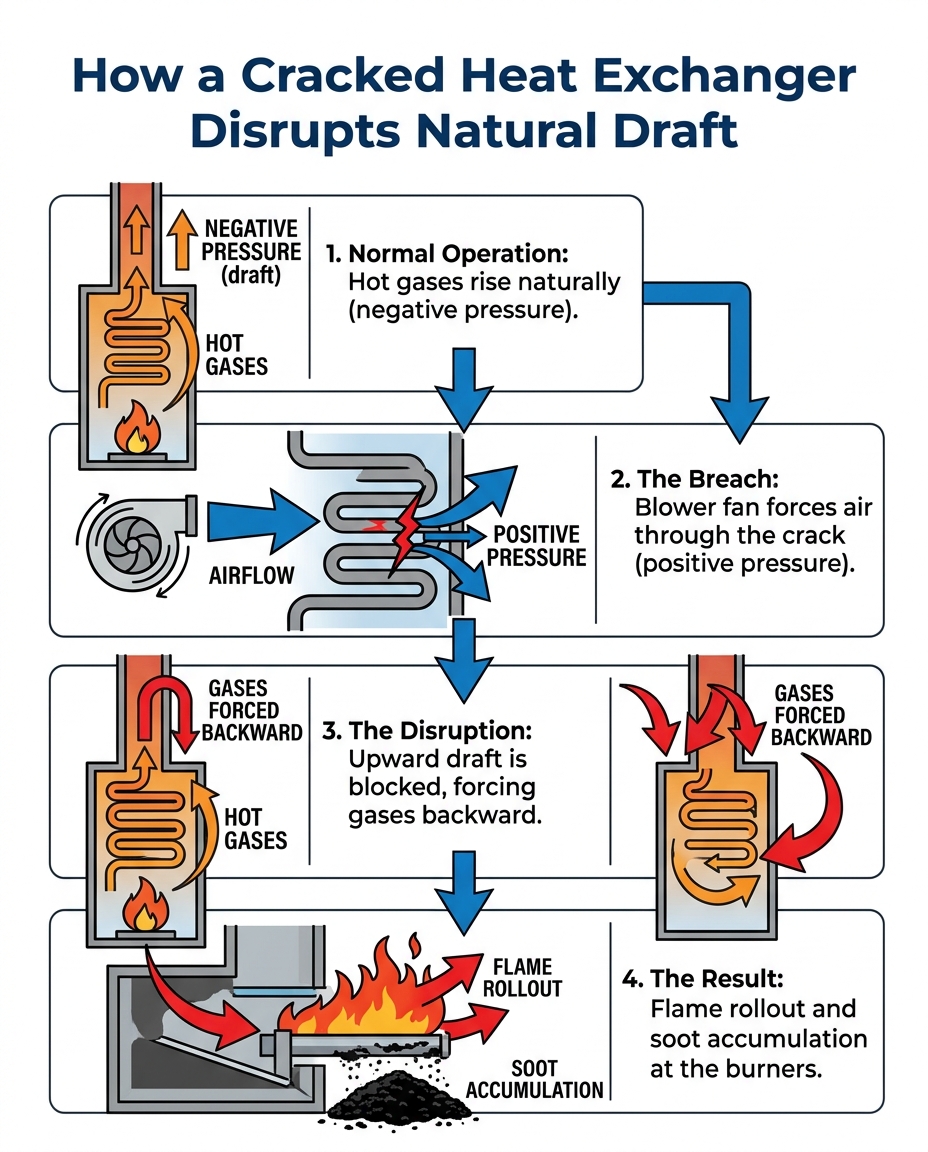
The problem: This blower fan creates a high-pressure zone outside the heat exchanger. Meanwhile, the inside of the combustion chamber is operating under a low-pressure (negative) zone to maintain the upward chimney draft. As long as the metal heat exchanger is intact, these two air streams never touch.
The cause: In our years of inspecting aging furnaces, we've found that when a crack forms in the heat exchanger—often due to years of thermal expansion and contraction—that solid barrier breaks. As soon as the main blower fan kicks on, it forces high-pressure indoor air directly through the crack and into the negative-pressure combustion chamber.
The solution: Unfortunately, the laws of aerodynamics take over immediately. The high-pressure air rushing through the crack acts like a roadblock. It instantly breaks the natural upward thermal buoyancy of the chimney draft. Instead of exhaust gases flowing smoothly up the flue, they collide with the turbulent, pressurized air from the blower. The upward draft stalls completely, forcing the toxic exhaust gases to find another way out.
Flame Rollout: The Immediate Safety Threat
When the chimney draft stalls due to a pressurized heat exchanger, the hot combustion gases have nowhere to go but backward. This dangerous condition is known as flame rollout. Because the exhaust cannot escape up the blocked flue, the flames and toxic gases spill backward, rolling out of the front of the burner cabinet and into the surrounding room.
Flame rollout is a severe fire hazard. The flames can easily scorch the wiring inside the furnace cabinet, melt plastic components, or ignite nearby combustible materials. To prevent this, modern furnaces are equipped with a safety device called a flame rollout switch. This sensor detects the excessive heat spilling out of the burner area and immediately shuts down the gas valve to extinguish the flames.
Why You Must Never Reset a Tripped Rollout Switch
If your furnace suddenly stops working and you discover that the rollout switch has tripped, you are facing a critical decision point. When our technicians respond to these specific no-heat calls, we always warn homeowners that a tripped rollout switch is not a nuisance issue—it is your system's final line of defense against a catastrophic failure. Repeatedly resetting this switch without addressing the underlying draft disruption is incredibly dangerous.
By forcing the furnace to run with a broken draft, you are allowing toxic exhaust gases to spill into your living space. This directly leads to the severe risk of carbon monoxide leaks in aging furnaces. Carbon monoxide is an odorless, colorless gas that is a natural byproduct of combustion. If the draft fails, this gas will quickly accumulate in your home, creating a life-threatening situation for your family.
Why Aging Masonry Chimneys Face Higher Risks
The architecture of your home plays a significant role in how vulnerable your heating system is to draft failures. Many older homes in Greensburg and Murrysville feature traditional brick-and-mortar masonry chimneys. In our experience servicing furnaces across Westmoreland County, the team at Cochran Heating & Cooling sees firsthand how these historic flues rely strictly on natural thermal buoyancy to exhaust gases.
Unlike modern, high-efficiency PVC venting pipes that use powerful inducer motors, traditional masonry chimneys are highly sensitive to even minor combustion chamber breaches. Because they depend entirely on the heat of the exhaust to pull gases upward, the slightest introduction of positive pressure from a cracked heat exchanger can collapse the draft entirely.
The Hidden Damage of Condensation
When a draft is compromised in an unlined or aging masonry chimney, the exhaust gases slow down. As they linger in the cold brick flue, they cool off and condense into a highly acidic moisture. This acidic condensation clings to the inside of the chimney, slowly eating away at the mortar joints and brickwork from the inside out.
Over time, this structural deterioration can cause the chimney liner to crumble, creating further blockages that make the draft even worse. If your older home has suffered from ongoing venting issues, scheduling a professional chimney and flue inspection is a critical step to ensure the masonry hasn't been structurally compromised by prolonged exposure to acidic exhaust.
Visible Indicators of Draft Disruption and Combustion Breaches
Because a cracked heat exchanger is hidden deep inside the furnace cabinet, you cannot simply look at the metal to see if it is broken. However, our technicians know that because the structural breach fundamentally alters the chimney draft, it leaves behind several clear, visible warning signs. If you notice any of the following symptoms, shut your heating system down immediately at the thermostat.
• Soot buildup: A primary indicator of exhaust spilling backward is fine, black soot accumulating around the furnace exterior, burner cabinet, or draft hood.
• Unusual flame characteristics: A healthy gas furnace should produce a steady, crisp blue cone of flame. If the flames are dancing, flickering, or burning yellow and orange, the draft is starved for oxygen.
• Acrid odors: The presence of strange, sharp, or chemical-like smells near the furnace while the blower is running often means exhaust gases are mixing with your indoor air.
• Scorched metal: Look for peeling paint, melted wires, or scorch marks on the outside of the burner cabinet, which are clear signs that flame rollout has already occurred.
Comparing Normal Operation to Draft Disruption
Understanding the difference between a healthy system and a failing one can help you act quickly. Here is a breakdown of how the symptoms shift when the pressure changes.
• Burner Flame Appearance — Normal Chimney Draft: Steady, crisp blue cone — Disrupted Draft (Cracked Exchanger): Wavering, yellow, or orange flames
• Surrounding Cabinet Area — Normal Chimney Draft: Clean metal, no residue — Disrupted Draft (Cracked Exchanger): Black soot, scorch marks, peeling paint
• Exhaust Odor — Normal Chimney Draft: None (vented safely outside) — Disrupted Draft (Cracked Exchanger): Acrid, sharp smells near the unit
• System Operation — Normal Chimney Draft: Runs full heating cycles smoothly — Disrupted Draft (Cracked Exchanger): Shuts down abruptly (rollout switch trips)
We must reiterate that these signs require immediate professional intervention. Never attempt DIY testing or repairs on a combustion appliance. The risks of fire and carbon monoxide exposure are simply too high, which is why our experts are trained to handle them safely.
The Professional Approach to Diagnosing Draft Failures
When you suspect that your chimney draft has collapsed due to a structural failure, our HVAC professionals at Cochran Heating & Cooling will use specialized tools to confirm the diagnosis safely. We do not rely on guesswork; our team measures the exact pressure differentials to see exactly how the air is behaving inside the system.
1. Combustion Analysis: Our technicians use a digital combustion analyzer to measure the exact makeup of the exhaust gases. High levels of carbon monoxide or unburned fuel in the flue gas immediately indicate that the draft is failing and the burners are starved for oxygen.
2. Draft Gauge Testing: By inserting a draft gauge into the flue pipe, we can measure the actual negative pressure pulling up the chimney. If the gauge shows positive pressure when the main blower fan kicks on, it confirms that air is leaking through the heat exchanger.
3. Visual Inspection: Using specialized inspection cameras, our team will visually examine the curves and welds of the heat exchanger to locate the exact hairline cracks or rusted-out holes causing the pressure leak.
4. Safety Code Verification: We evaluate the entire venting system to ensure it meets strict safety codes, such as NFPA 54 (National Fuel Gas Code), ensuring that the exhaust path is appropriately sized and free of masonry blockages.
The Decision Point: Why We Do Not Patch Heat Exchangers
Once a cracked heat exchanger is confirmed, it almost always necessitates a conversation about full system replacement rather than patching. In our professional experience, the metal inside a furnace endures massive temperature swings every single day. Any weld or patch applied to a crack will expand and contract at a different rate than the surrounding metal, virtually guaranteeing that it will break open again. Because the risk of carbon monoxide exposure is so severe, our team advises that replacing the compromised component—or upgrading to a new, energy-efficient furnace (which may qualify for general energy rebates or tax credits)—is the only way to permanently restore safe operation.
Prioritizing Safety When Combustion Systems Fail
A cracked heat exchanger is not just a worn-out part; it is a severe structural failure that turns natural chimney physics into an immediate safety hazard. When high-pressure blower air forces its way into the combustion chamber, it destroys the upward draft, pushing toxic exhaust and flames backward into your home.
Recognizing the visible signs of this pressure collision—like soot buildup, yellow flames, and tripped rollout switches—allows you to take action before dangerous carbon monoxide exposure occurs. If you notice any of these symptoms, shut your system down and schedule a professional evaluation with Cochran Heating & Cooling immediately to restore safe, reliable heating operation to your home.
Frequently Asked Questions
Why is flame rollout dangerous?
Flame rollout is dangerous because it allows open flames and toxic exhaust gases to spill backward out of the furnace cabinet instead of venting safely up the chimney. This creates an immediate fire hazard, as the flames can melt internal wiring or ignite nearby combustible materials. Furthermore, it releases high levels of carbon monoxide directly into your home's breathable air, posing a severe health risk.
How does a cracked heat exchanger affect furnace draft?
A cracked heat exchanger affects the furnace draft by allowing high-pressure air from the main blower fan to force its way into the low-pressure combustion chamber. This sudden influx of pressurized air acts like a roadblock, stalling the natural upward flow of the hot exhaust gases. The loss of this upward thermal buoyancy breaks the draft completely, forcing the exhaust to find another exit.
What are the signs of a bad furnace draft?
The most common signs of a bad furnace draft include black soot accumulating around the front of the burner cabinet, strange acrid odors when the system runs, and a flame rollout switch that repeatedly trips. You may also notice that the burner flames appear yellow, orange, and wavering, rather than forming a steady, crisp blue cone.
Can a cracked heat exchanger cause a fire?
Yes, a cracked heat exchanger can cause a fire by disrupting the chimney draft and causing flame rollout. When the exhaust gases are blocked from going up the flue, the flames are forced backward out of the burner area. These escaping flames can easily scorch the outside of the furnace cabinet and ignite surrounding walls, dust, or stored items.
Why does my furnace flame rollout switch keep tripping?
Your furnace flame rollout switch keeps tripping because it is detecting dangerous heat and flames spilling backward out of the combustion chamber. This usually happens when the chimney draft has failed, often due to a blocked flue or a cracked heat exchanger altering the air pressure. You should never repeatedly reset this switch; the system requires immediate professional diagnosis to prevent carbon monoxide poisoning or fire.