Why Is My Thermostat Reading 70 Degrees But the House Feels Freezing?
Why Does 70 Degrees Feel So Freezing Right Now?
Are you sitting on the couch listening to your furnace run continuously, yet you still find yourself reaching for a heavy blanket? You glance at the wall and are left wondering: why is my thermostat reading 70 degrees but the house feels freezing? This is a highly frustrating, concrete problem many homeowners face during the colder months when the temperature on the digital screen simply does not match the physical chill in the room.
You quickly reach a decision point: do you keep nudging the thermostat higher—wasting energy and overworking your heating system—or do you address the actual physical factors causing your discomfort? The truth is, raw ambient air temperature is only one part of the comfort equation. What we typically diagnose in these situations involves a combination of low indoor humidity, radiant heat loss, and subtle airflow restrictions that trick your body into feeling much colder than the room actually is.
If your system is struggling to keep your living space comfortable, professional residential HVAC services can help pinpoint the underlying issue. A thorough heating repair service and indoor air quality assessment can restore your home's true warmth.
The Science of Perceived Temperature vs. Actual Temperature
To understand why a room can feel physically cold even when the heating system is doing its job, we have to look at the fundamental difference between actual ambient air temperature and perceived temperature. Ambient temperature is simply the measurement of thermal energy in the air surrounding you—this is the exact number your thermostat sensor reads. Perceived temperature, however, is how your human biology actually interprets that environment.
Your body does not just passively sense the air; it actively senses the rate at which it is losing its own heat. According to the American Society of Heating, Refrigerating and Air-Conditioning Engineers (ASHRAE) Standard 55, optimal indoor comfort requires a relative humidity between 30% and 60%. When humidity drops below that threshold, the air becomes exceptionally dry, which fundamentally changes how you experience the temperature in the room.
Here is how the physics of heat loss affect your daily comfort:
1. Ambient Air Heat: The furnace warms the air in the room to the target temperature, satisfying the thermostat sensor on the wall.
2. Skin Moisture Evaporation: Dry indoor air acts like a sponge, rapidly pulling microscopic moisture away from your skin.
3. The Chill Effect: This rapid evaporation literally cools your body down, acting like a subtle, invisible breeze that makes a 70-degree room feel closer to 65 degrees.
How Your Skin Acts as a Sensor
Your skin is incredibly sensitive to evaporation. In the summer, high humidity prevents sweat from evaporating, which makes you feel hotter than the actual temperature. In the winter, the exact opposite happens. The dry air pulls moisture from your skin so quickly that it creates an evaporative cooling effect. This means your body is losing heat faster than the 70-degree air can replace it.
• 15% (Very Dry) — Thermostat Reading: 70°F — Perceived Temperature: 65°F - 66°F — Physical Comfort Level: Chilly, drafty feeling, dry skin
• 30% (Minimum Standard) — Thermostat Reading: 70°F — Perceived Temperature: 68°F — Physical Comfort Level: Acceptable, slightly cool
• 45% (Optimal) — Thermostat Reading: 70°F — Perceived Temperature: 70°F — Physical Comfort Level: Comfortable, balanced warmth
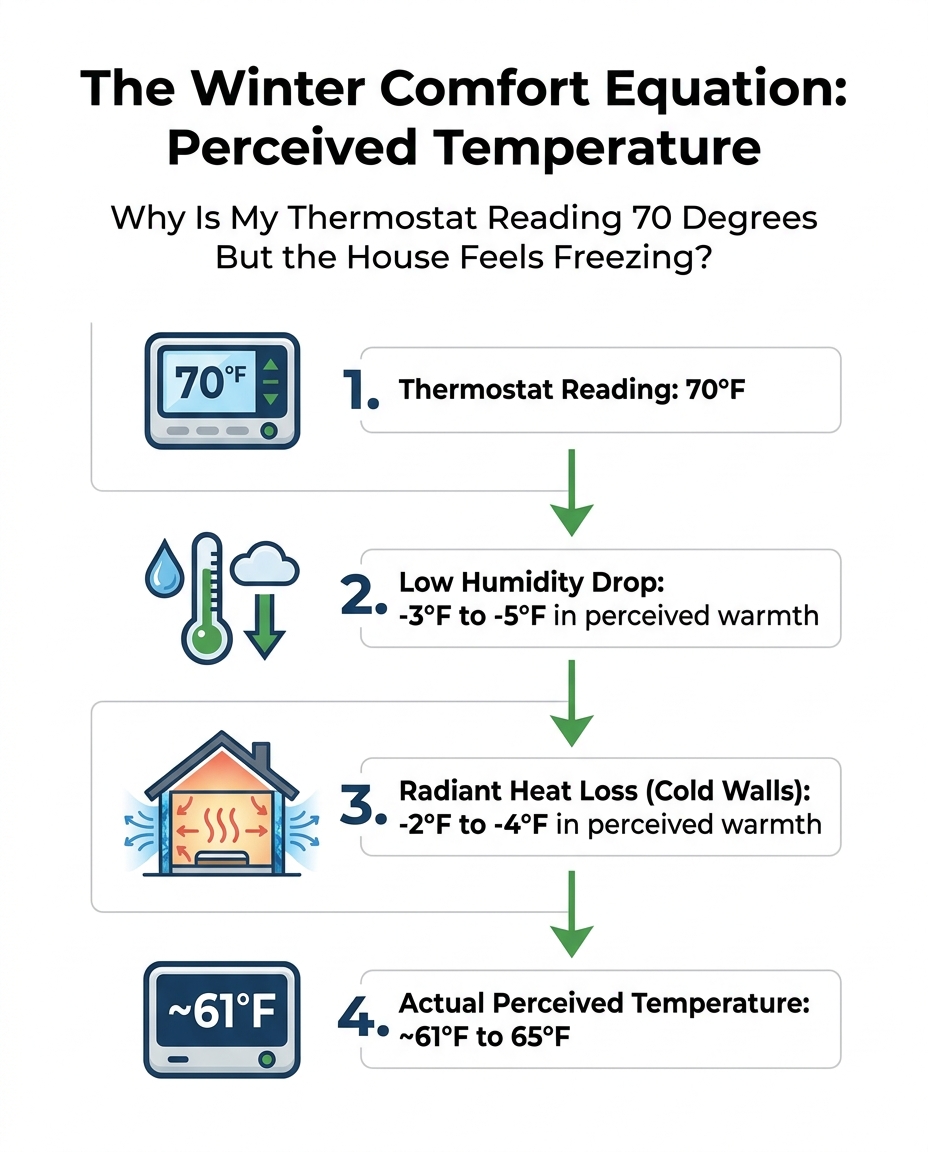
How Cold, Dry Air Sabotages Indoor Comfort
The Problem: During a typical Western PA winter, the outdoor air is extremely cold. While cold air might have a high relative humidity outside, its absolute humidity—the actual amount of water vapor it holds—is incredibly low. When this freezing, dry outdoor air naturally infiltrates your home through tiny gaps and is then heated by your gas furnace or heat pump, its capacity to hold moisture expands dramatically.
The Cause: Because your heating system warms the air without adding any new moisture to it, the relative humidity inside your home plummets. It is not uncommon for indoor humidity levels to drop below 15% during the peak of winter. This creates a literal desert-like environment inside your living room. Beyond just making the air feel physically colder, this extreme dryness causes a cascade of secondary issues. You will likely notice an increase in static electricity shocks, dry and shrinking hardwood floors, peeling wallpaper, and irritated sinuses or dry throats every morning.
The Solution: The most effective way to combat this specific chill is not to turn up the heat, but to restore the missing moisture. Professional indoor air quality solutions, such as Aprilaire whole-home humidifiers, integrate directly into your existing HVAC ductwork. These systems automatically monitor your indoor humidity and add the precise amount of water vapor needed to maintain that optimal 30% to 60% range. By restoring the humidity, you stop the rapid evaporation on your skin, allowing a 70-degree room to finally feel like a warm, cozy 70 degrees.
The Hidden Chill: Radiant Heat Loss in Older Homes
Even if your indoor humidity is perfectly balanced, you might still feel a deep chill when sitting in certain rooms. This phenomenon is governed by what thermal engineers call "mean radiant temperature." Heat naturally and constantly moves from warmer objects to colder ones. If you are sitting on a sofa next to an uninsulated exterior wall or an older window, your body heat is literally radiating across the room toward that cold surface.
The thermal vacuum effect: The ambient air between you and the wall might be perfectly warm, but the cold surface acts like a thermal vacuum, silently pulling the heat directly out of your body. You perceive this radiant heat loss as a draft, even if the windows are completely sealed and the air in the room is completely still.
In our experience working on homes in Western PA, this is incredibly common. The older housing stock in Westmoreland County, including many historic and mid-century homes in Jeannette and Greensburg, often lacks modern thermal breaks and advanced wall insulation. Plaster walls and single-pane or older double-pane windows become massive cold-sinks during the winter. When your body is surrounded by these cold surfaces, a 70-degree air temperature simply is not enough to offset the radiant heat your body is losing to the structure of the house itself.
Common Culprits Behind a Cold-Feeling House
Beyond humidity and radiant heat loss, there are several mechanical and structural reasons your heating system might satisfy the thermostat while leaving the rest of the house feeling frigid. If you are constantly adjusting the temperature, check for these common culprits:
• Drafty windows and exterior doors: Worn weatherstripping allows freezing outdoor air to continuously bypass your heating system, creating cold pockets that the thermostat never detects.
• Poor attic insulation: Heat naturally rises. If your attic lacks sufficient insulation, the warm air your furnace produces rapidly escapes through the ceiling, causing the system to run constantly without ever fully warming the living space.
• Dirty HVAC filters: A clogged air filter severely restricts the volume of warm air your blower motor can push through the ductwork, starving the furthest rooms of heat.
• Poor thermostat placement: If your thermostat is located in a naturally warm hallway, near a sunny window, or adjacent to the kitchen oven, it will register 70 degrees and shut the furnace off long before the bedrooms or living room have warmed up.
If you are struggling with specific cold rooms while others are boiling hot, solving uneven heating problems often requires a professional to evaluate your ductwork and insulation profile.
When Airflow Issues Mimic Heat Loss
Sometimes the issue is not that the house is losing heat, but that the heat is simply not getting to where you are sitting. Blocked return vents, furniture placed over supply registers, or closed dampers in the ductwork can completely disrupt the airflow in a room. When the warm air cannot circulate properly, the room will feel cold and stagnant. Furthermore, ignoring structural leaks can force your system to run non-stop. Addressing drafty windows and HVAC overwork is critical to preventing premature breakdowns and ensuring the warm air your system produces actually stays inside your home.
Why Pushing the Thermostat Higher Isn't the Answer
When you feel cold, your first instinct is usually to walk over and bump the thermostat up to 73 or 74 degrees. While this might provide a temporary burst of warm air from the vents, it is a highly inefficient way to solve the root problem. Cranking the heat to 75 just to feel like 70 wastes significant energy and will inevitably drive up your monthly utility bills.
More importantly, forcing the furnace or heat pump to run longer cycles to hit unnecessarily high target temperatures leads to severe premature wear and tear. Your system's blower motor, heat exchanger, and ignition components are forced to work overtime. This constant strain dramatically increases the likelihood of a mid-winter breakdown.
The humidity paradox: Pushing the temperature higher actually exacerbates the original problem. Heating the air even more expands its capacity to hold moisture even further, which drives the relative humidity even lower. The hotter you make the dry air, the faster it evaporates moisture from your skin, trapping you in a cycle of discomfort. Instead of masking the symptom, proper furnace troubleshooting and professional diagnostics are required to balance the temperature, humidity, and airflow properly.
Frequently Asked Questions About Winter Comfort and Thermostat Readings
Why am I so cold in my house when the heat is on 70?
You feel cold because low indoor humidity accelerates moisture evaporation from your skin, and cold exterior walls pull heat away from your body. Even when the ambient air is 70 degrees, these two factors create a significant physical chill. Dry winter air acts like a subtle breeze, cooling you down continuously. Addressing the humidity levels and mitigating radiant heat loss is the most effective way to restore your comfort without overworking your furnace.
Is 70 degrees warm enough for a house in winter?
Yes, 68 to 70 degrees is the standard recommended temperature for a house in winter, provided the indoor humidity is maintained between 30% and 60%. At these humidity levels, 70 degrees provides a comfortable, balanced environment for most people. If you find yourself shivering at this temperature, it is a strong indicator that your home's air is too dry or that you have significant drafts bypassing your heating system.
Why does 70 degrees feel cold in winter but hot in summer?
The difference comes down entirely to relative humidity. Summer air holds significantly more moisture, which prevents your sweat from evaporating easily, trapping heat against your body and making 70 degrees feel warm or even stuffy. In contrast, winter air is extremely dry, which speeds up the evaporation of moisture from your skin and causes a rapid cooling effect, making the exact same 70-degree air feel chilly and drafty.
How can I make my house feel warmer at 70 degrees?
You can make your house feel warmer by installing a whole-home humidifier to restore indoor moisture levels, which immediately stops the evaporative cooling effect on your skin. Additionally, sealing window drafts with weatherstripping and keeping interior doors open will improve airflow and reduce cold spots. Finally, using heavy curtains on older windows can create a thermal break that significantly reduces radiant heat loss.
How does humidity affect indoor temperature?
Humidity does not actually change the ambient air temperature reading on your thermostat, but it drastically changes the "perceived" temperature you feel. High humidity makes the air feel warmer by slowing down skin evaporation, while low humidity makes the air feel cooler by accelerating that evaporation. Managing your indoor humidity is just as critical to your physical comfort as managing the raw heat output of your furnace.
Can a bad thermostat make the house feel colder than it reads?
Yes, if the thermostat sensor is miscalibrated or located in a naturally warm spot—like near a busy kitchen, a heat-producing lamp, or in direct sunlight—it will read 70 degrees prematurely. This causes the thermostat to shut off the heating cycle long before the rest of the house actually reaches the target temperature. A professional technician can easily recalibrate the unit or relocate it to a more accurate central hallway.
Restore True Comfort to Your Home This Winter
Achieving true comfort during a harsh Western PA winter requires more than just a powerful furnace. It requires a delicate balance of ambient temperature, proper indoor humidity, and consistent airflow. When your thermostat reads 70 degrees but you are still shivering, your home is telling you that one of these critical elements is out of alignment.
Instead of continually pushing the thermostat higher and paying for heat you cannot feel, it is time to address the root cause. Whether you need a whole-home humidifier to restore moisture, a system diagnostic to correct airflow restrictions, or a comprehensive inspection to ensure your equipment is operating at peak performance, professional solutions provide lasting results. Schedule an inspection today to evaluate your home's unique comfort challenges and get back to enjoying the warmth you deserve.