Securing Your Basement Boiler Against Approaching Freezing Temperatures
The Urgent Need to Winterize Before the Freeze Hits
At Cochran Heating & Cooling, we know that when the weather begins to turn, securing your basement boiler against approaching freezing temperatures becomes a race against time for homeowners with older properties. Long before the first heavy snow falls, the invisible threat of rapidly dropping temperatures begins to test the thermal boundaries of your home. Heating pipes that run through unconditioned basements and drafty crawlspaces are exceptionally vulnerable to sudden cold snaps. If you wait until the thermometer plummets to evaluate your exposed plumbing, you risk facing catastrophic pipe bursts, severe water damage, and a complete loss of heat exactly when you need it most.
For homeowners looking to protect their investment and maintain consistent comfort, exploring residential HVAC services is a proactive step. Scheduling expert boiler repair services with our team ahead of the extreme cold ensures that your system is optimized, insulated, and ready to handle the heavy workload of the season.
The concept of flash-freezing is a very real danger in drafty, unfinished spaces. While the main living areas of your house might feel perfectly warm, the basement environment operates under entirely different conditions. A sudden influx of sub-freezing air through a compromised foundation vent or a poorly sealed window can drop the ambient temperature around a water-filled pipe well below freezing in a matter of hours. This rapid heat loss requires immediate, proactive measures. Before the deep December freezes arrive, evaluating and securing your heating infrastructure is the most effective way to prevent a winter emergency.
Why Unconditioned Spaces Threaten Your Heating System
In our years of experience servicing older homes throughout the local area, the technicians at Cochran Heating & Cooling frequently encounter architectural quirks that leave mechanical equipment exposed to the elements. Many Jeannette and Greensburg area basements feature older stone foundations or unsealed crawlspaces that completely lack modern thermal boundaries. These spaces were often designed to breathe, which was fine for coal storage a century ago, but presents a massive liability for modern plumbing and heating lines.
Western Pennsylvania's severe cold snaps can rapidly infiltrate these poorly sealed foundations, causing unexpected flash-freezing. Even if the immediate area around the boiler unit feels relatively warm due to ambient heat loss from the cast iron heat exchanger, the far corners of the basement can be drastically colder. Drafts accelerate heat loss exponentially. When cold exterior air constantly moves across a bare copper or PEX pipe, it strips away heat much faster than still air at the exact same temperature. This wind-chill effect on your plumbing means that a drafty basement at 35 degrees Fahrenheit can freeze a pipe faster than a completely sealed basement at 30 degrees.
The Mechanics of Rapid Heat Loss:
• The Sill Plate Gap: The area where your home's wooden framing rests on top of the masonry foundation is a notorious entry point for freezing drafts. As older mortar degrades and wood shrinks over decades, significant air gaps form.
• Basement Windows: Single-pane glass and dried, crumbling glazing putty offer almost zero resistance to winter winds.
• Unconditioned Crawlspaces: Heating lines often have to route through these shallow, unheated areas to reach additions or outer rooms, placing them directly in the path of the cold.
Because these specific architectural layouts require a highly targeted approach to winterization, a comprehensive evaluation is necessary. This evaluation often includes looking at how the equipment vents to the outside, which is why a pre-winter chimney and flue inspection is highly recommended to ensure safe operation alongside your thermal protection efforts.
Understanding the Unique Risks to Hydronic Systems
To effectively protect your home, you must first understand the specific type of equipment you are operating. Our team often explains to local homeowners that unlike older steam radiators that send vaporized water through the house, modern hydronic boiler heating systems (non-steam) rely on a continuous loop of circulating liquid water to deliver warmth to your baseboards or radiators. This fundamental difference makes hydronic setups uniquely susceptible to winter weather.
The Problem: Exposed Heat Sinks
Long runs of exposed piping act as massive heat sinks when they pass through a cold basement. As the heated water travels away from the main unit, it constantly bleeds thermal energy into the surrounding cold air. If the thermostat is satisfied and the circulator pump shuts off, that water stops moving. It sits stagnant in the coldest part of your house, slowly dropping in temperature until it matches the freezing air around it.
The Cause: The Physics of Expansion
The actual physics of a pipe burst are often misunderstood. When water freezes, it expands by approximately nine percent. However, the ice itself rarely breaks the pipe at the exact spot where it forms. Instead, as the ice block grows inside the pipe, it acts like a solid plug. It pushes the remaining liquid water toward a closed valve or a dead end in the plumbing. Because water is non-compressible, this trapped liquid creates immense hydraulic pressure—often exceeding thousands of pounds per square inch. The copper or PEX tubing eventually fails under this extreme pressure, splitting open longitudinally.
The Solution: Continuous Flow and Thermal Barriers
The key to protecting a hydronic network is maintaining flow and retaining heat. Even a small, localized section of frozen pipe can paralyze the entire heating network. If an ice plug forms in a single return line, the circulator pump cannot push water through the loop. The boiler will fire, heat the water in its internal tank, and then quickly shut off because the heat has nowhere to go. Meanwhile, the rest of the house rapidly drops to freezing temperatures, putting domestic water lines at risk next.
Identifying Vulnerable Pipe Runs in Your Basement
Taking a proactive approach means conducting a thorough visual inspection of your lower levels before the deep December freezes set in. A pattern we see often at Cochran Heating & Cooling is homeowners neglecting these unconditioned areas until it's too late. By systematically tracing your heating lines and identifying sources of cold air intrusion, you can spot potential disasters before they happen.
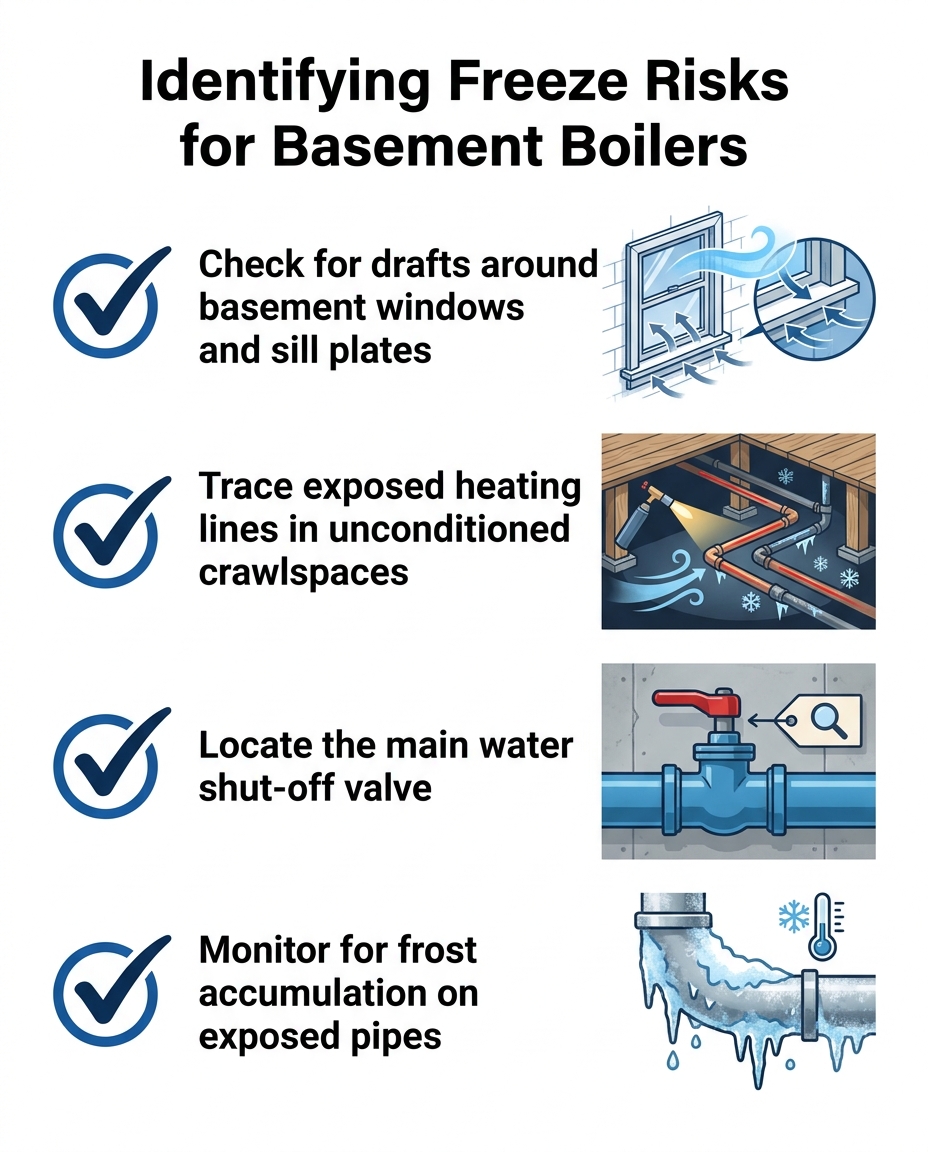
Locating Drafts and Air Leaks
Begin by analyzing the perimeter of your basement on a windy day. You do not need specialized equipment to find major air leaks; your hands and a careful eye are often enough.
• Check around basement windows and doors: Feel for cold air pushing past the sashes. Look for daylight visible through the frames or degraded weatherstripping that has flattened out over the years.
• Inspect the foundation perimeter: Walk the entire edge where the foundation meets the wood framing (the sill plate). Pay special attention to areas where utility lines, dryer vents, or electrical conduits penetrate the exterior wall.
• Observe cobweb movement: A surprisingly effective way to spot a draft in a dark corner is to watch for gently swaying cobwebs. If the webs are moving, cold air is actively blowing into the space.
Tracing Exposed Heating Lines
Once you have identified the cold zones, you must trace the path of your hydronic water lines to see if they intersect with these drafty areas.
• Follow the lines outward: Start at the main boiler unit and visually follow the supply and return pipes. Track them as they route up into the floor joists or branch off toward different heating zones.
• Check unheated storage rooms: Follow the lines into crawlspaces or unheated storage rooms. These areas are notorious for dropping below freezing because they are isolated from the ambient heat of the main basement.
• Identify missing insulation: Look for sections of pipe that are completely bare or where old fiberglass insulation has fallen away.
• Locate the main shut-off: Instruct every adult in the household on how to locate the main water shut-off valve. If a pipe does burst, stopping the flow of water immediately is the only way to minimize property damage.
Warning signs of immediate danger: If you touch an exposed pipe and it feels exceptionally cold, or if you ever see physical frost accumulation on the outside of a copper line, that section is at immediate risk of freezing solid.
The Danger of Lockouts During Cold Snaps
Even a perfectly insulated pipe can freeze if the water inside it stops moving for an extended period. This is why our emergency repair team considers a system lockout during a winter storm one of the most dangerous scenarios a homeowner can face.
A system lockout occurs when your boiler's internal computer detects a fault and shuts down the burner to prevent damage or safety hazards. This can happen for a variety of reasons: a dirty flame sensor failing to detect ignition, a blocked exhaust flue tripping a pressure switch, or a failing circulator pump relay. When the system locks out, it will not attempt to fire again until it is manually reset or professionally repaired.
When circulation stops during a lockout, the water in the hydronic pipes becomes completely stagnant. Without the continuous introduction of thermal energy from the main unit, the water in the exposed basement runs begins to cool rapidly. The timeline of a freeze during a lockout is alarmingly short—often happening much faster than the homeowner realizes the heat is off. If a lockout occurs at 2:00 AM, the pipes in a drafty crawlspace could easily freeze solid before the family wakes up at 7:00 AM and notices the house is cold.
This risk emphasizes the profound importance of having a reliable, modern unit that operates efficiently and safely. Upgrading to high-efficiency boiler solutions not only reduces your monthly energy consumption but also provides advanced diagnostics and greater reliability, significantly lowering the chances of an unexpected shutdown during deep December freezes.
DIY Draft Prevention vs. Professional Winterization
While homeowners can and should take active steps to seal their homes against the cold, it is critical to establish clear boundaries between basic home maintenance and tasks that require a licensed professional. Mishandling hydronic boiler heating systems (non-steam) can lead to severe safety hazards, including carbon monoxide exposure and fire risks.
• Draft Prevention — Safe Homeowner (DIY) Actions: Applying weatherstripping to basement doors, caulking window frames, and sealing minor sill plate gaps with expanding foam. — Requires a Licensed Professional: Repairing structural foundation damage, replacing compromised exhaust vents, or modifying the air intake for the combustion chamber.
• Pipe Insulation — Safe Homeowner (DIY) Actions: Installing split-foam pipe sleeves on clearly identified domestic cold-water lines far away from the heat source. — Requires a Licensed Professional: Insulating hydronic heating lines near the exhaust flue, distinguishing between heating and gas lines, or working near the boiler cabinet.
• System Operation — Safe Homeowner (DIY) Actions: Maintaining consistent thermostat settings (never setting it below 55°F) and keeping the area around the unit clear of debris. — Requires a Licensed Professional: Resetting a system that repeatedly locks out, adjusting water pressure, bleeding air from the lines, or testing safety limits.
• Long-Term Upgrades — Safe Homeowner (DIY) Actions: Monitoring energy bills and scheduling routine annual maintenance before the winter season begins. — Requires a Licensed Professional: Evaluating an aging, vulnerable unit for a complete boiler replacement to prevent catastrophic winter failures.
The experts at Cochran Heating & Cooling strictly advise against DIY pipe insulation if you cannot confidently distinguish between heating lines, domestic water lines, and natural gas lines. Furthermore, placing combustible foam insulation too close to the exhaust flue or the burner cabinet creates a severe fire hazard. When it is time to address complex insulation needs or diagnose a system that struggles to maintain temperature, calling a professional is the only safe choice. Addressing these issues proactively secures the long-term benefits of an efficient system and prevents the massive expense of water damage cleanup.
Frequently Asked Questions About Basement Heating Protection
At what temperature do boiler pipes freeze?
The standard threshold for freezing pipes is an ambient temperature of 20 degrees Fahrenheit or lower. However, in unconditioned spaces with heavy drafts, the wind-chill effect can cause pipes to freeze even if the surrounding air is slightly warmer. Hydronic heating lines are particularly at risk if the system loses power, as the stagnant water will quickly drop to match the freezing ambient temperature of the crawlspace or basement.
How do I keep my basement boiler pipes from freezing?
The most effective strategy is a combination of sealing air leaks and maintaining continuous water circulation. Start by blocking cold drafts around basement windows, sill plates, and exterior doors. Ensure your thermostat is set to a consistent temperature, even when you are away, to keep the boiler firing and the circulator pump moving warm water through the exposed lines.
Should I leave my boiler on to stop pipes freezing?
Yes, you should absolutely leave your heating system on during the winter months, even if you travel out of town. Set the thermostat no lower than 55 to 60 degrees Fahrenheit. This ensures the unit will cycle on periodically, pushing heated water through the hydronic loop and preventing the water in the vulnerable basement runs from becoming stagnant and freezing solid.
What happens to a hydronic heating system if pipes freeze?
If the pipes freeze, the expanding ice creates immense hydraulic pressure that typically causes the copper or PEX tubing to split open. Because hydronic systems rely on a closed loop, a single frozen section blocks the flow of water entirely, paralyzing the heating network. Once the ice thaws, the split pipe will leak continuously, causing severe water damage and requiring immediate professional repair.
Why are older basements more prone to rapid pipe freezing?
Older basements typically lack the thermal boundaries found in modern construction. Features like stone foundations, degraded mortar, unsealed sill plates, and single-pane windows allow massive amounts of freezing exterior air to pour into the space. This rapid influx of cold air can cause flash-freezing of exposed plumbing lines long before the ambient temperature of the main living areas drops.
Secure Your Heating System Before the Cold Arrives
Identifying vulnerable pipes in unconditioned spaces is not a task that can wait until the first blizzard is in the forecast. By taking the time to trace your hydronic lines, locate drafts, and understand the unique risks your basement presents, you can stop a winter disaster in its tracks. The peace of mind that comes with professional winterization from a trusted local team is invaluable when the temperatures drop.
Do not leave your home's comfort and safety to chance this winter. As your local HVAC experts, we encourage you to take action before the deep December freezes push your equipment to its limits. Schedule an inspection or reach out to Cochran Heating & Cooling for expert boiler repair services today to ensure your system is fully secure, properly insulated, and ready to deliver reliable heat all season long.