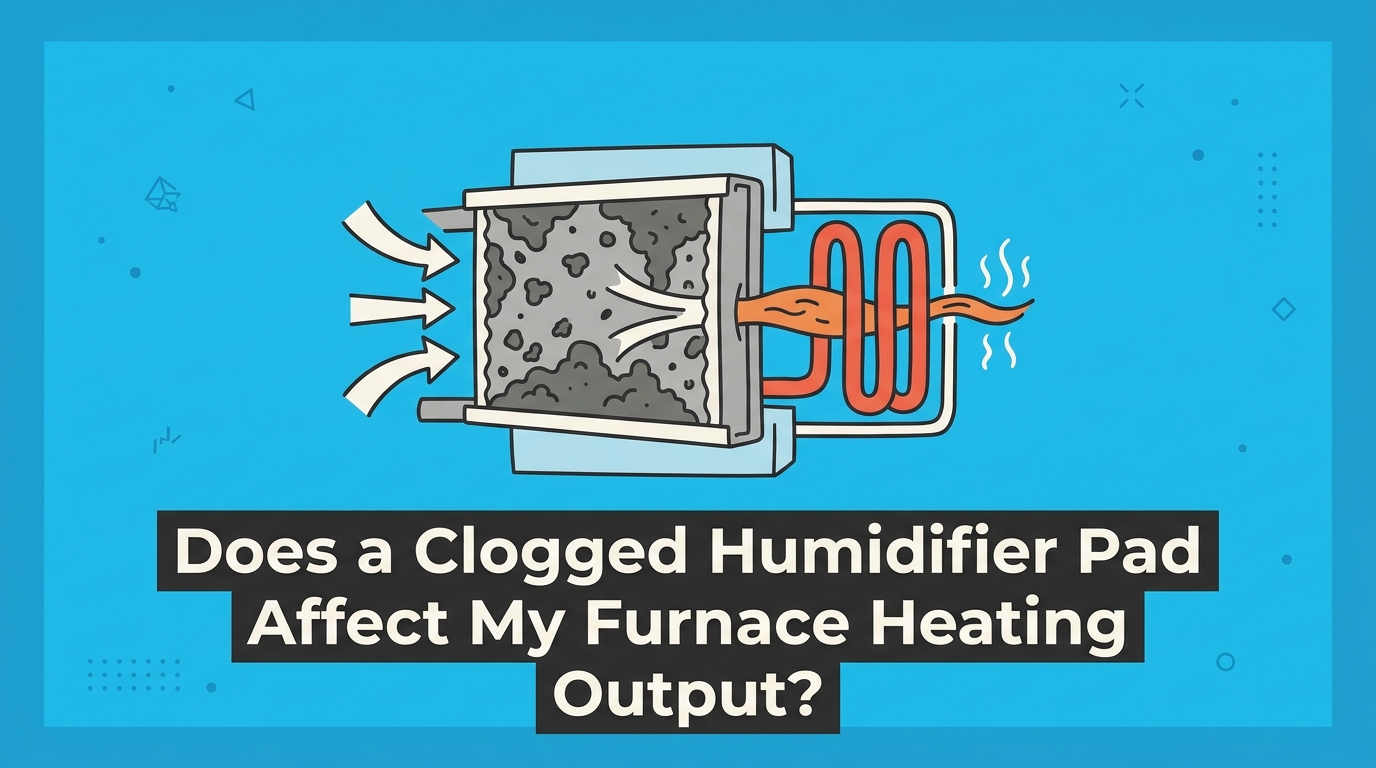
Does a Clogged Humidifier Pad Affect My Furnace Heating Output?
Why Your Furnace Might Be Struggling Alongside Your Humidifier
Is your furnace turning on and off rapidly, yet your home still feels stubbornly cold? If you find yourself asking, "Does a clogged humidifier pad affect my furnace heating output?" the answer is a resounding yes. Homeowners frequently assume that this rapid cycling—known as short-cycling—points to a major internal mechanical failure, a faulty thermostat, or simply a severely dirty primary air filter. However, there is another hidden culprit that often goes completely unnoticed until the system shuts down and leaves the house freezing.
During a peak Western PA winter, one of the most common issues we uncover is a neglected, rock-hard humidifier water panel restricting critical bypass airflow. When this happens, the interaction between your heating equipment and your indoor air quality system begins to work against you, trapping intense heat where it doesn't belong. If you need immediate help restoring your system's performance, exploring professional residential HVAC services or scheduling dedicated furnace repair and troubleshooting is the safest way to bring reliable warmth back to your home.
Many homes utilize a bypass humidifier to combat the dry winter air, but few homeowners realize just how deeply integrated this attachment is with the furnace's core airflow. A neglected water panel does not just stop adding moisture to the air; it physically alters the way your furnace breathes. Let's break down exactly how this overlooked maintenance item can bring your entire heating system to a grinding halt.
The Short Answer: Can a Clogged Humidifier Pad Cause Furnace Short-Cycling?
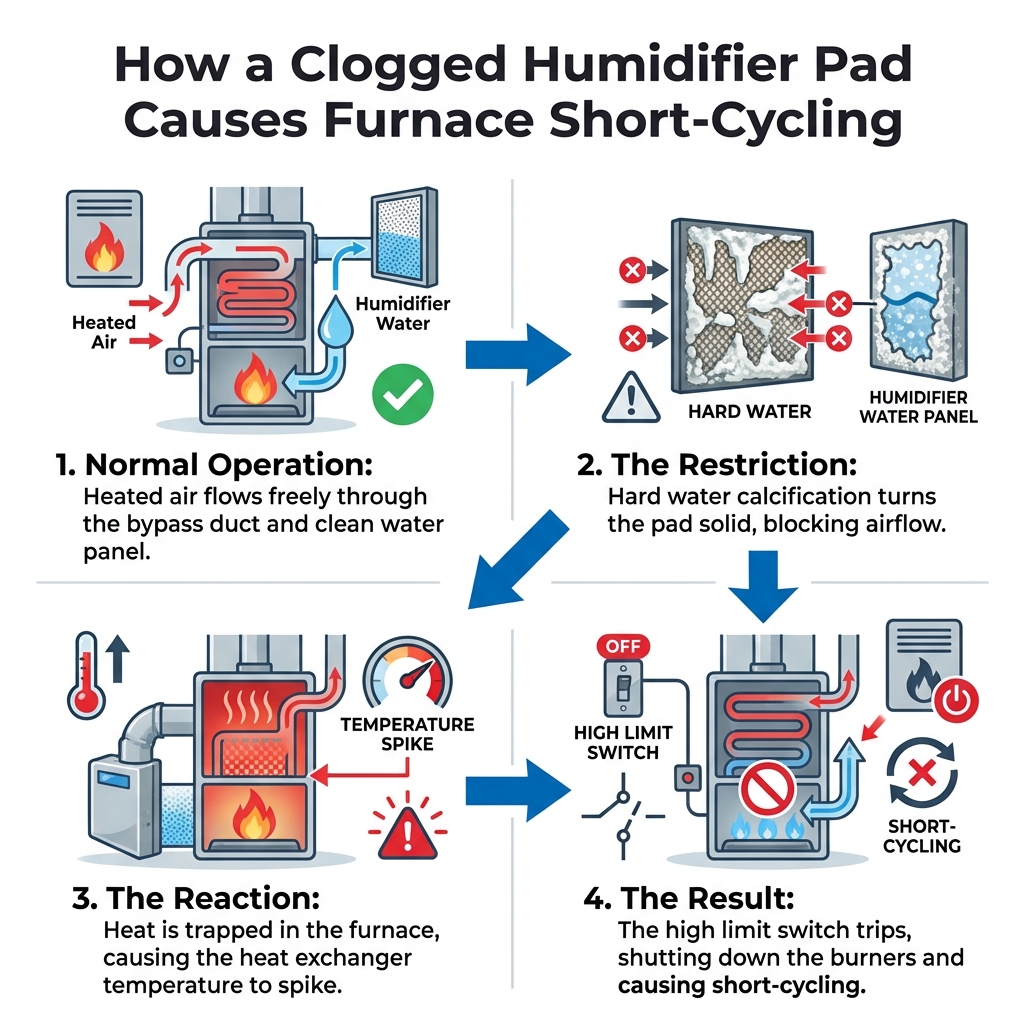
Yes, a clogged humidifier pad can severely affect your furnace heating output. In bypass humidifiers, a calcified water panel restricts airflow, causing heat to become trapped in the furnace. This trapped heat often trips the high limit switch, resulting in the furnace short-cycling and producing inadequate heat.
When you look at Aprilaire and similar bypass humidifier systems, they are designed to work in perfect harmony with your furnace's blower motor. They rely on a specific volume of air passing through the bypass duct, crossing over the water panel, and returning to the system to distribute moisture. When that water panel becomes heavily calcified from hard water, it ceases to be a porous sponge and instead becomes a solid brick wall.
This solid barrier acts exactly like a severely dirty primary air filter. The furnace is still generating a massive amount of thermal energy, but the necessary airflow required to carry that heat away into your ductwork is suddenly choked off. As a result, the internal temperature of the furnace spikes dangerously high in a matter of minutes. The system's safety mechanisms detect this overheating and immediately shut down the gas burners to prevent a fire hazard or a cracked heat exchanger.
This rapid shutdown is what you experience as short-cycling. The blower might continue to run for a few moments to cool the unit down, but the heat output stops prematurely. Once the internal temperature drops, the furnace tries to start again, only to overheat and shut down once more. Homeowners weighing their options between steam vs evaporative humidifier attachments often don't realize that the evaporative bypass models require strict airflow management to keep the furnace operating safely.
Understanding the Mechanics: Bypass Airflow and Your Heat Exchanger
To truly understand why a humidifier pad can disable a furnace, we have to look at the physics of your HVAC system's airflow. Your furnace is not just a box that makes heat; it is a carefully balanced air circulation engine. It relies on a specific concept known as static pressure to move conditioned air throughout your living space effectively.
The Role of the Bypass Duct
In a typical installation for Greensburg and Irwin residential homes, a bypass humidifier is mounted on either the supply plenum (where hot air leaves the furnace) or the return plenum (where cold air comes back in). A bypass duct connects the two sides. When the humidifier is running, a damper opens, allowing a portion of the hot supply air to detour through the humidifier, pass through the wet water panel, and re-enter the air stream.
The furnace's blower motor is calibrated to handle this exact volume of diverted air. The system expects that air to flow smoothly through the porous metal or paper mesh of the humidifier pad. When the pad is clean, the air meets very little resistance, and the furnace exhausts its heat properly.
How Static Pressure Responds to Blockages
Static pressure is the resistance to airflow within your ductwork. When the diverted air hits a wall of calcification instead of passing through, the static pressure inside the system changes dramatically. Because the air cannot push through the rock-hard pad, it backs up. This restriction is mechanically identical to running your furnace with a completely blocked, high-MERV air filter wrapped in plastic.
Without adequate airflow moving across the metal heat exchanger, the heat exchanger cannot transfer its thermal energy to the air. The metal gets hotter and hotter. This is a critical failure point because heat exchangers are designed to operate within a very specific temperature range. If they exceed that range, the metal can warp, stress, and eventually crack, leading to carbon monoxide risks. The restriction caused by a single, inexpensive humidifier pad can therefore threaten the most expensive and vital component of your entire heating system.
The Local Culprit: How Hard Water Accelerates Pad Calcification
You might wonder how a simple mesh pad can turn into a solid, impenetrable block of stone. The answer lies in the water flowing through your plumbing. In our experience, the rate at which a humidifier pad fails is directly tied to the local water quality, and this is a significant factor for homes in our region.
The Impact of Western Pennsylvania Water
Explain how Western Pennsylvania's hard water accelerates calcification, turning pads rock-hard and severely blocking airflow during peak winter. Municipal and well water in this region contains notoriously high levels of dissolved minerals, primarily calcium and magnesium. While these minerals are generally harmless to drink, they wreak havoc on appliances that rely on evaporation.
The Evaporation Cycle and Mineral Buildup
When your thermostat calls for humidity, a solenoid valve opens and trickles water over the top of the humidifier panel. The warm air from the furnace blows across this water, causing it to evaporate into the air stream. However, only the pure H2O evaporates. The calcium and magnesium are left behind, clinging to the mesh of the pad.
Over weeks and months of continuous operation during a peak Western PA winter, these mineral deposits rapidly accumulate. What starts as a light, chalky white film eventually builds into thick, crusty layers. Because the furnace is running almost non-stop during cold snaps, the evaporation cycle is relentless. Eventually, the microscopic gaps in the pad are entirely filled with scale. At this point, the pad is no longer absorbing water or allowing air to pass; it is simply a solid obstruction in your ductwork, setting the stage for severe furnace overheating.
Diagnosing the Issue: Dirty Air Filter vs. Calcified Water Panel
When your furnace begins to short-cycle, the symptoms can be incredibly confusing. The house is cold, the vents are barely blowing warm air, and the furnace sounds like it is constantly starting and stopping. Because the symptoms of a dirty primary air filter and a clogged humidifier pad are virtually identical, it is crucial to know how to tell them apart before assuming the worst.
Below is a breakdown of what we typically see when diagnosing these two overlapping issues in Aprilaire and similar bypass humidifier systems:
• Primary Symptom — Dirty Primary Furnace Filter: Furnace short-cycles; weak airflow at all vents. — Calcified Humidifier Pad: Furnace short-cycles; weak airflow at all vents.
• Visual Inspection — Dirty Primary Furnace Filter: Filter is coated in thick gray dust, pet hair, or debris. — Calcified Humidifier Pad: Pad is coated in heavy white, yellow, or brown crusty mineral scale.
• Physical Texture — Dirty Primary Furnace Filter: Soft but deeply impacted with household particulate matter. — Calcified Humidifier Pad: Brittle, stiff, and rock-hard to the touch.
• Immediate Action — Dirty Primary Furnace Filter: Slide out the old filter and replace it with a clean one of the same size. — Calcified Humidifier Pad: Turn off the furnace, open the humidifier cover, and replace the water panel.
The quick fix: Always check your primary furnace filter first. It is the most common airflow restrictor and the easiest to access. If the filter is clean or brand new, and the furnace is still shutting down prematurely, your next step should be inspecting the humidifier.
To safely check the pad, ensure the furnace is completely powered off at the switch or breaker. Unlatch the plastic cover of the humidifier unit. Slide out the scale control insert and the water panel. If the panel feels heavier than usual, looks like it is covered in plaster, or feels completely rigid, it is severely calcified and must be thrown away. If you replace both the filter and the pad and the system still struggles, you are likely dealing with common furnace repair problems that require a professional technician to resolve.
The Danger of a Tripping High Limit Switch
When restricted bypass airflow causes your furnace to overheat, the system relies on a specific internal component to prevent a catastrophe: the high limit switch. Understanding how this switch operates is vital for understanding the boundary between safe homeowner troubleshooting and a necessary professional repair.
Anatomy of a High Limit Switch Failure
The high limit switch is a critical safety device featuring a temperature-sensitive probe that extends directly into the heat exchanger chamber. Its sole job is to monitor the internal temperature of the furnace. If the temperature rises above a safe threshold—usually due to a lack of airflow from a clogged filter or a blocked humidifier pad—the switch automatically trips, cutting power to the gas valve and shutting down the burners.
In Greensburg and Irwin residential homes, we frequently see the aftermath of a furnace that has been allowed to short-cycle for too long. A high limit switch is designed to trip in an emergency, but it is not designed to trip repeatedly day after day. Every time the switch is forced to open under extreme heat, the bi-metal disc inside it experiences thermal stress. Over time, this repeated wear and tear weakens the component.
When Safety Becomes a Hazard
Eventually, a limit switch that trips too many times will become permanently stuck in the "open" position. When this happens, the furnace will not ignite at all, no matter how clean your air filter or humidifier pad is. The system goes into a hard lockout, leaving you without heat.
A strict warning for homeowners: You should never attempt to manually reset, bypass, or replace internal furnace safety switches without a license. Bypassing a limit switch removes the only safety net preventing your heat exchanger from melting down or starting a fire. If replacing your airflow filters does not immediately cure the short-cycling, the limit switch or the heat exchanger may already be compromised, and a professional diagnostic is mandatory.
Preventative Care: When to Replace Your Pad and When to Call a Pro
The best way to handle furnace short-cycling is to prevent the airflow restriction from occurring in the first place. Use transparent diagnostic expertise to explain what we typically see in local homes, focusing on honest preventative care to save homeowners from unnecessary repair calls. Routine maintenance of your indoor air quality attachments is just as critical as servicing the furnace itself.
To keep your system breathing easily during a peak Western PA winter, follow this proactive checklist:
• Replace the water panel annually: Do not wait for the pad to become a solid block of calcium. We recommend replacing the humidifier water panel at least once a year, ideally in the early fall before the heating season begins. If your home has exceptionally hard well water, you may need a mid-season replacement in January or February.
• Check the bypass damper: Most bypass humidifiers have a manual damper with "Summer" and "Winter" settings. Ensure this damper is open (set to Winter) when the furnace is running so that air can flow properly through the duct.
• Monitor primary filters monthly: A clean humidifier pad cannot make up for a severely clogged primary air filter. Check your standard 1-inch filters every 30 days, or your 4-inch media filters every 3 to 6 months.
• Inspect the drain line: Ensure the plastic drain tube running from the bottom of the humidifier to your floor drain is clear of obstructions and mold buildup, allowing excess water to flow away freely.
If you have diligently replaced the primary filter and the humidifier pad, and the furnace continues to start and stop rapidly, you have reached the limit of homeowner maintenance. This indicates that the limit switch is likely worn out, the blower motor is failing, or the heat exchanger is compromised. At this stage, investing in preventative HVAC maintenance and having a licensed technician evaluate the system is the only way to prevent premature component failure and restore safe operation.
Frequently Asked Questions About Humidifier Pads and Furnace Performance
Homeowners dealing with Aprilaire and similar bypass humidifier systems often have specific questions about how these units impact their overall heating performance. Here are the most common inquiries we receive regarding airflow, maintenance, and short-cycling.
Can a dirty humidifier filter cause furnace problems?
Yes, a clogged filter severely restricts the intended airflow through your HVAC system's bypass duct. When this airflow is choked off by mineral deposits, the furnace cannot exhaust its heat properly. This restricted airflow directly leads to internal overheating, short-cycling, and unnecessary strain on the blower motor.
Will a clogged humidifier pad cause short cycling?
Absolutely. A clogged pad acts like a solid wall, trapping intense heat inside the furnace's heat exchanger. As the internal temperature spikes to dangerous levels, the trapped heat trips the high limit switch, which acts as a safety mechanism to shut down the burners prematurely. This constant on-and-off process is the definition of short-cycling.
How often should I change my whole house humidifier pad?
You should replace your whole house humidifier pad at least once a year, ideally right before you turn your furnace on for the winter. However, homes with particularly hard municipal or well water may experience faster mineral buildup. In these cases, you may require mid-season replacements to keep airflow unrestricted.
Does a bypass humidifier restrict airflow?
By design, a bypass humidifier safely diverts a specific, manageable amount of air from the supply to the return duct to add moisture. The furnace is calibrated to handle this normal operation without issue. However, when the water panel becomes heavily calcified, it creates an unintended and severe restriction that disrupts the system's static pressure.
Why is my furnace overheating with a bypass humidifier?
Your furnace is overheating because the diverted air cannot pass through the calcified pad to complete its circuit. The lack of proper circulation causes the internal temperature of the furnace to spike rapidly. Without adequate airflow moving across the heat exchanger to carry the warmth into your home, the equipment simply gets too hot to operate safely.
Resolve Your Furnace Airflow Issues with Local Expertise
A healthy, efficient furnace relies entirely on unrestricted airflow from both the primary air filter and the humidifier water panel. When either of these components becomes choked with debris or hard water calcification, your system is forced to work harder, run hotter, and shut down prematurely to protect itself. Neglecting these simple replacements can turn a minor maintenance task into a major mechanical headache.
In our experience working in Greensburg and Irwin residential homes, a simple pad replacement is often all it takes to restore comfort. However, if basic replacements don't stop the short-cycling, professional diagnostics are strictly required to ensure your limit switch and heat exchanger are intact. Don't let a hidden airflow restriction leave your family in the cold—schedule an inspection with a local expert to protect your system and enjoy a warm, comfortable winter.