Navigating Power Outages and Backup Generators for Your HVAC in Jeannette
The Winter Threat to Your Heat Pump During a Jeannette Grid Failure
You finally invested in backup power, but navigating power outages and backup generators for your HVAC in Jeannette becomes incredibly frustrating when your heat pump trips the generator breaker every time it turns on. You are not alone in this experience. In our years of experience at Cochran Heating & Cooling working on heat pumps in Jeannette, PA, this is one of the most common and stressful scenarios our technicians see homeowners face during severe winter weather. You lose grid power, the standby generator kicks in beautifully, the lights come on, but the moment the thermostat calls for heat, the entire backup system bogs down and shuts off.
The concrete problem: Investing in a standby generator to protect your home, only to lose climate control anyway because the generator overloads when the heat pump activates.
In Westmoreland County, freezing rain and heavy snow frequently knock out the local power grid precisely when you need continuous heating the most. When temperatures drop below freezing, your heat pump must run consistently to maintain safe indoor temperatures and prevent your pipes from freezing. If your backup power system cannot handle the electrical demands of your heating equipment, your home is left vulnerable to the elements.
Common signs your generator is struggling with your HVAC system:
• Engine bogging: The generator engine audibly strains, sputters, or drops in pitch when the heating system clicks on.
• Flickering lights: The lights in your home dim significantly or flicker right before the generator trips.
• Tripped breakers: The main breaker on the generator itself flips to the "off" position, requiring a manual reset.
• System lockouts: Your thermostat goes blank or the heat pump control board locks out due to insufficient voltage.
The root cause of this frustration rarely lies with a defective generator or a broken heat pump. Instead, the issue stems from a fundamental misunderstanding of how electrical loads work during the initial moments of operation. To ensure your home remains warm during the next winter grid failure, you must understand your system's true starting wattage before finalizing any generator sizing decisions.
Understanding the Hidden Power Draw: Running Watts vs. Locked Rotor Amps
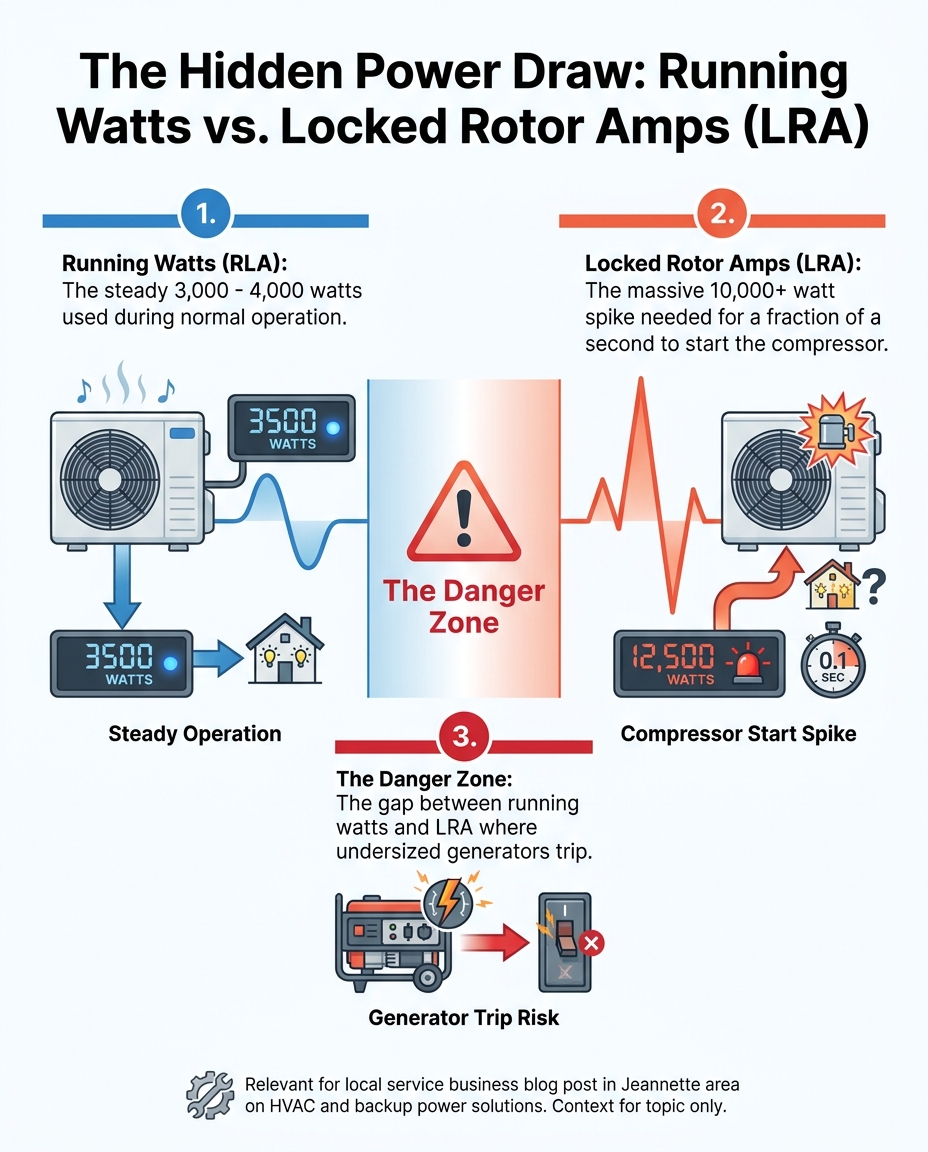
The Problem: Homeowners frequently purchase a standby generator based on the "running watts" listed on their heat pump's specification sheet. When the power goes out, the generator handles the baseline load just fine, but instantly overloads and shuts down the moment the compressor tries to start.
The Cause: There is a massive, hidden power draw required to overcome the mechanical inertia of an HVAC compressor. This instantaneous spike in electrical demand is known as the startup surge (Locked Rotor Amps), and it is vastly different from the power the system uses while it is already running.
To understand why this happens, we have to look at the two distinct electrical ratings that govern your heating and cooling equipment:
Running Load Amps (RLA) / Running Watts
Running watts represent the steady, continuous flow of electricity required to keep your heat pump operating once the compressor is already spinning. Think of this like cruising down the highway in a car; once you are up to speed, it takes a relatively consistent and moderate amount of fuel to keep moving forward. Generic generator sizing calculators online almost always use running watts to estimate your backup power needs, which creates a false sense of security.
Locked Rotor Amps (LRA) / Starting Watts
Locked Rotor Amps (LRA) is the momentary, massive surge of electricity needed for a fraction of a second to start the compressor from a dead stop. Returning to the car analogy, LRA is the equivalent of trying to push a heavy, parked car from a standstill. The initial effort required to break the inertia is immense. For a heat pump, the compressor motor is physically locked in place until that massive jolt of electricity forces it to turn. This startup surge can be three to five times higher than the running wattage.
The Solution: You must size your backup power solution—or modify your HVAC equipment—based on the LRA, not the running watts. Failing to account for this hidden danger is the number one reason backup power systems fail during winter emergencies.
• Running Watts (RLA) — What It Measures: Steady power used during normal operation. — Duration: Continuous while heating/cooling. — Impact on Backup Generators: Easily handled by most standard standby generators.
• Locked Rotor Amps (LRA) — What It Measures: Massive electrical surge to start the compressor. — Duration: Less than one second. — Impact on Backup Generators: Causes voltage drops, engine bogging, and tripped breakers if undersized.
Why a 3-Ton Heat Pump Overloads Standard Standby Generators
To see exactly how this plays out during a power outage, let us look at the data for a typical residential heating system. Our technicians typically see standard 3-ton heat pumps—a very common size for homes we service in our area—hovering roughly between 3,000 and 4,000 running watts under normal operating conditions. If you look at a standard 10,000-watt (10kW) standby generator, you might logically assume you have more than enough capacity to run the heat pump, your refrigerator, and several circuits of lights.
However, the mechanical reality of the compressor tells a different story. When that 3-ton heat pump receives a signal from the thermostat to turn on, the compressor demands a startup surge (Locked Rotor Amps). For a system of this size, the LRA demand can easily exceed 10,000 to 15,000 watts during that initial fraction of a second.
The Mechanics of a Generator Overload
When the heat pump demands 15,000 watts instantly, and the generator is only capable of producing a maximum surge of 10,000 or 12,000 watts, a specific sequence of events occurs:
1. Voltage Drop: The generator's alternator struggles to meet the massive electrical draw, causing the voltage across your home's electrical panel to plummet.
2. Frequency Fluctuation: The physical engine driving the generator bogs down under the heavy magnetic load, causing the electrical frequency to drop below the standard 60 Hertz.
3. Protective Tripping: The generator's onboard circuit breaker detects the massive current draw and the dropping voltage. To prevent the alternator from melting down or the engine from stalling, the breaker trips, severing power to the house.
This is not just an electrical problem; it is a highly specific technical HVAC hurdle. A pattern we see often is sizing a generator solely on the electrical panel's load calculations without understanding the mechanical demands of a scroll compressor, which leads directly to cold nights and frustrated homeowners.
The Compounding Danger of Emergency Heat Strips in Extreme Cold
The situation becomes even more complex when extreme winter weather hits Western Pennsylvania. Heat pumps are incredibly efficient at transferring heat from the outside air into your home, but as temperatures plummet toward single digits, their efficiency drops. To compensate, the system relies on auxiliary or emergency heat strips to keep the indoor temperature comfortable.
These heat strips are fundamentally different from the compressor. They act as massive electrical resistance heaters—essentially functioning like giant versions of the glowing coils inside a toaster. Unlike the compressor, which has a massive startup surge but a lower running wattage, heat strips pull a massive, continuous amount of wattage the entire time they are active.
The worst-case scenario during a blizzard: Imagine a severe winter storm knocks out the power. Your home is freezing, so your thermostat automatically calls for emergency heat to warm the house quickly. The generator starts up. The heat strips activate, immediately drawing 5,000 to 10,000 watts of continuous power. A moment later, the heat pump compressor tries to start, demanding its massive 15,000-watt LRA surge on top of the heat strips' load. The combined electrical demand instantly crushes the generator's capacity, tripping the breaker.
Understanding how your thermostat stages these heating elements is critical. If you are experiencing frequent overloads during extreme cold, you may be dealing with heat pump emergency heat mode issues that require professional configuration to ensure your backup power can handle the load.
How an HVAC Professional Can Ease the Load with a Hard Start Kit
The Problem: Your existing generator cannot handle the massive startup surge (Locked Rotor Amps) of your heat pump, leaving you without reliable heating during an outage.
The Cause: The compressor motor requires a massive, instantaneous jolt of electricity to overcome its physical inertia, which simply exceeds the maximum surge capacity of the backup generator's alternator.
The Solution: Rather than spending thousands of dollars to upgrade to a massive, oversized generator, an HVAC professional can often solve this issue at the source by installing a hard start kit on the heat pump itself.
What is a Hard Start Kit?
A hard start kit is a specialized combination of a high-capacity start capacitor and a potential relay. You can think of it as a localized, high-voltage battery attached directly to your compressor. When the thermostat calls for heat, the hard start kit discharges its stored energy directly into the compressor motor. This provides the necessary jolt to break the mechanical inertia, significantly reducing the amount of starting amperage (LRA) drawn directly from the generator or the grid.
By absorbing the brunt of the startup surge, our team typically sees a hard start kit reduce the required starting wattage by 30% to 50%. This reduction is frequently exactly what is needed to allow a standard standby generator to start a 3-ton heat pump without tripping the breaker.
Professional Installation is Mandatory
At Cochran Heating & Cooling, we frequently talk with homeowners who assume their generator is defective, when in reality, their HVAC simply needs a hard start kit. Our precise technical knowledge of heat pump surge requirements allows us to adapt existing Westmoreland County residential HVAC setups for seamless backup power transitions. We know exactly how to match the microfarad rating of a capacitor to the specific tonnage and LRA of your compressor.
A critical safety warning: Installing a hard start kit involves interacting with high-voltage components that store lethal amounts of electrical energy, even when the power is turned off. This is never a do-it-yourself project. An improperly sized hard start kit can permanently destroy your compressor, void your equipment warranty, or cause serious electrical fires. This modification must be sized and installed exclusively by a licensed HVAC technician.
Assessing Your Westmoreland County Home for Backup Power Readiness
Before the next major freezing rain or snowstorm hits the local grid, you need to ensure your home is genuinely prepared. Relying on guesswork or generic online calculators for generator sizing is a recipe for disaster. The peace of mind that comes from knowing your heating system will seamlessly transition to backup power during a winter storm requires proactive, professional assessment.
Steps to ensure backup power readiness:
• Evaluate the Data Plate: Every heat pump has a manufacturer's data plate affixed to the outdoor cabinet. This plate lists the specific RLA and LRA ratings for your exact unit. When our technicians assess a home, we read these specifications to calculate your true surge requirements.
• Assess Auxiliary Heat Loads: Your technician will check the kilowatt rating of your emergency heat strips to determine how much continuous wattage they will demand during a severe freeze.
• Determine Hard Start Viability: Based on the LRA readings, a professional can determine if adding a hard start kit will sufficiently lower the surge to accommodate your current or planned generator size.
• Review System Efficiency: Older compressors often draw significantly higher LRA as their internal bearings wear down. If your system is aging and struggling to start, upgrading the equipment might be necessary.
If an assessment reveals that your current system is simply too old, inefficient, or electrically demanding for standard residential backup power, it may be time to consider a replacement. General energy rebates, federal tax credits, or local utility incentive programs may apply to qualifying high-efficiency heat pump upgrades, making it easier to transition to a modern system with lower starting requirements. We always advise readers to verify current programs and eligibility with a tax professional or their local utility provider.
Frequently Asked Questions About Standby Generators and Heat Pumps
What size generator do I need to run a 3 ton heat pump?
A 3-ton heat pump typically requires a generator in the 10kW to 15kW range, depending heavily on the startup surge. While the running watts are generally around 3,000 to 4,000, the LRA can dictate a much larger generator size. If your system utilizes a professionally installed hard start kit, you can often safely run the unit on the lower end of that capacity spectrum. Always have a professional evaluate your specific data plate before purchasing.
Why does my heat pump trip my generator?
Your heat pump trips the generator because its momentary startup surge (LRA) exceeds the generator's maximum output capacity. When the compressor tries to start, it demands a massive amount of electricity for a fraction of a second. If the generator cannot supply this instant demand, its internal breaker trips to protect the alternator and engine from catastrophic damage.
What is LRA on an HVAC unit?
Locked Rotor Amps (LRA) is the initial surge of electrical current required to get the compressor motor spinning from a dead stop. Because the motor is physically stationary (locked) before startup, breaking that mechanical inertia requires significantly more power than keeping the motor running. The LRA rating is always substantially higher than the running wattage.
Will a 10kw generator run a heat pump?
A 10kW generator can run a smaller heat pump, but success depends entirely on the system's LRA, whether auxiliary heat is active, and the presence of a hard start kit. While 10kW provides plenty of running wattage, a larger 3-ton or 4-ton unit's startup surge can easily exceed the generator's surge capacity, causing it to trip. Professional evaluation is required to know for sure.
Can a hard start kit prevent my generator from overloading?
Yes, a hard start kit can prevent overloading by reducing the sudden electrical demand on the generator during the compressor's startup phase. By discharging stored energy directly into the compressor, the kit acts like a booster, lowering the LRA pulled from the generator by up to 30% to 50%. This is often the most practical solution for overload issues.
Do I need an HVAC technician to install a hard start kit?
Absolutely. You need a licensed HVAC technician to properly size and install a hard start kit. The process involves handling high-voltage capacitors that can hold lethal charges even when the power is off. Furthermore, installing the wrong size kit can permanently damage your compressor and void your manufacturer warranty.
Schedule a Professional HVAC Assessment Before the Next Outage
Proper preparation is the only way to prevent freezing pipes and the total loss of climate control during a winter grid failure. Waiting until the power goes out to discover that your standby generator cannot handle your startup surge (Locked Rotor Amps) is a stressful and dangerous position to be in.
Do not guess when it comes to your home's safety and comfort. You need a clear understanding of your starting watts versus your running watts, and that requires professional guidance. Schedule an inspection with our local Cochran Heating & Cooling experts to determine your true starting wattage requirements, evaluate your heat pump's data plate, and decide if a hard start kit is the right solution for your home. Ensure your system is ready to handle the load before the next storm hits.