Can I Run My Heat Pump if the Outdoor Unit is Covered in Ice?
Is It Safe to Run a Heat Pump Covered in Ice?
Are you wondering, "Can I run my heat pump if the outdoor unit is covered in ice?" after waking up to a harsh Pennsylvania winter freeze? At Cochran Heating & Cooling, this is one of the most common emergency questions our team receives. You step outside, look at your outdoor condenser, and find it completely encased in a thick, solid block of ice. The fan is struggling to spin, the metal is groaning, and your house is slowly losing heat. It is a stressful moment that forces an immediate decision: do you try to chip the ice away, let the system keep running, or switch your thermostat to emergency heat?
The short answer is: No, it is not safe to run your normal heat pump cycle if the outdoor unit is completely encased in ice. You must intervene to protect the equipment.
During a severe winter cold snap, especially when freezing rain sweeps through, moisture can coat an outdoor unit faster than the system can melt it off. While a light dusting of white frost is entirely normal, a solid block of ice is an emergency. If you allow the system to continue running its standard heating cycle while buried in ice, you risk catastrophic damage to the internal components. Instead of panicking or reaching for a snow shovel, your first priority is to switch the system to emergency heat. This action keeps your family warm while you safely assess the situation and prevent costly potential damage.
The Immediate Answer: What to Do Right Now
If your heat pump is completely encased in ice, switch your thermostat to emergency heat immediately. Do not wait to see if the ice will melt on its own, and do not let the system continue to strain against the blockage. Taking swift action protects your home's heating equipment from permanent failure.
Our team's priority is providing honest, transparent guidance that protects your equipment and keeps your family warm, rather than rushing you into an immediate sales pitch. Here is exactly what you need to do right now:
1. Turn on Emergency Heat: Go to your indoor thermostat and switch the system from "Heat" to "Emergency Heat" (often labeled as EM Heat). This shuts down the frozen outdoor unit and activates your indoor backup heating system.
2. Perform a Visual Inspection: Walk outside and look at the unit from a few feet away. Note whether the ice is just on the metal fins, if it covers the top grille, or if the fan blades are frozen solid.
3. Do Not Touch the Unit: Keep your hands, tools, and hot water away from the machinery. Tampering with the ice can cause irreversible damage to the delicate internal coils.
4. Monitor the Indoor Temperature: Ensure your vents are blowing warm air from the backup heat source. As long as your house is staying warm, you have stabilized the situation.
Why running a frozen unit is dangerous: A heat pump works by pulling ambient heat from the outside air and transferring it indoors. When a solid block of ice covers the metal fins, it completely cuts off the airflow. The system cannot pull any heat from the air. Worse, the fan motor will burn itself out trying to spin against the ice buildup, and the compressor can suffer a fatal mechanical failure due to liquid refrigerant returning to the pump. Shutting down the outdoor unit is the only way to prevent this chain reaction of damage.
Understanding the Difference: Normal Frost vs. Severe Ice Buildup
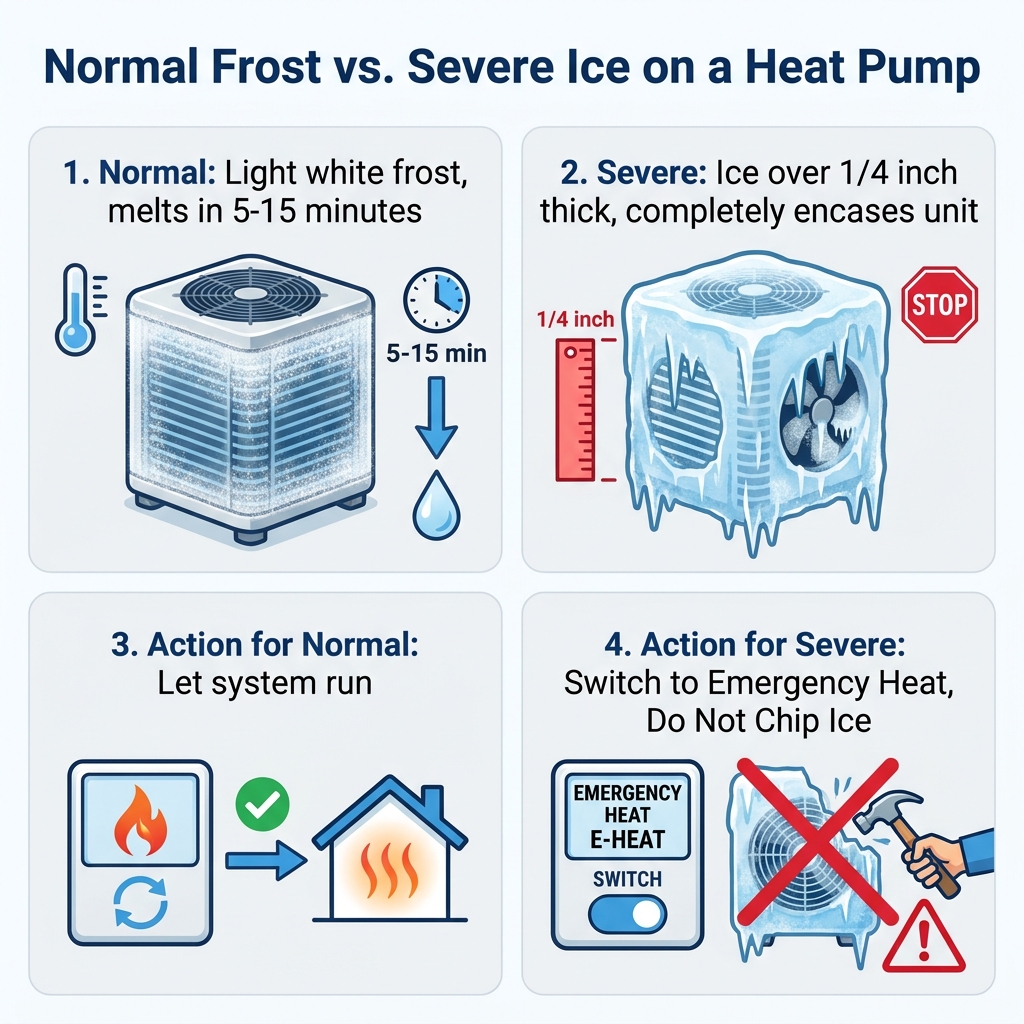
Most homeowners don't realize that a little bit of frost on a heat pump is actually a sign that the system is working exactly as designed. Because the refrigerant inside the outdoor coils is colder than the winter air outside, condensation naturally forms on the metal fins. When the outdoor temperature drops below freezing, that condensation turns into a thin layer of white frost.
However, there is a massive difference between normal frost and a severe ice buildup that threatens your system. Knowing how to tell the two apart can save you from a late-night panic.
• Normal Frost — Visual Appearance: A thin, light white coating resembling powdered sugar on the sides of the unit. — What It Means: The system is successfully extracting heat from the cold winter air. — Required Action: Do nothing. The system will melt it automatically within 15 minutes.
• Severe Ice — Visual Appearance: Solid, clear, or milky ice thicker than 1/4 inch; fan blades frozen; unit looks like an ice cube. — What It Means: The defrost cycle has failed, or extreme weather has overwhelmed the system. — Required Action: Switch to Emergency Heat immediately and call a professional.
How the Defrost Cycle Works
To handle normal frost, your heat pump is equipped with an automatic defrost cycle. When sensors detect that the coils are getting too cold or airflow is restricted by frost, the system temporarily reverses its operation. It shifts into air conditioning mode for just a few minutes.
This might sound counterintuitive in the middle of winter, but it serves a specific purpose. By reversing the flow of refrigerant, the system sends hot, high-pressure gas from inside your home directly into the outdoor coils. The outdoor fan stops spinning to allow the heat to build up rapidly, melting the frost away. Once the ice is gone, the system switches back to heating your home. If you notice a cloud of steam rising from your outdoor unit on a cold morning, that is simply the defrost cycle doing its job. However, if this cycle breaks down, you will quickly experience heat pump defrost cycle problems that lead to a solid block of ice.
Why You Must Never Chip Ice Off Your Heat Pump
When you see your expensive heating equipment buried under a layer of ice, the natural instinct is to clear it away as quickly as possible. Many homeowners head straight to the garage to grab a snow shovel, an ice pick, a screwdriver, or a hammer. You must resist this urge completely.
In our years of experience servicing heat pumps across PA, the technicians at Cochran Heating & Cooling have seen countless ruined systems caused by a homeowner attempting DIY ice removal. The components inside your outdoor unit are incredibly fragile and are not built to withstand blunt force.
• Fragile Aluminum Fins: The exterior of your heat pump is surrounded by thousands of thin aluminum fins. These fins are roughly the thickness of a soda can. Hitting them with a tool will instantly crush them flat, permanently destroying the unit's ability to pull air through the coils.
• Vulnerable Copper Coils: Hidden just beneath those fins are pressurized copper tubes carrying chemical refrigerant. One slip of an ice pick or a heavy strike from a shovel can puncture these coils. A punctured coil results in a catastrophic refrigerant leak, turning a simple freezing issue into a total system failure that often requires replacing the entire outdoor unit.
• The Danger of Hot Water: Another common mistake is pouring buckets of boiling or hot water over the frozen unit. While this might melt the top layer of ice temporarily, the water quickly runs down into the base pan and refreezes. This creates a much thicker, harder layer of ice around the base of the fan and the compressor, making the original problem significantly worse.
Never attempt to physically break the ice off your unit. The risk of destroying the equipment is simply too high.
How Safely Keep Your Home Warm: Switching to Emergency Heat
If you cannot run the heat pump and you cannot chip the ice away, how do you keep your house from freezing? This is exactly why your system is equipped with an emergency heat setting. Activating this feature is the safest way to maintain your indoor comfort while protecting your outdoor equipment.
Emergency heat (EM Heat) is designed specifically for situations where the outdoor heat pump fails, freezes, or cannot keep up with extreme winter temperatures. When you activate this setting, the thermostat sends a signal to completely shut down the outdoor unit. It then engages a secondary, backup heating source located entirely inside your home. In most setups, this backup source consists of high-powered electric resistance heating strips tucked inside your air handler, though some homes use a backup gas or oil furnace.
How to activate your emergency heat:
1. Locate your central thermostat on the wall.
2. Navigate to the system mode settings (where you normally choose between Heat, Cool, and Off).
3. Select the option labeled "Emergency Heat" or "EM Heat." You may see a red indicator light turn on.
4. Set your desired indoor temperature.
Once activated, the outdoor unit will go completely silent, and warm air will continue blowing from your indoor vents. While electric heating strips do consume more electricity than the normal heat pump cycle, running them for a few days is vastly preferable to replacing a destroyed outdoor compressor. This feature gives you the time you need to wait for the weather to warm up or for a professional technician to arrive.
Common Causes of Severe Heat Pump Freezing in Our Area
In Jeannette and across Westmoreland County, our specific winter weather patterns make heavy ice accumulation a common local HVAC emergency. Our team at Cochran Heating & Cooling knows firsthand that understanding why your system froze solid can help you prevent it from happening again.
When Weather is the Culprit
Sometimes, the machine is functioning perfectly, but Mother Nature simply overwhelms it. In Western Pennsylvania, we frequently experience winter weather events where heavy precipitation is immediately followed by a rapid, severe temperature drop. Freezing rain, sleet, or heavy, wet snow can coat the outdoor unit in a thick layer of moisture. If the temperature plummets before the system's defrost cycle has a chance to trigger, that moisture turns into a solid block of ice.
Additionally, high winds can blow snowdrifts directly against the sides of the condenser. If extreme weather is the sole cause, the ice will often melt naturally once the sun comes out and temperatures rise slightly above freezing.
When the System Needs Repair
If the weather has been clear and dry, but your unit still looks like a glacier, you are likely dealing with a mechanical or systemic failure. These issues require professional diagnosis:
• Restricted Airflow: Heat pumps need massive amounts of air to function. If the unit is choked by unraked fall leaves, overgrown winter brush, or a clogged indoor air filter, the system will run too cold and freeze over.
• Broken Defrost Controls: The automatic defrost cycle relies on a circuit board, a reversing valve, and temperature sensors. If any of these components fail, the system will never realize it needs to melt the frost, allowing ice to build up endlessly.
• Failing Fan Motors: If the outdoor fan motor dies, air stops moving across the coils entirely, causing immediate and severe freezing.
• Refrigerant Issues: A low refrigerant charge—usually caused by a small leak in the copper lines—changes the pressure inside the system. This pressure drop causes the coils to become much colder than they should be, turning normal winter moisture into rapid ice accumulation. Only a licensed technician can safely handle and recharge chemical refrigerants.
Frequently Asked Questions About Frozen Heat Pumps
Should I turn off my heat pump if it's frozen?
Yes, you should immediately stop running the normal heating cycle if the outdoor unit is completely encased in ice. Continuing to run a frozen heat pump forces the compressor and fan motor to work against a solid blockage, which can cause severe mechanical damage. Instead of turning the system completely "Off," switch your thermostat to the "Emergency Heat" setting to keep your home warm safely.
Is it normal for a heat pump to have ice on it in winter?
A light layer of white frost is completely normal during winter operation. Because the outdoor coils are colder than the surrounding air, condensation forms and freezes on the metal fins. Your system is designed to handle this light frost by automatically running a defrost cycle every 30 to 90 minutes.
How do I safely get ice off my heat pump?
The only safe way to remove severe ice is to let it melt naturally or rely on a professional technician. Never use shovels, ice picks, or blunt objects to chip the ice, as this will puncture the fragile refrigerant coils and destroy the unit. You should also avoid pouring hot water on the unit, as it can quickly refreeze into a thicker layer.
Does emergency heat defrost the outside unit?
No, the emergency heat setting does not actively defrost the outdoor unit. Emergency heat completely bypasses the outdoor equipment and relies solely on secondary heating strips or a backup furnace located inside your home. Activating it simply prevents further damage to the outdoor unit while you wait for the ice to melt on its own.
Can pouring warm water on a heat pump melt the ice safely?
Pouring warm or hot water over a frozen heat pump is highly discouraged. While it might melt the surface ice, the water quickly drips down into the base of the unit and refreezes as it hits the freezing metal and cold air. This creates a solid block of ice around the delicate fan blades and compressor base.
How long does a normal heat pump defrost cycle take?
A standard defrost cycle typically takes between 5 and 15 minutes to complete. During this brief window, the outdoor fan will stop spinning, and you may hear a shifting noise as the system temporarily reverses to melt the frost. Once the ice is cleared, the system automatically resumes its normal heating operation.
Get Professional Help for Your Frozen Heat Pump
Waking up to a frozen outdoor unit is alarming, but knowing how to react makes all the difference. While a light dusting of frost is nothing to worry about, a system completely encased in a block of ice demands immediate attention. By switching your thermostat to emergency heat, you ensure that your family stays warm without putting your expensive outdoor equipment at risk of catastrophic failure.
Remember, ignoring a severe ice buildup or attempting dangerous DIY ice removal will only lead to bigger problems. If the ice does not melt naturally after the weather clears, or if your system freezes repeatedly during dry weather, it is time to bring in an expert. Schedule a professional inspection with the experts at Cochran Heating & Cooling who understand the unique challenges of regional winter weather. They can safely diagnose the root cause—whether it is a faulty defrost board, restricted airflow, or a refrigerant leak—and get your main heating system running reliably again.