Emergency HVAC Access During Westmoreland County Snowstorms
The Hidden Cause of Heating Restoration Delays During Winter Storms
The thermostat is dropping, the house is freezing, and you are anxiously watching the street for a service van. Ensuring emergency HVAC access during Westmoreland County snowstorms is often the most stressful part of a sudden winter breakdown. Most homeowners assume that the biggest hurdle to getting their heat restored is the condition of the icy roads. However, the reality of winter service calls is much different. At Cochran Heating & Cooling, a pattern we see often is that the most significant delay occurs right in your own front yard.
When peak winter blizzards strike the region, our technicians frequently arrive at properties only to find equipment completely buried under heavy drifts. Whether you are scheduled for a complex professional furnace installation or an urgent midnight repair, a technician cannot safely begin work until they have clear physical access to the home, the utility meters, and the exterior HVAC units. The time spent digging out equipment is time not spent diagnosing the actual mechanical failure.
There is a critical preparation window between the moment you call for emergency service and the moment the van pulls up to your curb. By understanding what a technician needs to safely access your property, you can eliminate hours of potential delays. Taking proactive steps to clear specific pathways and utility access points ensures that the moment help arrives, the focus remains entirely on restoring your home's heat.
Navigating Westmoreland County Logistics During a Blizzard
Over our years of experience dispatching from our Jeannette office, our team has seen how severe winter weather fundamentally changes how service routes operate. The heavy, wet snow typical of Western Pennsylvania creates unique logistical challenges that rapidly bury ground-level utilities and compound access issues across the region. We prioritize transparent communication with our customers because we want you to understand exactly why response times fluctuate during peak storms and how we prioritize community care through realistic updates.
When a blizzard hits Westmoreland County communities like Greensburg, Latrobe, and Murrysville, the entire operational timeline shifts. A service call that normally takes one hour to complete can easily stretch into three hours if the property is not prepared for a technician's arrival. This creates a domino effect, pushing back service times for every subsequent homeowner waiting in the cold.
The Reality of the One-Hour Service Radius
Our standard service radius at Cochran Heating & Cooling covers approximately one hour of travel from Jeannette, but during a severe weather event, those travel times easily double or triple. Plows prioritize main arteries, leaving secondary residential streets treacherous. When our technicians finally navigate these difficult roads and arrive at a home, a buried driveway or unplowed walkway adds another 30 to 60 minutes to the emergency call before the diagnostic process even begins.
Back-to-back calls requiring on-site snow removal severely limit the number of families we can help in a single day. Proactive community care relies on a partnership between homeowners and technicians. When you clear the way before we arrive, you not only speed up your own repair, but you also help us reach the next freezing family that much faster.
Why Clear Driveways and Walkways Are Critical for Diagnostics
It is easy to underestimate the sheer volume of equipment required to diagnose and repair a modern heating system. Our team typically sees that homeowners don't realize an HVAC technician does not simply walk up to your front door with a single wrench. They must transport sensitive diagnostic tools, heavy replacement parts, and specialized safety gear from their service van to your basement or utility closet.
Ignoring these fundamental access points directly contributes to delaying a 24-hour HVAC repair call. If a technician is forced to park on the street because a driveway is impassable, the physical distance between the van and the furnace becomes a major logistical bottleneck.
Safe Equipment Transport
The physical weight: Technicians carry heavy recovery machines, vacuum pumps, nitrogen tanks, and dense tool bags. Carrying 50 to 80 pounds of gear across an icy, unplowed yard is dangerous and inefficient.
Slip hazards: Icy pathways covered by fresh snow are prime locations for severe slip-and-fall injuries. An unsafe walking condition not only risks the technician's safety but also risks dropping and destroying expensive, calibrated diagnostic equipment.
Reducing On-Site Diagnostic Time
Multiple trips: Diagnosing a complex heating failure often requires multiple trips back to the service van to retrieve specific multimeters, replacement motors, or specialized torches. If the van is parked a block away due to unplowed street access, every trip adds 10 to 15 minutes to the repair timeline.
Accelerated timelines: A freshly cleared driveway allows the technician to back the service van directly up to the garage or walkway. This proximity drastically reduces transition time, allowing the technician to focus entirely on testing electrical circuits and replacing failed components.
The Severe Risks of Snow-Buried Gas Meters
During heavy snowfall, your exterior natural gas meter is highly vulnerable to becoming buried. In our local service area, we frequently encounter this severe functional and safety hazard. Gas meters are designed with specific regulators and vents that require proper ambient air exposure to function correctly.
• Appliance Malfunction — The Mechanical Cause: Buried regulators fail to manage incoming gas pressure, starving the furnace of fuel. — The Safe Solution: Maintain a clear perimeter around the meter so the regulator can sense atmospheric pressure.
• Carbon Monoxide Buildup — The Mechanical Cause: Snow blocking the meter's relief vent forces excess pressure or gas back into the home. — The Safe Solution: Keep the vent opening completely free of snow and ice accumulation at all times.
• Physical Equipment Damage — The Mechanical Cause: Heavy, wet snow loads or falling ice from the roof crack the piping or meter casing. — The Safe Solution: Gently brush snow off the meter by hand or with a soft broom—never kick it or use a hard shovel.
When the regulator vent is blocked by compacted snow, the meter cannot accurately adjust the gas pressure entering your home. This pressure regulation failure will cause your furnace to run erratically, fail to ignite, or shut down entirely. More importantly, if the system cannot vent properly outside, you face a severe risk of carbon monoxide building up inside your living space. Always clear your meter gently; striking the pipes with a metal shovel can cause a catastrophic gas leak.
High-Efficiency Furnaces and Blocked PVC Exhaust Vents
One of the most common reasons our dispatchers field "no heat" calls during a blizzard has nothing to do with a broken internal component. High-efficiency furnaces (typically those rated 90% AFUE or higher) do not vent exhaust up a traditional metal chimney. Instead, they vent exhaust gases and pull fresh intake air through white PVC pipes that exit the side or back of your house, often quite close to ground level.
When drifting snow piles up against the side of your home, these low-profile vents are easily blocked. If this happens, you might not actually need professional furnace repair at all—you may just need a shovel.
Locating Your PVC Vents
Identifying the pipes: Walk the exterior perimeter of your home and locate two white PVC pipes protruding from the siding or foundation. One is the exhaust vent, and the other is the fresh air intake.
Clearing the perimeter: You must ensure a completely clear perimeter around both pipes. Even a partial blockage caused by a snowdrift or a layer of freezing rain can restrict airflow enough to trigger a system shutdown.
The Mechanics of the Safety Shutoff
Detecting a blockage: Modern high-efficiency furnaces are equipped with sensitive pressure switches. These switches constantly monitor the draft inside the PVC exhaust pipe. If snow blocks the exit, the pressure inside the pipe changes instantly.
Automatic shutdown: The moment the pressure switch detects this blockage, it opens the electrical circuit and cuts power to the gas valve. The furnace will automatically shut down to prevent deadly carbon monoxide from backing up into your basement. Bypassing this safety feature is never an option. Fortunately, simply clearing the snow away from the exterior pipes and resetting the system can sometimes restore heat instantly.
Heat Pump Clearance Requirements for Proper Defrost Cycles
Heat pumps offer excellent efficiency, but they require specific exterior conditions to operate correctly during freezing weather. Unlike a gas furnace tucked safely inside a basement, the outdoor portion of a heat pump is fully exposed to the elements. During a snowstorm, the unit must remain clear to facilitate proper airflow and essential mechanical cycles.
Maintaining proper clearance around this equipment is a critical part of preventative HVAC maintenance in Westmoreland County. We regularly advise our customers that a heat pump works by absorbing ambient heat from the outside air and transferring it indoors. If the unit is buried in snow, the restricted airflow prevents the system from absorbing any heat, rendering it useless.
The 18-Inch Clearance Rule
Creating a buffer zone: Heat pumps require a minimum of 18 to 24 inches of clearance on all sides to maintain adequate airflow. You must safely clear snow away from the top, sides, and base of the unit.
Protecting the defrost cycle: In freezing weather, heat pumps naturally accumulate a layer of frost on their exterior coils. The system handles this by entering an automatic defrost cycle, temporarily reversing its operation to melt the ice. However, if snow buildup is packed tightly around the base, the melted water has nowhere to drain. It will quickly refreeze into a solid block of ice, interfering with the fan blades, crushing the delicate exterior fins, and leading to a complete system freeze-up. When clearing this area, use a soft broom to avoid damaging the aluminum fins.
Your Pre-Arrival Snow Clearing Checklist
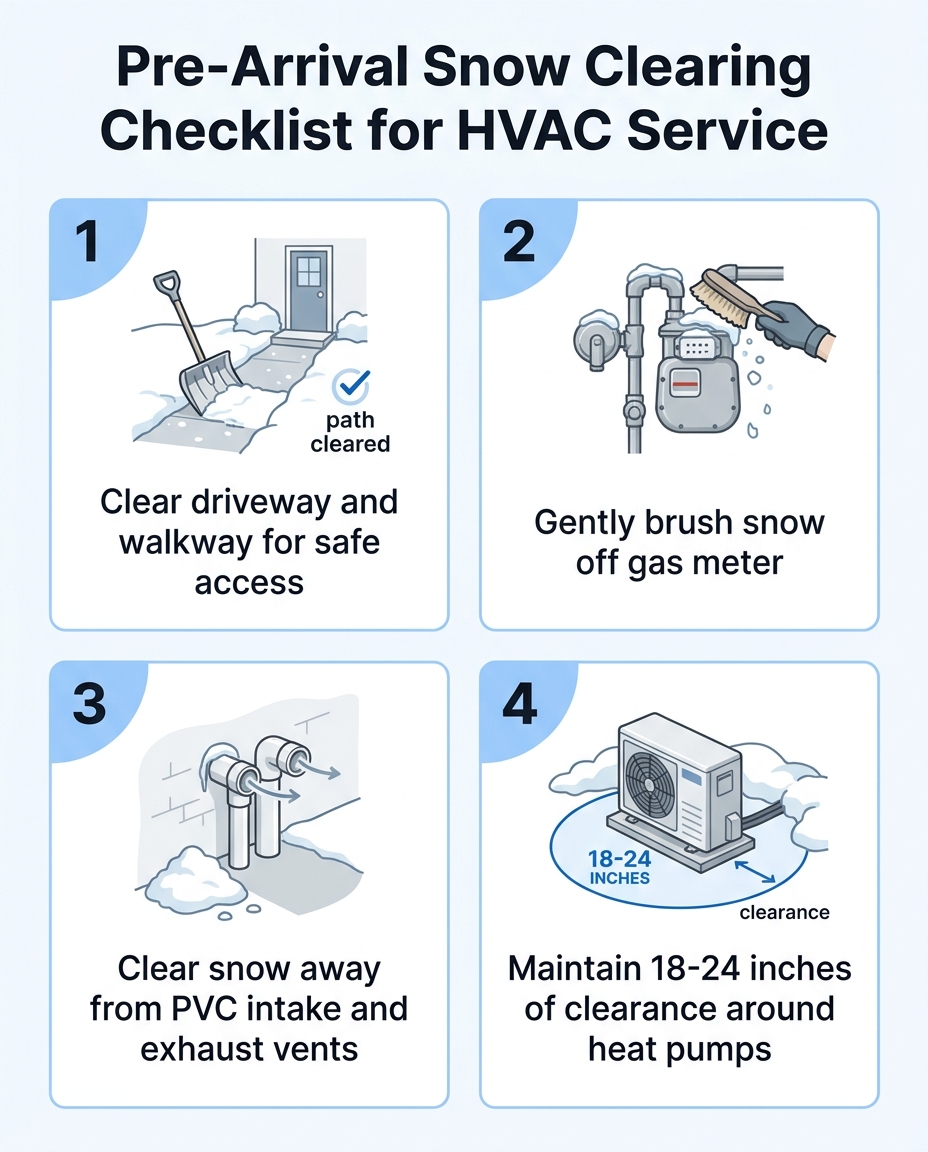
If your heating system fails during a severe winter storm, taking immediate action outside your home is just as important as checking your thermostat inside. Before a dispatched Cochran Heating & Cooling technician arrives at your property, complete this critical preparation checklist to ensure they can begin diagnostics immediately:
• Clear the driveway: Shovel and salt the driveway to allow the heavy service van to park as close to the house as possible, ensuring safe equipment transport.
• Shovel the main walkway: Create a safe, slip-free path from the driveway to your front door or basement utility entrance.
• Brush the gas meter: Gently remove snow from the gas meter using your hands or a soft broom, ensuring the regulator vent is completely unobstructed.
• Uncover PVC vents: Locate the exterior intake and exhaust pipes for your high-efficiency furnace and clear away any snowdrifts blocking the openings.
• Dig out the heat pump: Shovel a clear 18 to 24-inch buffer zone around the entire perimeter of your outdoor heat pump to allow for proper airflow and drainage.
Partnering with Your Local HVAC Team for Faster Winter Service
Surviving a severe winter storm in Western Pennsylvania requires preparation, vigilance, and a reliable support system. The logistical challenges of navigating heavy snow and freezing temperatures are immense, but a clear, realistic checklist of preparation directly impacts how quickly technicians can restore your heat. When you clear the physical barriers around your home, you allow our technicians to do what they do best: diagnose the mechanical issue and get your system running safely.
Our Jeannette-based team at Cochran Heating & Cooling is deeply committed to reaching your home safely, no matter what the radar looks like. We understand the stress of losing heat during a blizzard, and we work tirelessly to dispatch help across our service area as quickly as road conditions allow. If your furnace or heat pump fails during the next major storm, complete your outdoor clearing checklist, stay safe inside, and reach out for immediate HVAC service. We will partner with you to get your home warm again.
Frequently Asked Questions
What needs to be cleared of snow for an HVAC technician?
You must clear the driveway, main walkways, gas meter, exterior PVC exhaust vents, and outdoor heat pump units. A Cochran Heating & Cooling technician requires safe, slip-free access to transport heavy diagnostic equipment from their van to your utility room. Clearing these specific areas prevents lengthy delays upon arrival, allowing the technician to immediately begin testing your system rather than shoveling snow.
How do I safely remove snow from my gas meter?
The safest way to remove snow from a gas meter is to gently brush it away using your hands or a soft-bristled broom. You should never use a metal shovel, ice pick, or hard tool, as striking the pipes can crack the casing or cause a severe gas leak. Ensure the regulator vent remains completely unobstructed so the meter can properly read atmospheric pressure.
Why did my high-efficiency furnace stop working during a blizzard?
High-efficiency furnaces often shut down during blizzards because drifting snow blocks their exterior PVC exhaust or intake pipes. When these low-level vents are buried, a sensitive internal pressure switch detects the restricted airflow and cuts power to the gas valve. This is a critical safety feature designed to prevent deadly carbon monoxide from backing up into your living space.
Does snow affect my gas meter's pressure?
Yes, heavy snow accumulation can severely affect your gas meter's ability to regulate pressure. The meter relies on a small relief vent exposed to ambient air to manage the flow of natural gas into your home. If this vent is packed with wet snow or ice, the regulator fails, which can starve your furnace of fuel or push excess pressure into the house.
How much clearance does a heat pump need during a snowstorm?
A heat pump requires a minimum clearance of 18 to 24 inches on all sides to function efficiently during winter weather. This buffer zone ensures the unit has adequate airflow to absorb ambient heat from the outdoor environment. It also provides the necessary space for melted water to drain away during the system's automatic defrost cycle, preventing the unit from freezing into a solid block of ice.
Can a blocked exhaust vent cause carbon monoxide buildup?
Yes, a blocked exhaust vent is a primary cause of dangerous carbon monoxide buildup in residential homes. If the toxic exhaust gases generated by combustion cannot exit the building through the exterior pipes, they will eventually spill back into the basement or utility room. While modern furnaces have safety switches to shut the system down if a blockage is detected, keeping vents clear is vital for your family's safety.