Understanding the True Lifespan of an HVAC Air Purifier UV Bulb
The "Dummy Light" Dilemma: Why a Glowing UV Bulb Might Not Be Protecting Your Home
A glowing blue light inside your ductwork does not automatically mean your air is being purified, which is a critical detail when understanding the true lifespan of an HVAC air purifier UV bulb. Most homeowners trust their eyes. If a lightbulb in the living room is glowing, it is working. If the check engine light on your dashboard is off, the car is fine. We are conditioned to rely on visual cues to tell us when home systems are functioning properly. However, applying this same logic to the ultraviolet (UV) air purification system inside your ductwork creates a dangerous false sense of security. The visible blue glow you see is often just a "dummy light" that continues to shine long after the actual sanitizing power has faded away.
If you are looking to upgrade your home's defenses, exploring comprehensive indoor air quality solutions and modern indoor air products is the best place to start.
A typical pattern we see is a homeowner scheduling their September pre-heating tune-up, peering into the HVAC cabinet, and seeing that familiar bright blue light spilling out from the purifier. Because the bulb is still glowing, they assume the air circulating through their home is actively being scrubbed of mold spores, bacteria, and viruses. They decide to skip replacing the bulb for another year, thinking they are saving money while remaining fully protected.
The problem: That visible light is deceiving you. The technology that produces the blue glow is entirely separate from the invisible energy wave that actually neutralizes airborne pathogens. Relying on sight alone means you might be heading into the peak cold and flu season with a system that is doing absolutely nothing to clean your air. To understand why this happens, we have to look past the visible spectrum and explore the physics behind how these bulbs actually degrade over time.
Demystifying the Spectrum: Visible Glow vs. Invisible Germicidal Power
To understand why your UV air purifier might be failing you, we have to separate what you can see from what actually cleans the air. The bright blue light emitting from your HVAC system is just a harmless byproduct. Inside the casing of a UV lamp, manufacturers use specific gases—typically a mixture containing argon and mercury vapor. When an electrical current passes through these gases, they ignite and produce a visible blue or purple glow. This glow is entirely harmless to bacteria and viruses. It is simply the mechanical reaction of the gases being electrified.
The true germicidal effectiveness of an ac air purification system relies on an entirely different part of the electromagnetic spectrum: UVC light. Specifically, these systems are engineered to produce UVC radiation that peaks at a wavelength of 254 nanometers. This specific wavelength is highly destructive to microscopic organic matter. However, the human eye cannot see 254-nanometer UVC light. It exists completely outside our visual spectrum.
The disconnect: Because the invisible UVC energy and the visible blue gas glow are produced simultaneously, homeowners link them together. The reality is that the gases inside the bulb will continue to produce a visible blue glow long after the bulb's ability to generate 254-nanometer UVC light has completely burned out. You can have a bulb that lights up your entire ductwork in bright blue, yet emits zero pathogen-killing UVC radiation.
The Physics of Your AC Air Purifier HVAC System
How exactly does that invisible UVC light protect your home? When airborne contaminants like mold spores, bacteria, and viruses pass through the HVAC system, they are exposed to the UVC radiation. The 254-nanometer light penetrates the cellular walls of these microorganisms and scrambles their DNA and RNA. Once their genetic code is disrupted, the pathogens are instantly sterilized. They can no longer reproduce, infect your family, or colonize on your indoor cooling coils.
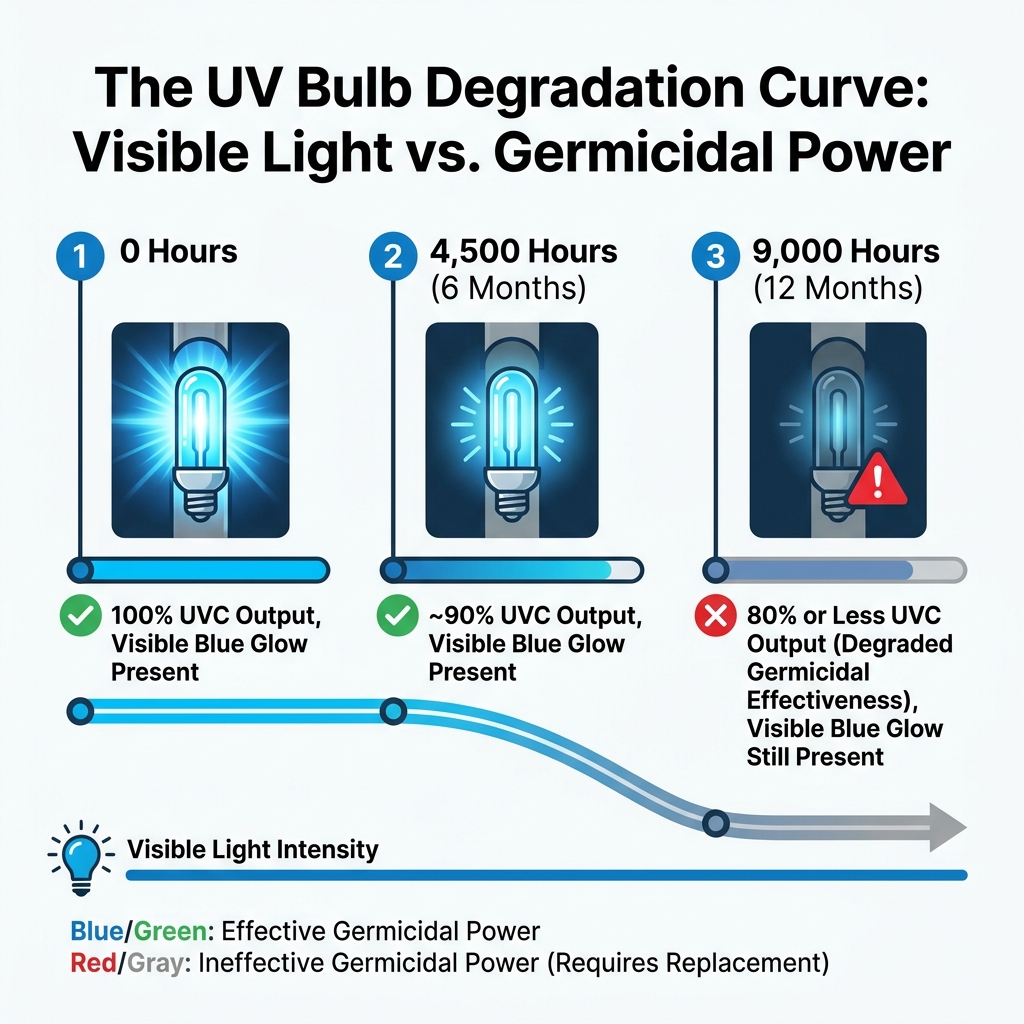
This process requires a highly concentrated, powerful dose of UVC energy. Unfortunately, the materials inside the lamp that generate this specific invisible wavelength degrade much faster than the gases producing the visible light. While the blue glow might last for years, you only get about 9,000 hours (approx 12 months) of effective UVC output before the sanitizing power drops below useful levels.
• What creates it? — Visible Blue Glow: Electrified argon and mercury gases — Invisible UVC Light (254 nm): Specialized quartz glass and internal coatings
• Can you see it? — Visible Blue Glow: Yes, highly visible — Invisible UVC Light (254 nm): No, completely invisible to the human eye
• Does it kill germs? — Visible Blue Glow: No, it is purely cosmetic — Invisible UVC Light (254 nm): Yes, it destroys pathogen DNA and RNA
• How long does it last? — Visible Blue Glow: Often 2 to 3 years before burning out — Invisible UVC Light (254 nm): Degrades significantly after 9,000 hours (12 months)
• Reliability as an indicator? — Visible Blue Glow: None (The "Dummy Light") — Invisible UVC Light (254 nm): Requires tracking hours of operation or professional metering
The 9,000-Hour Reality: How Fast Does a UV Bulb Degrade?
An HVAC UV air purifier bulb typically has a true lifespan of 9,000 to 12,000 hours, or about 12 months of continuous use. After this time, the invisible UVC spectrum degrades and loses its germicidal effectiveness, even if the bulb continues to emit a visible blue glow. This is the most critical scientific reality homeowners need to understand about their indoor air quality systems.
The degradation curve of a UVC lamp is steep. According to standards and testing related to Ultraviolet Germicidal Irradiation (UVGI), these specialized bulbs lose roughly 15% to 20% of their germicidal energy the moment they cross the 9,000-hour threshold. While 80% effectiveness might sound adequate, the speed of air moving through your ductwork means that pathogens are only exposed to the light for a fraction of a second. The UVC output must be at peak intensity to successfully penetrate and destroy the DNA of a virus moving at high speeds. Once the bulb degrades past that 12-month mark, it transitions from a powerful air purifier to merely a blue nightlight sitting inside your ductwork.
Staying on top of this degradation curve is a vital part of comprehensive HVAC system care. If you wait until the visible blue light burns out completely—which could take two or three years—your home has been circulating unprotected, unpurified air for a very long time.
Tracking Continuous Operation
You might be wondering how 9,000 hours translates to real-world usage. The math is surprisingly straightforward because UV air purifiers are designed to run constantly. There are 8,760 hours in a standard calendar year. Therefore, 9,000 hours equates almost perfectly to 12 months of continuous, 24/7 operation.
• Why 24/7 operation is necessary: UV bulbs in an ac air purifier hvac setup are generally wired to remain on continuously, even when the blower motor isn't running.
• Coil protection: Continuous operation prevents mold and bacterial growth from taking hold on the dark, damp surfaces of your evaporator coil.
• Preventing cycling damage: Turning a UV bulb on and off every time the thermostat calls for air actually degrades the filament much faster than leaving it on constantly.
Because the system runs non-stop to protect your equipment and your air, the 12-month replacement cycle is a hard, mathematical rule, not just a manufacturer's suggestion.

Why a Degraded Bulb is a Hidden Risk for Tightly Sealed Homes
Understanding the physics of a degrading UV bulb is only half the equation. The other half is understanding the environment you live in. Modern homes are built to be highly energy-efficient. To keep utility bills low, builders focus on creating a tight "envelope"—sealing up drafts, adding heavy insulation, and installing high-performance windows. While this is fantastic for keeping heated or cooled air inside, it creates a massive challenge for indoor air quality.
When a home is tightly sealed, there is very little natural fresh air ventilation. The air inside your house is continuously recirculated through the return vents, into the HVAC system, and back out into your living spaces. Without a fully functional ac air purification system to scrub that air, airborne contaminants, pet dander, volatile organic compounds (VOCs), and flu viruses become trapped. They compound and multiply over time.
In Jeannette, PA, homes are tightly sealed against freezing winters, eliminating natural ventilation entirely for months at a time. This makes a fully functional, non-degraded UV bulb absolutely essential for neutralizing trapped indoor airborne pathogens year-round. If you enter the winter season with a degraded bulb, you are essentially sealing your family inside a recirculating chamber of stale, contaminated air.
The Winter Indoor Air Quality Trap
The danger peaks just as the weather turns cold. During a September pre-heating tune-up, many homeowners ignore the age of their UV bulb because the weather is still mild and windows might still be open occasionally. But as freezing temperatures arrive, external air exchange is completely shut off.
This is where the "dummy light" trap becomes a genuine health concern. A homeowner sees the blue glow and assumes their family is protected during the peak of cold and flu season. In reality, because that bulb has passed its 9,000-hour lifespan, the invisible UVC spectrum has degraded. When a family member brings a winter virus home, the HVAC system simply picks it up and redistributes it to every other room in the house, unhindered by the weak, degraded UV light. The primary defense mechanism of the tightly sealed home has failed, even though it looks like it is working perfectly.
Beyond the Blue Glow: Evaluating Your AC Air Purification System
If you cannot trust your eyes to tell you when a UV bulb needs replacing, how do you manage your indoor air quality? The answer lies in shifting away from visual inspections and moving toward strict schedule tracking and professional verification. Relying on data rather than a blue glow is the only way to guarantee your ac air purification system is actually doing its job.
As family-owned HVAC professionals in Jeannette, Cochran Heating & Cooling prioritizes honest, transparent advice. We believe homeowners deserve to know exactly how their equipment works so they aren't relying on a "dummy light" when their family's air quality is at stake. Proper evaluation requires a proactive approach.
Setting a Reliable Maintenance Schedule
To ensure you always have 9,000 hours (approx 12 months) of effective UVC output, follow these concrete steps for tracking and evaluating your system:
1. Document the exact installation date: Never install a UV bulb without writing the date directly on the base of the unit with a permanent marker. Keep a secondary record near your thermostat or in your home maintenance log.
2. Set an 11-month calendar alert: Do not wait for the 12-month mark to start thinking about a replacement. Set a digital reminder for 11 months so you have time to source the correct bulb or schedule a service visit before the germicidal power drops off.
3. Request professional UV metering: During a routine maintenance visit, experienced technicians don't just look at the light. They can use specialized UVC meters to measure the exact nanometer output of the bulb, verifying scientifically whether it is still producing germicidal radiation.
4. Inspect the evaporator coil: If your UV system is mounted over the indoor coil (to prevent mold growth), a technician will check the physical condition of the coil. If biological growth is present despite a glowing blue bulb, it is absolute proof that the UVC spectrum has degraded and failed.
Ignoring this 12-month replacement cycle does more than just lower your air quality; it can lead to severe mold buildup inside your HVAC cabinet, which eventually restricts airflow, reduces heating efficiency, and forces your blower motor to work twice as hard.
Why Fall is the Optimal Time for UV Bulb Replacement
Timing is everything when it comes to home maintenance. While a UV bulb will degrade after 12 months regardless of what month you installed it, aligning that annual replacement cycle with your fall HVAC preparation offers distinct strategic advantages for your home's indoor air quality.
Handling this during a September pre-heating tune-up makes logical sense because it prepares your home's defenses right before they are tested the most. By replacing the bulb in early fall, you guarantee that the lamp is producing its absolute maximum 254-nanometer UVC output on the exact day you close your windows and seal the house for winter.
Combining your UV bulb replacement with a routine maintenance plan visit also saves you time. The technician is already opening the HVAC cabinet to clean the furnace burners, check the heat exchanger, and replace the standard media filter. Swapping the UV bulb at the same time ensures comprehensive system health without requiring a secondary service call mid-winter.
Maximizing Your UVC Investment
Think about how you use your home throughout the year. During the spring and summer, you might spend more time outdoors, and natural ventilation plays a larger role in your air quality. During the winter, you spend the vast majority of your time indoors, breathing recirculated air.
By resetting the 12-month clock in the fall, you align the peak performance window of the bulb—the first 4,000 to 5,000 hours where UVC output is at its absolute strongest—with the months you are most vulnerable to indoor air pollutants and winter viruses. If you wait until spring to replace an old bulb, you are wasting the strongest germicidal power on the months when your windows are open, and leaving your home vulnerable when winter returns.
Frequently Asked Questions About HVAC UV Light Effectiveness
How do I know if my HVAC UV light is working?
The only reliable way to know if your HVAC UV light is actively sanitizing the air is to track the installation date or have a professional measure the UVC output with a specialized meter. Because the invisible germicidal spectrum degrades after about 9,000 hours, you cannot rely on visual inspections. If the bulb has been operating continuously for more than 12 months, it is no longer working effectively, regardless of how it looks.
Why is my HVAC UV light still blue if it needs replacing?
The blue glow is merely a byproduct of gases like argon and mercury igniting inside the lamp casing. These gases continue to produce visible light long after the materials responsible for generating the invisible, pathogen-killing UVC spectrum have degraded. The blue light is essentially a "dummy light" that outlasts the actual sanitizing power of the bulb.
How often should you change the UV light in your HVAC?
You should replace the UV light in your HVAC system every 12 months (approximately 9,000 hours of continuous operation). Even if the bulb is still glowing brightly, the invisible UVC energy required to neutralize mold, bacteria, and viruses drops significantly after one year, leaving your home unprotected.
Does a UV light really work in an HVAC system?
Yes, when maintained properly, a UV light is highly effective at neutralizing airborne pathogens and preventing mold growth on HVAC coils. The 254-nanometer UVC radiation penetrates the cellular walls of microorganisms and destroys their DNA, preventing them from reproducing. However, this only works if the bulb is replaced annually before the germicidal spectrum degrades.
How does the UVC spectrum degrade over 9,000 hours?
Over 9,000 hours of continuous operation, the internal components and quartz glass of the lamp undergo solarization, which blocks the invisible UVC energy from escaping the bulb. After 12 months, the lamp loses roughly 15% to 20% of its germicidal intensity. Because air moves quickly through ductwork, this reduction in intensity means pathogens are no longer exposed to a high enough dose of UVC to be neutralized.
Secure Your Indoor Air Quality Before Winter Arrives
Understanding the true lifespan of an HVAC air purifier UV bulb protects your home from falling into the "dummy light" trap. When you know that visible blue light does not equal invisible UVC sanitization, you can make informed, proactive decisions about your family's health. You gain the peace of mind that comes from knowing your system is actively neutralizing pathogens, rather than just casting a useless blue glow over your ductwork.
As you prepare your home for the colder months, take a moment to check your records. If your bulb has been running since last winter, it is time for a change. We encourage you to verify your bulb's age during your September pre-heating tune-up and explore the latest indoor air products to ensure your tightly sealed home remains a safe, healthy environment all winter long.