Humidifier Attachments: Steam vs. Evaporative for Dry Pennsylvania Winters
Bracing for the Bitter Cold: Why Winter Demands Better Indoor Humidity
Before the first hard freeze hits Westmoreland County, evaluating Humidifier Attachments: Steam vs. Evaporative for Dry Pennsylvania Winters is the smartest step you can take for your home's indoor air quality. As temperatures drop, the air outside loses its ability to hold moisture. Once that frigid air enters your home and runs through your heating system, indoor humidity plummets well below the EPA's recommended 30% to 50% range. This notoriously cold and dry regional climate forces heating systems to run constantly, rapidly depleting whatever moisture is left in your living spaces.
In our years of servicing heating systems across the local area, our team has learned that solving this issue requires more than just a quick fix. The real decision comes down to choosing between a high-maintenance bypass evaporative humidifier and a higher-electrical-draw steam humidifier. You have to weigh the electrical operating cost of steam against the continuous water waste and regular pad maintenance of traditional evaporative systems. By looking at honest, long-term operational trade-offs rather than just upfront equipment features, you can make the best choice for your household.
If you are looking to upgrade your comfort before the freezing weather sets in, a closer look at your residential HVAC services can ensure your entire system is prepared to handle the dry Pennsylvania winters ahead.
The Toll of Heavy Heating Loads on Local Homes
To understand why standalone humidification is necessary, you have to look at the basic mechanics of winter air. Cold air simply holds less moisture than warm air. When your furnace pulls in this cold, dry air and heats it up, the air expands. Because its capacity to hold moisture has increased but no new moisture has been added, the heated air becomes incredibly thirsty. It aggressively pulls moisture from wherever it can find it—your hardwood floors, your wooden furniture, and even your skin and sinuses.
When our technicians visit Jeannette and Greensburg area homes during severe cold snaps, a pattern we see often is how constant furnace operation makes this problem much worse. The continuous heavy heating loads exacerbate dry, itchy skin, cause respiratory irritation, and can even lead to cracked wood fixtures around the house. Whole-home humidifier attachments are designed to integrate directly with your existing HVAC system to combat this continuous moisture loss, replacing the humidity that your furnace strips away.
Beyond personal comfort, this dry air also impacts your equipment. Understanding how humidity drops impact your HVAC blower motor is crucial, as dry air is denser and harder to push through ductwork, forcing your system to work overtime.
Why Portable Units Fall Short
We frequently hear from homeowners who try to solve winter dryness with small, plug-in humidifiers. Unfortunately, our team typically sees these portable units fall short in several key ways:
• Limited reach: Portable units only treat single rooms, leaving the rest of the house completely dry.
• Constant refilling: They require daily (or even twice-daily) manual refilling with distilled water.
• Inconsistent levels: They lack the precise control needed to keep the entire home within the safe 30% to 50% range.
In contrast, whole-home attachments treat the entire living space efficiently by distributing moisture directly through your central ductwork, providing a seamless solution for the whole family.
Bypass Evaporative Humidifiers: Mechanics and Maintenance Realities
Bypass evaporative humidifiers are one of the most common solutions installed in homes today. These systems rely on your furnace's heat and blower to distribute moisture. Here is exactly how the bypass mechanism works:
1. Air routing: A bypass duct routes a portion of the warm air from your furnace supply plenum into the humidifier.
2. Moisture absorption: This warm air passes through a water-soaked evaporator pad (often called a water panel).
3. Distribution: As the warm air absorbs moisture from the pad, it is routed back into the return duct to be circulated throughout your home.
While effective, this design comes with a significant drawback: continuous water waste. To keep the water panel clean and prevent stagnant water from pooling, fresh water constantly trickles over the pad while the unit is running. A large portion of this water never evaporates; instead, it flows straight down the drain.
Additionally, homeowners must face the reality of maintenance fatigue. In our extensive experience installing and servicing humidifier systems throughout Westmoreland County, we consistently see that homeowners must replace these water panels annually or even bi-annually. If you forget to perform this regular maintenance, the pad becomes calcified with hard water minerals or, worse, develops mold. A neglected evaporative pad renders the unit completely useless or unsanitary.
The Hidden Cost of Water Waste
The volume of drain-water generated by a bypass system can be surprising. For every gallon of moisture actually added to your home's air, several gallons may flow directly into your floor drain. While this continuous flushing is absolutely necessary to keep the evaporator pad clean and free of scale buildup, it directly impacts your household utility usage over a long winter.
Steam Humidifiers: Independent Operation and Electrical Demand
For homeowners looking for maximum control and performance, our team often recommends steam humidifiers because they offer a distinctly different approach. Instead of relying on the heat from your furnace to evaporate water, steam canisters use electricity to boil water internally. This creates pure, clean steam that is injected directly into your ductwork and carried throughout the house by the blower fan.
The major climate advantage of a steam unit is its ability to operate independently of a heating call. During milder winter days, your furnace might not need to run very often to keep the house warm. However, the air inside can still become uncomfortably dry. Because a steam humidifier generates its own heat to boil water, it can humidify your home even when the furnace burners are off, ensuring your humidity levels never drop during dry Pennsylvania winters.
The primary trade-off for this premium performance is higher electrical consumption. Boiling water requires significant energy, meaning steam units typically require a dedicated 120V or 240V electrical circuit. However, many homeowners find the simplified maintenance to be worth the electrical draw. Swapping out a self-contained steam canister is generally less frequent and far less messy than prying out a calcified, crusty evaporative pad.
Consistent Comfort Regardless of Heating Cycles
The independence of a steam unit provides tighter, more accurate control over your indoor relative humidity. Bypass units only work when the blower and the heat are active. If your home is well-insulated and the furnace doesn't run frequently, a bypass unit simply won't have enough runtime to add sufficient moisture. Steam units bypass this limitation entirely, providing consistent comfort based purely on your humidity needs, not your heating schedule.
Head-to-Head: Comparing Operational Costs and Hassle
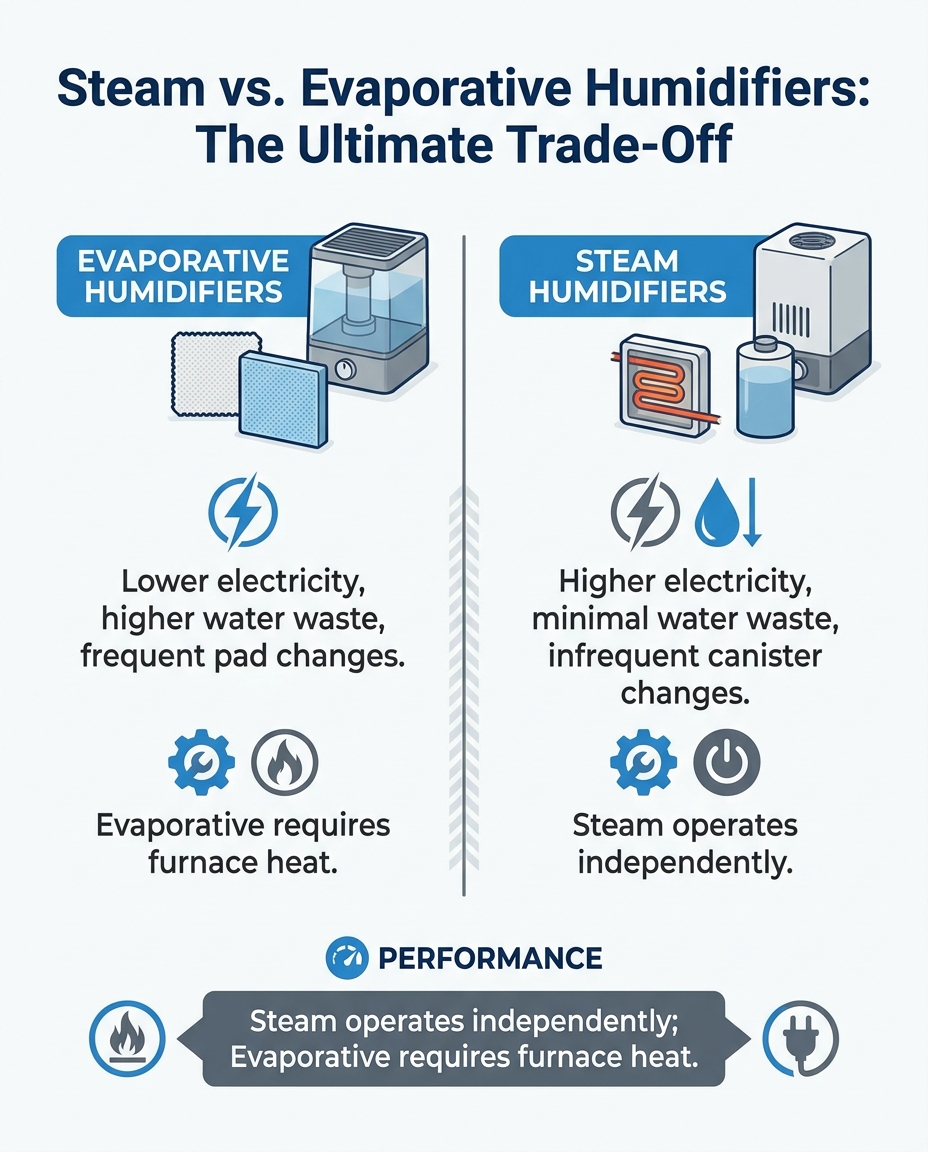
When it comes time to choose, synthesizing the comparison into a clear, side-by-side evaluation of long-term impacts is the best way to move forward. You have to balance the utility impacts directly: the electrical cost of boiling water for steam versus the cost of continuous water flow down the drain for an evaporative unit.
In our years of installing IAQ systems across Westmoreland County, we've learned that honest HVAC advice means looking beyond the initial installation. A true professional guides you based on long-term operational costs—like electricity versus water and maintenance—not just upfront equipment features. You also have to evaluate your own maintenance tolerance. Consider the psychological reality of remembering to change evaporative pads versus the periodic, straightforward canister replacements of steam units.
• Utility Impact — Bypass Evaporative Humidifiers: Higher water usage (continuous drain flow) — Steam Humidifiers: Higher electrical usage (boiling water)
• Maintenance Needs — Bypass Evaporative Humidifiers: Frequent (annual/bi-annual pad changes) — Steam Humidifiers: Less frequent (periodic canister swaps)
• Operation — Bypass Evaporative Humidifiers: Requires furnace heat to function — Steam Humidifiers: Operates independently of heating calls
• Upfront Complexity — Bypass Evaporative Humidifiers: Standard ductwork integration — Steam Humidifiers: Requires dedicated electrical circuit
Pros and Cons of Evaporative Systems:
• Pro: Lower electrical consumption during operation.
• Pro: Generally simpler upfront integration with existing ductwork.
• Con: Significant water waste down the drain.
• Con: High risk of mineral buildup if maintenance is forgotten.
Pros and Cons of Steam Systems:
• Pro: Delivers precise humidity regardless of furnace activity.
• Pro: Pure steam leaves no mineral dust in the ductwork.
• Con: Requires higher electrical capacity and a dedicated circuit.
• Con: Higher energy draw to boil the water.
By understanding these distinct differences, Jeannette and Greensburg area homes can find the perfect balance for improving indoor air quality without unwanted surprises on their utility bills.
Matching the Right Humidifier to Your Heating System
Choosing the right attachment isn't just about personal preference; it is also highly dependent on what your existing HVAC system can safely support. Not every home is an immediate candidate for every type of humidifier.
First, you have to consider space constraints around your indoor unit. On our service calls, we frequently find that bypass humidifiers require enough physical space on the supply and return plenums to route the bypass ducting. If your furnace is installed in a tight utility closet or a crawlspace with complex ductwork, fitting a bypass system can be challenging. Steam humidifiers, while more compact at the injection site, still require proper clearance for the steam dispersion tube to ensure moisture doesn't condense and pool inside your metal ducts.
Electrical capacity is another critical factor. Because steam units draw a significant amount of power to boil water, your home's main electrical panel must have the capacity to support a new, dedicated circuit. Older homes might require an electrical upgrade before a steam unit can be safely integrated.
Whether you are considering standard bypass models or advanced humidifier systems, assessing these technical factors requires a professional eye. Attempting to integrate these systems without proper load calculations or ductwork assessments can lead to poor performance, water damage, or electrical hazards.
Making the Final Call for Your Winter Comfort: Humidifier Attachments: Steam vs. Evaporative for Dry Pennsylvania Winters
Ultimately, the best choice for your home comes down to your personal tolerance for ongoing maintenance versus your preference for utility usage. There is no single right answer—only the answer that fits your lifestyle and your home's infrastructure.
If you want independent operation, precise humidity control, and less frequent maintenance, a steam system is likely your best route, provided your electrical panel can handle the load. If electrical capacity is a concern and you are perfectly comfortable changing out water pads once or twice a season, a bypass evaporative system remains a reliable, effective way to fight off dry Pennsylvania winters.
Remember that proper sizing and professional installation are critical for either system to function efficiently. An oversized humidifier can cause condensation on your windows, while an undersized unit will leave your home feeling just as dry as before.
Expert Answers to Common Humidifier Questions
Is a steam humidifier better than an evaporative humidifier?
The short answer is that steam humidifiers offer superior performance and control, but they are not universally "better" for every home. Steam units can operate independently of your furnace, ensuring your home stays humidified even on mild winter days. However, they require more electricity and a dedicated circuit. Evaporative units are highly effective but rely on your furnace running to distribute moisture.
Do steam humidifiers use a lot of electricity?
Yes, steam humidifiers use more electricity than evaporative models because they must boil water to create steam. They typically require a dedicated 120V or 240V circuit to operate safely. While this increases your electrical usage during the winter, many homeowners feel the precise humidity control and reduced water waste make the energy trade-off worthwhile.
How much water does a bypass humidifier waste?
Bypass humidifiers can send several gallons of water down the drain for every single gallon of moisture actually added to your home's air. This continuous flow is a necessary design feature to flush away hard water minerals and prevent mold from growing on the evaporator pad. If you are on a metered water system, this continuous drain flow is an important operational cost to consider.
Which whole-home humidifier requires the least maintenance?
Steam humidifiers generally require the least frequent maintenance. Instead of changing a messy, calcified water pad once or twice a season, steam units use self-contained canisters that only need to be swapped out periodically. This straightforward replacement process reduces the maintenance fatigue that many homeowners experience with traditional bypass systems.
Can a steam humidifier run without the furnace being on?
Yes, a steam humidifier can generate moisture entirely on its own. Because it uses electricity to boil water internally, it does not need the heat from your furnace burners to create humidity. It simply signals your HVAC system's blower fan to turn on and distribute the steam through your ductwork, providing consistent comfort regardless of heating cycles.
How often do I really need to change my humidifier water panel?
In Jeannette and Greensburg area homes, you should change your evaporative water panel at least once a year, ideally before the heavy heating season begins. If your home has particularly hard water, you may need to change it twice a season. Leaving a calcified pad in the unit blocks airflow, prevents moisture absorption, and can become a breeding ground for bacteria.
Secure Your Home's Winter Comfort Today
As the temperatures continue to drop, acting before the deepest cold sets in is crucial for maintaining your indoor air quality. Allowing your home to dry out completely not only damages your wood fixtures but leaves your family dealing with dry skin, static shocks, and uncomfortable respiratory irritation all season long.
Our team is here to provide professional guidance based on years of local experience. We can evaluate your specific home layout, check your electrical capacity, and discuss your maintenance preferences. Whether you need a simple bypass unit or want to explore whole-home air purifiers and indoor air quality solutions alongside your new humidifier, we can design a system that fits your exact needs. Schedule a consultation today to secure your comfort with the right Humidifier Attachments: Steam vs. Evaporative for Dry Pennsylvania Winters.