The Relationship Between Fall Allergies and Your HVAC Filter MERV Rating
The Fall Airflow Trap: Balancing Ragweed Relief with Furnace Safety
If your furnace is struggling to keep your home warm while you battle seasonal pollen, you are likely experiencing the direct results of the relationship between fall allergies and your HVAC filter MERV rating. As the fall heating season begins, airborne irritants like ragweed hit their absolute peak. For many homeowners, the immediate reaction is to run out to the hardware store and buy the most restrictive, highest-rated allergy filter on the shelf. The problem is that these heavy-duty filters can accidentally suffocate your furnace just as you need it most.
Managing indoor air quality is a priority for any household, but it creates an urgent tension when it comes to maintaining proper heating equipment function. Your furnace requires a massive, continuous volume of air to operate correctly. When you install a dense allergy filter designed to block microscopic particles, you are also blocking the airflow your blower motor relies on. Finding a filter that traps microscopic pollen without causing your furnace to overheat or short-cycle is a critical decision point for every homeowner.
The start of the heating season often overlaps perfectly with peak outdoor allergens. This overlap leads to impulsive filter upgrades that prioritize allergy relief over mechanical safety. However, a filter that is too dense creates a dangerous trap. It starves the heating system of intake air, leading to uneven heating, strained components, and sudden system shutdowns. To protect both your respiratory health and your HVAC equipment, you have to understand how these filters are graded and what your furnace is actually capable of handling.
How MERV Ratings Work Against Microscopic Fall Allergens
To understand why a dense filter causes problems, you first need to know how air filters are graded and what those grades actually mean for your home. The Minimum Efficiency Reporting Value (MERV) scale is an industry-standard measurement that indicates how effectively a filter captures particles between 0.3 and 10 microns in size.
1. Understanding the residential scale: MERV ratings typically range from 1 to 16 for standard use. A higher number means the filter media is woven more tightly, allowing it to trap much smaller particles.
2. The standard equipment limit: Most standard residential home HVAC systems are engineered to push air through filters rated between MERV 1 and MERV 11. Going beyond this requires specialized ductwork or high-powered motors.
3. The commercial threshold: Ultra-high ratings (MERV 13 and above) are generally designed for hospital settings, clean rooms, or commercial buildings equipped with heavy-duty blower motors capable of overcoming immense airflow resistance.
Many homeowners assume that a higher MERV rating is automatically better for their family. While a MERV 13 filter will certainly catch more particles than a MERV 8 filter, it also acts like a thick wool blanket over your return vent.
Sizing Up Ragweed and Mold Spores
When dealing with seasonal irritants, it helps to look at the actual physical size of what you are trying to catch. You do not inherently require the most restrictive filter on the market to capture common fall allergens.
• Ragweed Pollen — Typical Size (Microns): 10 to 20 microns — Required Filtration Level: Easily captured by MERV 8 to 11
• Mold Spores — Typical Size (Microns): 10 to 30 microns — Required Filtration Level: Easily captured by MERV 8 to 11
• Pet Dander — Typical Size (Microns): 5 to 10 microns — Required Filtration Level: Captured by MERV 10 to 11
• Smog and Smoke — Typical Size (Microns): Less than 1 micron — Required Filtration Level: Requires MERV 13+ or dedicated IAQ systems
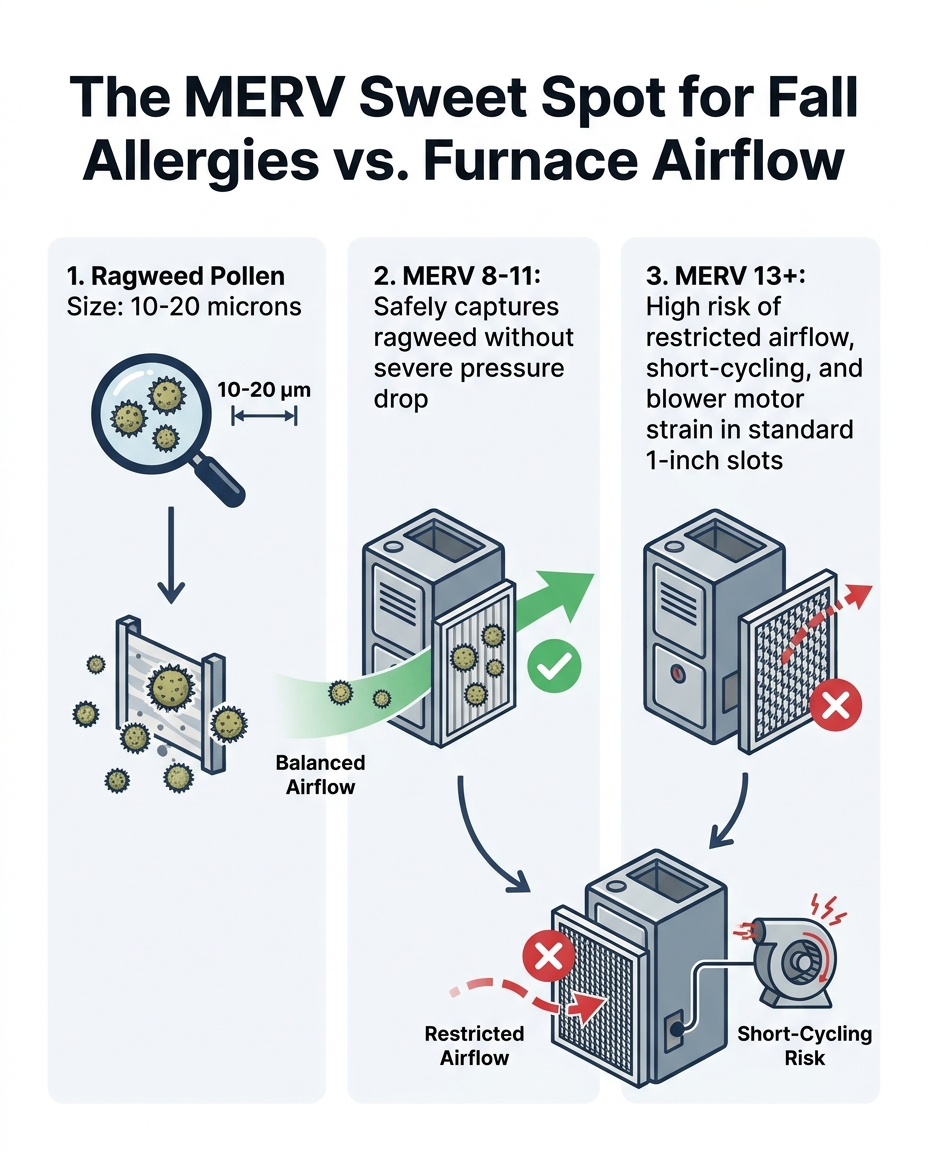
Because ragweed pollen particles are relatively large—typically 10 to 20 microns in size—they get caught quite easily by mid-range filters. Throwing a MERV 14 filter at a 20-micron ragweed problem is like using a coffee filter to catch a golf ball. It works, but it unnecessarily blocks everything else, including the air your furnace desperately needs to distribute heat throughout your home.
The Mechanics of Filter Suffocation in Standard HVAC Systems
The core issue with high-MERV filters in standard 1-inch slots is a mechanical concept called "pressure drop." When you install a filter packed with dense, tightly woven media, the blower motor has to work significantly harder to pull the same amount of air through that restrictive material. Think of it like trying to breathe heavily through a thick paper towel instead of a loose cloth mask; your lungs have to work much harder to get the same amount of oxygen.
This restriction creates a dangerous chain reaction inside your heating equipment. The intake air is blocked, which means not enough cool air is flowing over the furnace's heat exchanger. The heat exchanger's job is to transfer the heat from the burner flames into the air circulating through your ductwork. Without a steady, high-volume flow of air to absorb that heat and carry it away, the internal temperature of the furnace spikes rapidly.
While heavy winter filters can damage blower motors over months of sustained use, the risk is immediate when the furnace fires up for the first time in autumn with a dense allergy filter freshly installed. The blower motor strains against the pressure drop, drawing excess electricity and generating excess heat of its own. Over time, this strain leads to premature motor failure, a repair that is entirely preventable.
Why Your Furnace Might Short-Cycle
Short-cycling is a protective shutdown mechanism built into every modern furnace. When the heat exchanger gets too hot because of a lack of airflow, a critical safety component called the high-limit switch trips. This switch automatically shuts off the gas burners to prevent a fire or a cracked heat exchanger.
If your furnace turns on, blows warm air for just three to five minutes, and then abruptly shuts off before the house reaches the temperature set on the thermostat, it is short-cycling. The system is desperately trying to protect itself from overheating because the dense allergy filter is suffocating it. The lack of airflow from restrictive 1-inch high-MERV filters is a leading culprit for this exact pattern of constant, brief heating cycles.
Why Fall Heating Season Amplifies the High-MERV Risk
The timing of early autumn creates a unique challenge that puts heating systems at high risk. In Western Pennsylvania, we experience sudden, sharp temperature drops just as the heavy ragweed pollen season hits its peak. Homes in Jeannette, Greensburg, and Westmoreland County often require the furnace to run heavily at night while outdoor airborne allergens are still at their absolute highest during the day.
This seasonal overlap forces your HVAC system into a dual role. It is suddenly acting as both a heavy-duty air purifier and a whole-home heater simultaneously. When the temperature dips into the 40s overnight, your furnace needs to run long, consistent cycles to warm the house. If you have just installed a MERV 13 filter to combat the Westmoreland County ragweed, you are compounding the stress on the blower motor right when the system needs to work its hardest.
The furnace is fighting the dense filter media for every cubic foot of air. In our years of experience at Cochran Heating & Cooling servicing homes throughout the local area, this specific seasonal overlap is when our team sees the highest spike in airflow-related service calls. Homeowners close their windows to keep the chill out, trap the indoor allergens inside, and then install a restrictive filter to clean the air, inadvertently choking the furnace on the very first cold night of the year.
Identifying the Symptoms of a Restrictive Air Filter
How do you know if your current allergy filter is too restrictive for your heating system? Your furnace will usually give you warning signs before a complete breakdown occurs. If you recently upgraded to a high-MERV filter to fight fall allergies, watch for these physical symptoms of airflow restriction:
• Weak air from supply registers: If you hold your hand over a vent and barely feel a breeze while the system is running, the blower is struggling to push air through the dense filter.
• Unusual whining or groaning noises: A blower motor that is fighting a high pressure drop will often sound strained, emitting a high-pitched whine as it works overtime to pull air.
• Uneven heating throughout the house: When airflow is restricted, the rooms furthest from the furnace will stay cold because the system lacks the pressure to push warm air to the ends of the ductwork.
• Rapid on-and-off cycling: As mentioned earlier, if the furnace repeatedly turns on and off after only a few minutes, it is a major red flag that the limit switch is tripping due to overheating.
• A bowing or bent filter: Pull the filter out and inspect it. If the cardboard frame is bent or the pleated material is bowing inward toward the blower compartment, the suction pressure is too extreme. The motor is literally trying to pull the filter through the ductwork.
If you notice any of these symptoms, the safest immediate action is to turn off the system, remove the highly restrictive filter, and replace it with a standard mid-range option to restore proper airflow.
The MERV Sweet Spot: Protecting Both Your Lungs and Your Blower Motor
The goal is to find a balance—a filter that effectively manages fall allergies without putting your heating equipment at risk. For standard residential HVAC systems using 1-inch thick filters, the ideal sweet spot falls in the MERV 8 to MERV 11 range.
A MERV 8 to MERV 11 filter is highly effective at capturing 10-to-20 micron ragweed particles, mold spores, and pet dander. More importantly, it does this without causing a dangerous pressure drop. At Cochran Heating & Cooling, we believe in giving honest, transparent advice, even if it goes against common marketing claims: our technicians actively discourage homeowners from wasting money on expensive MERV 13 or MERV 14 1-inch filters. Buying the most restrictive filter on the shelf will likely lead to costly blower motor replacements and emergency service calls.
The golden rule of HVAC filters: The filter's primary job is to protect the equipment from dust and debris. Purifying the air for the humans inside the home is a secondary benefit. Never compromise the equipment's airflow for a higher MERV rating.
Instead of buying a denser filter, the best strategy during peak allergy season is to change a mid-range filter more frequently. Swapping out a MERV 8 or MERV 10 filter every 30 to 45 days during the fall provides consistently clean air while allowing your furnace to breathe easily and operate safely.
Beyond 1-Inch Filters: Dedicated IAQ Solutions for Severe Allergies
Standard 1-inch filter slots are primarily designed to protect the internal components of the HVAC equipment from dust and debris, not to purify the air for the entire home. If you suffer from severe fall allergies and a MERV 11 filter isn't providing enough relief, the solution isn't to cram a denser 1-inch filter into your furnace. The solution is a professional indoor air quality (IAQ) upgrade.
Dedicated whole-home air purifiers and media cabinets are designed to accommodate 4-to-5-inch thick filters. These robust systems offer high MERV ratings with drastically lower airflow resistance. Additionally, active air purification technologies like Aprilaire and REME HALO IAQ systems work to neutralize allergens, mold spores, and airborne irritants directly, improving air quality without suffocating the furnace. The REME HALO, for example, uses ionized hydro-peroxides to actively sweep the air, causing microscopic particles to stick together so they are easier for a standard filter to catch.
Why Thicker Media Filters Outperform 1-Inch Pleats
The secret to a 4-inch or 5-inch media cabinet lies in its geometry.
1. Massive surface area: If you unfold a standard 1-inch filter, you might get a few feet of material. If you unfold a 4-inch media filter, you get massive amounts of surface area.
2. Lower airflow resistance: Because the air has so much more space to pass through the deep pleats, a 4-inch MERV 13 filter actually creates less airflow restriction than a standard 1-inch MERV 8 filter.
3. Longer lifespan: The increased surface area means these thick media filters only need to be changed every 6 to 12 months, rather than every 30 days.
These systems require professional installation to modify the ductwork near the furnace, but they offer superior, safe allergy relief. By upgrading to a dedicated media cabinet, you can achieve hospital-grade filtration without compromising your heating system's performance or risking a cracked heat exchanger.
Frequently Asked Questions About MERV Ratings and Airflow
What MERV rating is best for fall allergies?
The best MERV rating for balancing fall allergy relief and furnace safety is typically between MERV 8 and MERV 11. This range efficiently captures 10-to-20 micron irritants like ragweed and mold spores without suffocating your HVAC system. Going higher than MERV 11 in a standard 1-inch slot often causes restrictive airflow problems that can damage your heating equipment.
Can a high MERV filter damage my furnace?
Yes, a high MERV filter can cause significant damage to your furnace if the system isn't designed to handle the resistance. Dense filters create a heavy pressure drop that forces the blower motor to work harder, which can lead to premature motor failure. The restricted airflow also causes the heat exchanger to overheat, repeatedly tripping safety switches and causing excess wear and tear over time.
Does MERV 11 restrict airflow too much?
For most modern residential HVAC systems, a MERV 11 filter will not restrict airflow too much, provided you change it regularly. It sits right at the upper limit of what standard 1-inch filter slots can handle safely. However, if you leave a MERV 11 filter in place for months until it is caked in dust and pollen, it will absolutely cause severe airflow restriction.
Will a MERV 13 filter stop ragweed pollen?
A MERV 13 filter will easily stop ragweed pollen, but it is massive overkill for that specific task. Ragweed pollen is relatively large, and filters rated MERV 8 to 11 already capture it highly effectively. Using a MERV 13 filter in a standard slot for ragweed is unnecessary and introduces a high risk of suffocating your furnace's airflow just as the heating season begins.
Why is my furnace short cycling with a new filter?
If your furnace turns off prematurely right after installing a new filter, the dense filter material is likely blocking the intake air. Without enough air moving over the heat exchanger, the internal temperature spikes rapidly. The furnace's high-limit switch detects this dangerous heat and shuts the system down to prevent a fire, resulting in a short cycle.
How often should I change my HVAC filter during Western PA's ragweed season?
During the peak of Western PA's ragweed season, you should check your filter every 30 days and replace it no later than every 45 days. Heavy pollen counts, combined with closed windows and the start of the heating season, cause filters to clog much faster in September and October. Frequent changes are the best way to maintain clean air without stressing your furnace.
Breathe Easier This Fall Without Straining Your Heating System
The relationship between fall allergies and your HVAC filter MERV rating is ultimately all about mechanical balance. Protecting your blower motor and ensuring your furnace operates safely is just as important as filtering out the heavy ragweed pollen. Remember that higher is not always better when it comes to standard 1-inch filter slots; a filter that is too dense will simply suffocate your system.
By sticking to the MERV 8 to 11 sweet spot and changing your filter frequently, you can maintain a comfortable, warm, and breathable home all season long. If standard filters aren't providing enough relief for your family, consult with a local expert to explore safe, dedicated IAQ upgrades like media cabinets or active purification systems. You deserve a clear explanation of what works best for your specific system, so you can enjoy the crisp autumn weather without worrying about your indoor air or your heating equipment.