Cool Career, Hot Skills: HVAC Training in Westmoreland County
Launch your HVAC career! Find top HVAC technician training in Westmoreland County, including costs and job outlook for a stable profession.
## Why an HVAC Career is in High Demand
**HVAC technician training Westmoreland County** offers a direct path to one of the most stable and rewarding careers in today’s job market. With employment projected to grow 15 percent from 2016 to 2026—much faster than average for all occupations—skilled technicians are in high demand across Pennsylvania.
**Quick Answer: HVAC Training Options in Westmoreland County**
- **Northern Westmoreland Career and Technology Center**: Vocational training for high school and adult students
- **Key Certifications**: EPA 608, industry training, OSHA 10-Hour Safety
- **Program Types**: Certificate (under 1 year), Diploma, Associate Degree (18-24 months)
The HVAC industry provides *excellent job security* because heating and cooling systems are essential in homes, schools, hospitals, and businesses. As one industry expert noted, “This career area is always growing, has great monetary potential and will always be in demand.”
**Why HVAC careers are booming:**
- Constant need for system repairs and maintenance
- New construction requiring fresh installations
- Energy efficiency upgrades driving retrofits
- Retiring workforce creating job openings
## Your Guide to HVAC Technician Training in Westmoreland County
Starting your **HVAC technician training Westmoreland County** journey is straightforward, with several local options designed to provide hands-on experience with real equipment. These programs offer flexible paths for high school students and adults ready for a career change.
### Westmoreland County Community College (WCCC)
Located in Youngwood, Westmoreland County Community College offers accessible and affordable **HVAC technician training Westmoreland County**. WCCC provides flexible options, including an *associate degree*, a *diploma*, and *certificate programs*. Their 18-month associate degree program balances comprehensive training with a quick entry into the workforce.
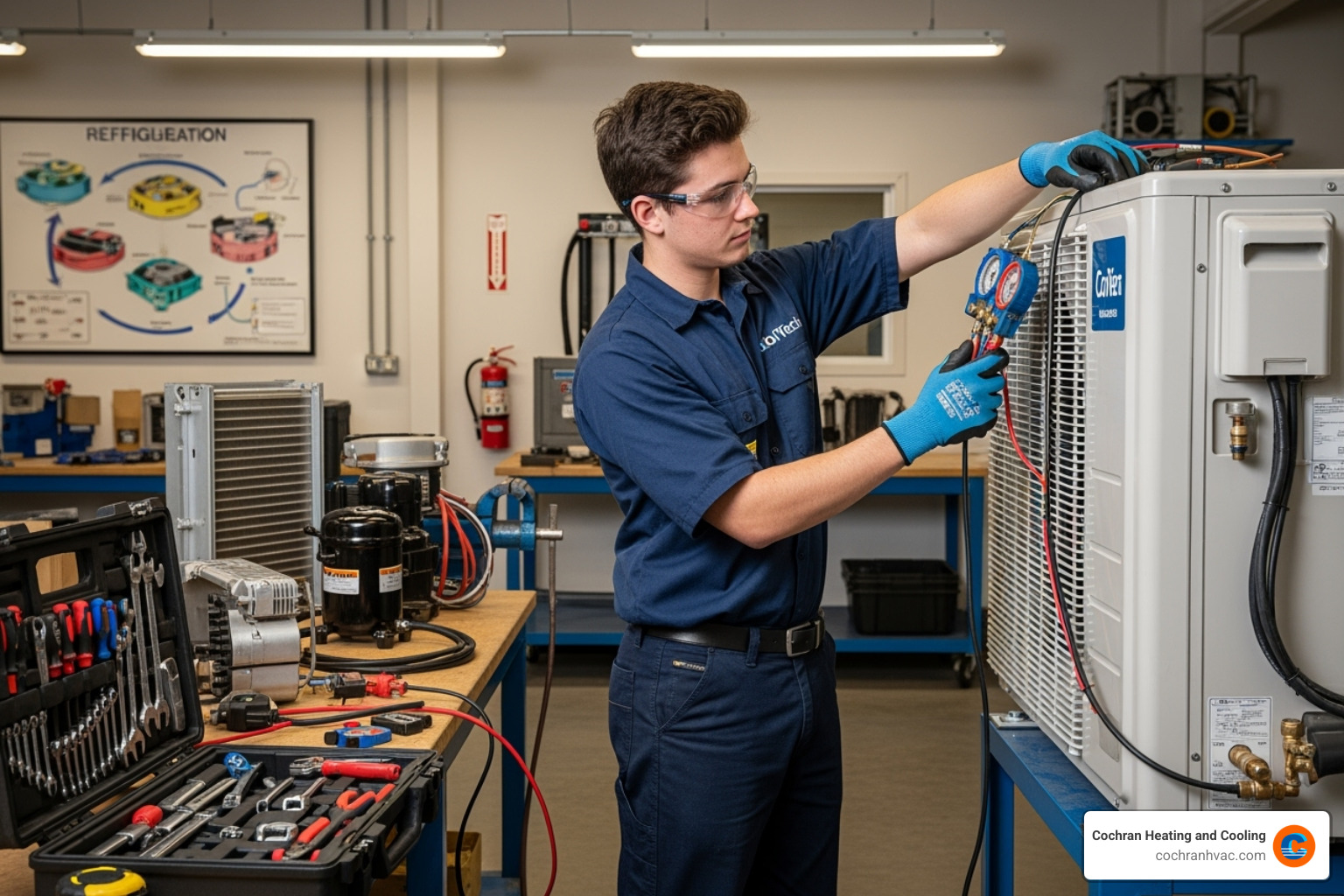
The curriculum blends classroom theory with extensive *hands-on lab training* on actual equipment. You’ll cover everything from basic refrigeration cycles to advanced troubleshooting, learning *ductwork fabrication*, *control circuitry*, *gas and oil furnaces*, and modern *heat pumps*.
### Northern Westmoreland Career and Technology Center (NWCTC)
For vocational training focused on practical skills, NWCTC offers excellent **HVAC technician training Westmoreland County** for both *high school* and *adult education* students. The curriculum emphasizes real-world applications on *residential and commercial systems*, using “live” equipment from gas furnaces to commercial refrigeration.
The hands-on approach helps you master *sheet metal fabrication*, *soldering and brazing*, and *blueprint reading*. Students can also earn valuable *industry-recognized certifications* like EPA 608 and OSHA 10-Hour. The competency-based program allows you to advance once you’ve mastered each skill. Download their brochure for more details.
### Other Regional Training Options
Beyond local schools, quality programs are available within a reasonable driving distance.
- **Penn Commercial** in Washington, PA, is the Tri-State Area’s only Lennox Partner School. Its 18-month associate degree program provides intensive *hands-on training* with industry-standard equipment, offering a potential edge in the job market.
- **Thaddeus Stevens College of Technology** in Lancaster offers a 2-year, 75-credit *associate degree* with impressive graduate placement rates (96-100%). The program emphasizes applying algebra and physics concepts to solve complex HVAC problems.
These regional options provide *specialized technology degrees* and different learning approaches, allowing you to find a program that matches your learning style and career goals.
## The Skills and Certifications You’ll Earn
A successful HVAC career is built on a foundation of technical skills and official certifications. Training programs focus on preparing you for real-world challenges, ensuring you’re both book-smart and hands-on capable.
### Core Technical Skills Taught
**HVAC technician training Westmoreland County** programs are designed to turn you into a well-rounded professional. The core of your training revolves around **troubleshooting and problem-solving**, learning to diagnose system failures and determine the best fix.
- **Electrical Circuitry**: You’ll master reading schematics and safely working with DC and AC circuits, which form the backbone of modern HVAC systems.
- **Refrigerant Handling**: You will learn the refrigeration cycle, how to properly charge systems, and how to safely and legally recover refrigerants.
- **System Installation**: Hands-on training covers the entire installation process for new construction and replacement projects.
- **Ductwork Fabrication**: You’ll learn to size and fabricate ducts according to industry standards for optimal airflow.
- **Blueprint Reading**: This skill is essential for understanding how systems integrate into buildings.
- **Equipment Expertise**: Training covers a variety of equipment, including **gas and oil furnaces** and **heat pumps**.
The training also develops communication and customer service skills. At Cochran Heating and Cooling, we know that technical expertise combined with great customer service creates lasting success, a philosophy we apply to every heating repair.
### Essential Industry Certifications
In the HVAC world, certifications are often legal requirements that open doors to better opportunities and higher pay.
- **EPA 608 Certification**: This is federally required for anyone who handles refrigerants, making it essential for legal work on most HVAC systems. Most training programs include preparation and testing for this certification.
- **industry training**: North American Technician Excellence (industry training) is the gold standard in the industry. Employers actively seek HVAC technicians as proof of real-world competence.
- **OSHA 10-Hour Safety**: This certification is crucial for learning to identify workplace hazards and follow safety protocols.
- **R-410A Safety**: This credential provides specialized knowledge for safely handling the common R-410A refrigerant, which operates at high pressures.
Local programs often include other valuable credentials, such as **Gastite installation** or brand-specific certifications, making you more versatile. Many of these are built into the curriculum, so you earn credentials as you learn. For more career information, the U.S. Dept. of Labor’s site for this career field is an excellent resource.
### Certificate and Diploma Programs
For those who want to start earning quickly, certificate and diploma programs are an excellent choice. These paths are ideal for *hands-on learners* who want to enter the HVAC field without spending years in a classroom.
- **Certificate programs** offer *short-term training* (weeks to months) focused on *skill-specific*, core technical abilities for entry-level work.
- **Diploma programs** are more comprehensive, typically taking one to two years, while still maintaining a practical, hands-on focus.
Both options prepare you for *entry-level positions* like HVAC installer or maintenance technician and allow for *quick entry to the workforce*.
### Associate Degree (AAS) Programs
An Associate in Applied Science (AAS) degree provides a well-rounded education combining technical training with broader academic knowledge. These *two-year programs* (often 18-24 months) offer a deeper understanding of HVAC/R theory, teaching you not just *how* systems work, but *why*.
The curriculum includes *in-depth theory* and *general education courses* (math, science, communication), which improves problem-solving skills for complex field challenges. An AAS degree also improves *supervisory potential*, opening doors to leadership roles like service manager or even business ownership. Furthermore, many AAS degrees offer *transfer options*, allowing you to apply credits toward a bachelor’s degree in a related field like mechanical engineering.
All three paths provide a solid foundation for a rewarding HVAC career.
## Career Outlook and Salary in Westmoreland County
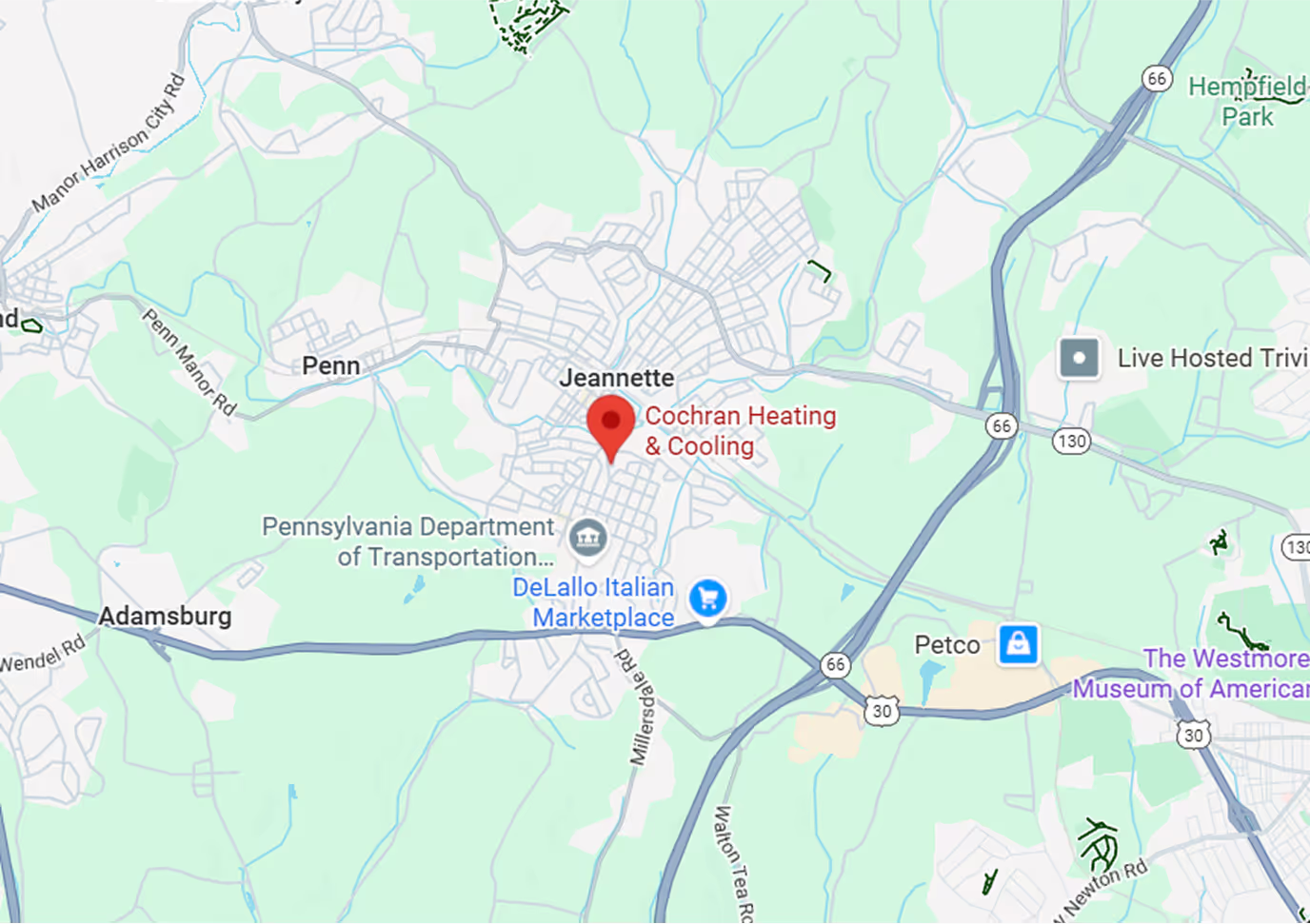
After completing your **HVAC technician training Westmoreland County**, a promising career awaits. Demand for skilled technicians is strong across the region, including communities like Greensburg and North Huntingdon. Our operations in Jeannette and throughout the county highlight this continuous need for qualified professionals.
### Job Opportunities for Graduates
HVAC training opens up a variety of career paths.
- **HVAC Service Technicians** diagnose and repair systems, restoring comfort to homes and businesses.
- **Installers** set up new systems in residential and commercial properties, ensuring they run perfectly from day one.
- **Maintenance Technicians** focus on preventative care through regular check-ups, which is crucial for system longevity and efficiency, as detailed in our guide on the Benefits of Regular HVAC Service.
- **Refrigeration Technicians** work with specialized cooling systems in commercial settings like restaurants and grocery stores.
With experience, leadership roles like **Installation Foreperson** or **Service Manager** become available. The ultimate goal for many is becoming an **HVAC Company Owner**, a realistic possibility with the right skills and industry knowledge.
### Average Salaries and Earning Potential
- **Experience**: Seasoned technicians with a reputation for quality work are invaluable and command higher pay.
- **Education Level**: An associate degree often leads to a higher starting salary and faster advancement.
- **Certifications**: Specialized credentials like industry training can significantly boost your paycheck.
- **Specialization**: Focusing on complex commercial systems, geothermal technology, or energy efficiency can lead to premium pay rates.
The HVAC field offers great monetary potential and constant demand, ensuring skilled technicians will always have a secure and well-paying career.
## Frequently Asked Questions about HVAC Training
Here are answers to common questions about starting your **HVAC technician training Westmoreland County**.
### How long does it take to complete HVAC training in Westmoreland County?
The timeline depends on the program you choose.
- **Certificate programs** are the fastest option, taking from a few weeks to under a year.
- **Diploma programs** typically require one to two years of study.
- **Associate degrees**, like those at Westmoreland County Community College and Penn Commercial, take about **18 to 24 months** to complete.
- **Self-paced online options** may allow up to 12 months for coursework, but still require in-person, hands-on lab work.
### What are the admission requirements for local HVAC programs?
Most programs have straightforward requirements to attract motivated students.
- A **high school diploma or GED** is the standard foundation.
- **Good math and science skills** are important for calculations and understanding technical concepts.
- **Mechanical aptitude** and **strong problem-solving abilities** are highly valued, as technicians constantly diagnose and fix issues.
- **Clear communication skills** are essential for interacting with customers and team members. Some programs may use placement tests to help support you are ready for the coursework.
### Is financial aid available for HVAC training?
Yes, numerous options can make **HVAC technician training Westmoreland County** affordable.
- **Federal financial aid (FAFSA)** is available for most degree and diploma programs, offering grants, loans, and work-study opportunities.
- **Scholarships** are offered by organizations like the HACC Foundation and other local groups. Check with your school’s financial aid office for specific opportunities.
- **GI Bill benefits** can be used by veterans for approved HVAC programs to cover tuition and housing.
- **Employer sponsorship** is an option where companies pay for your education in exchange for a work commitment after graduation.
- **Payment plans** are offered by most schools to help spread out costs over time.
## Launch Your HVAC Career in Westmoreland County
Starting an HVAC career in Westmoreland County is a path to a stable, rewarding, and well-compensated profession. With excellent local training options at schools like Westmoreland County Community College and Northern Westmoreland Career and Technology Center, you can gain the skills for a future with job security and excellent earning potential.
At Cochran Heating and Cooling, we know that well-trained professionals are the backbone of our business. Our ability to serve Westmoreland County with emergency service for over 35 years depends on skilled technicians who take pride in their craft. Proper training creates true professionals who make a difference in people’s lives.
Whether you choose a quick certificate or an in-depth associate degree, you are investing in a fulfilling career. Ready to take the next step? To see what a successful HVAC company looks like, learn more About Cochran Heating and Cooling.
testimonials