Sealing Ductwork Leaks Before the Deep Pennsylvania Freeze

When Your Furnace Runs Constantly But Rooms Stay Cold
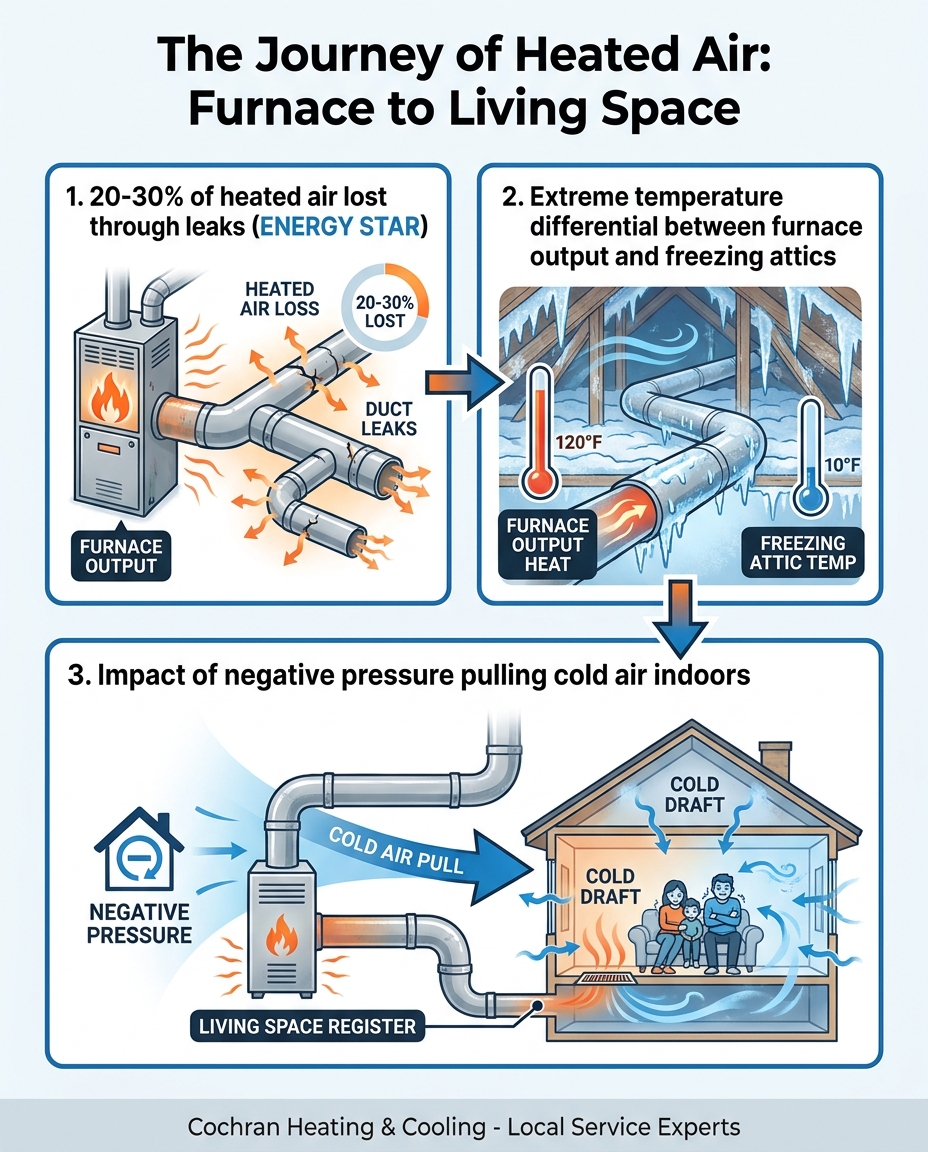
According to ENERGY STAR, nearly 20 to 30 percent of the air moving through a typical home's duct system is lost to leaks, holes, and poorly connected joints, which is why sealing ductwork leaks before the deep Pennsylvania freeze is one of the most critical steps you can take for your home's winter efficiency. That staggering statistic represents a massive amount of wasted energy, but more importantly, it represents the physical comfort your family is missing out on when temperatures plummet. When a heating system runs continuously but the living spaces remain stubbornly cold, the problem often isn't the furnace itself. Instead, the heated air is escaping into freezing, unconditioned spaces long before it ever reaches your bedroom or living room vents.
In our experience servicing heating systems across the region, we consistently see homeowners struggling with this exact scenario. You hear the furnace kick on, you feel a weak trickle of lukewarm air at the register, and you watch your utility usage climb, yet you still need to wear heavy sweaters indoors. This frustrating cycle happens because the delivery network—your ductwork—is compromised. The heated air is essentially being pumped outdoors or into empty attic spaces, forcing the heating equipment to work overtime to compensate for the massive structural deficit.
Addressing this issue requires a professional to properly diagnose and seal these hidden gaps before severe winter weather arrives. Once a deep Pennsylvania winter freeze sets in, accessing these tight, unconditioned spaces becomes significantly more difficult, and the heat loss accelerates dramatically. Making the decision to secure your ductwork now ensures that the heat your furnace generates actually makes it into the rooms where you need it most, providing reliable comfort and protecting your equipment from unnecessary strain.
The Physics of Heat Loss in Unconditioned Attics and Crawlspaces
To understand why duct leaks are so devastating to your home's comfort, you have to look at the mechanics of where these leaks typically occur. The most vulnerable points in any HVAC system are the "unconditioned spaces"—areas like attics, crawlspaces, and unfinished basements that are not insulated or climate-controlled like the rest of your living area. During a deep Pennsylvania winter freeze, the temperature in these unconditioned spaces can easily drop well below freezing, turning minor gaps in your ductwork into major sources of catastrophic heat loss.
When a furnace operates, it typically outputs air that is heated to around 120°F to 140°F. If the ductwork carrying that hot air runs through an attic where the ambient temperature is 20°F, the temperature differential is extreme. This massive gap in temperature means that any hot air escaping through a loose joint or degraded seam is immediately swallowed by the freezing environment. Worse, the freezing ambient air rapidly strips heat from the thin metal of the ductwork itself, meaning that even the air that manages to stay inside the duct is cooled significantly before it reaches your vents.
• Conditioned Living Space — Typical Winter Temperature: 68°F - 72°F — Impact on Unsealed Ductwork: Minimal heat loss; escaped air still warms the home interior. — Heat Loss Severity: Low
• Finished Basement — Typical Winter Temperature: 60°F - 65°F — Impact on Unsealed Ductwork: Slight loss; escaped air contributes to overall floor warmth. — Heat Loss Severity: Moderate
• Unfinished Crawlspace — Typical Winter Temperature: 30°F - 45°F — Impact on Unsealed Ductwork: Significant heat transfer; hot air escapes into damp, cold zones. — Heat Loss Severity: High
• Unconditioned Attic — Typical Winter Temperature: 10°F - 30°F — Impact on Unsealed Ductwork: Catastrophic heat loss; massive temperature differential strips heat instantly. — Heat Loss Severity: Severe
This is fundamentally a structural physics issue, not a mechanical failure of the heating equipment. You can have a brand-new, top-of-the-line furnace operating perfectly, but if the delivery system passes through a freezing zone with unsealed joints, the laws of thermodynamics dictate that the heat will aggressively move toward the cold. The quick fix: The only way to stop this rapid heat transfer is to structurally seal the envelope of the ductwork, ensuring the physical barrier between the hot air and the freezing environment remains completely airtight.
Understanding Temperature Differentials
The math of heat transfer dictates that the greater the difference in temperature between two objects or spaces, the faster heat will move between them. In the dead of winter, the extreme cold of an uninsulated attic aggressively pulls heat away from anything warm. Because sheet metal and flexible duct materials are highly conductive, they offer very little resistance to this temperature exchange unless they are properly sealed and insulated. When freezing ambient air surrounds an unsealed duct, it accelerates the cooling of the ductwork material itself, causing the heated air inside to lose its thermal energy rapidly as it travels toward your living spaces.
Why High-Efficiency Systems Underperform in Extreme Weather
One of the most common frustrations we see involves homeowners who have recently invested in premium, high-efficiency gas furnaces or advanced heat pumps, only to find that their homes still suffer from cold rooms and drafts. It is incredibly disheartening to upgrade to a system with a 95% AFUE (Annual Fuel Utilization Efficiency) rating and still feel chilly when the winter wind howls. The reality is that an HVAC system is only as efficient as its delivery network. A 95% AFUE rating simply means the furnace converts 95% of its fuel into heat within the cabinet—it does not account for what happens to that heat once it enters the ductwork.
In homes in Jeannette, Greensburg, and North Huntingdon, we frequently evaluate heating systems that are technically operating flawlessly but are failing to deliver comfort because a 95% efficient furnace cannot compensate for 30% duct leakage. If a third of your heated air is blowing into the rafters, your overall system efficiency plummets. The furnace is forced to run continuously, trying to satisfy the thermostat setting in the living room while fighting a losing battle against the heat loss happening in the attic.
This constant running to compensate for heat loss does more than just waste energy; it puts unnecessary, premature wear and tear on the system's most critical components. Blower motors are designed to cycle on and off, giving them time to cool down. When a furnace runs nonstop to overcome unsealed ducts, the blower motor is pushed to its absolute limits. Similarly, the heat exchanger sustains prolonged exposure to high temperatures, increasing the risk of stress fractures over time. Addressing the delivery system is just as important as upgrading the heating unit itself, as the two must work in perfect harmony to achieve true high-efficiency performance.
Identifying the Hidden Signs of Compromised Ductwork
Because ductwork is largely hidden behind drywall, tucked into crawlspaces, or buried under attic insulation, it can be difficult to know when leaks are occurring. However, the symptoms of compromised ductwork often manifest directly inside your living spaces. Recognizing these signs early allows you to address the problem before a deep Pennsylvania winter freeze pushes your system to the breaking point. While the instinct might be to grab a flashlight and investigate, we strongly advise against homeowners crawling into freezing, tight, and potentially hazardous unconditioned spaces to look for leaks themselves. Instead, monitor your home for these specific indoor indicators.
• Uneven temperatures between floors: If your first floor is freezing while the second floor is sweltering, or if specific rooms never seem to get warm despite the vents being fully open, you likely have a delivery issue caused by escaping air.
• Excessive dust accumulation: When heated air leaks out of supply ducts, it alters the air pressure inside the home. This negative pressure can actively pull dirty, unconditioned air from the attic or crawlspace into your return ducts, distributing heavy dust throughout your living spaces.
• Weak airflow at the registers: Place your hand over the vent in the coldest room of your house while the furnace is running. If the airflow feels weak or barely noticeable compared to vents closer to the furnace, a massive leak is likely bleeding off the pressure along the way.
• Unusual odors when the heat kicks on: Because negative pressure pulls air from unconditioned zones, you may smell musty, stale, or dusty odors originating from the crawlspace or attic being drawn into your home's air supply.
The impact on indoor air quality cannot be overstated. When compromised ducts pull unconditioned air into your living spaces, they bypass your furnace filter entirely. This means allergens, fiberglass particles, and stale air are constantly circulating through your home, reducing your air quality alongside your heating efficiency.
When to Call for a Professional Assessment
The primary trigger for calling a professional is the specific combination of a constantly running furnace coupled with persistent cold zones in the house. If you have replaced your filter, ensured all vents are unblocked, and your thermostat is functioning properly, but the system still cannot maintain the set temperature, it is time for a professional assessment. Do not wait for the equipment to fail from overwork; addressing the delivery network early is the most effective preventative measure.
Addressing Ductwork Deterioration in Westmoreland County's Aging Homes
The challenges of heat loss are particularly pronounced in older properties. Westmoreland County features a high density of century-old and aging homes, each with its own unique architectural history and retrofitted HVAC challenges. In homes in Jeannette, Greensburg, and North Huntingdon, we frequently encounter original ductwork that was installed decades ago, long before modern energy efficiency standards or advanced sealing techniques were developed. Understanding the specific vulnerabilities of these aging systems is crucial for maintaining winter comfort.
Original ductwork in older homes often relies on degraded cloth tape or failing mechanical joints that were never designed to be completely airtight. When these systems were installed, energy was relatively inexpensive, and minor leaks were simply accepted as part of the heating process. Today, however, that degraded tape has often dried out, turned brittle, and completely peeled away from the sheet metal. The mechanical joints—where two pieces of metal ducting slide together—are often loose, allowing massive volumes of heated air to escape into the cavities of the home.
Furthermore, decades of expansion and contraction take a heavy toll on these older systems. Metal ductwork expands when hot furnace air rushes through it and contracts when the system shuts off and the freezing winter air surrounds it. Over twenty, thirty, or fifty years of seasonal temperature swings, this constant micro-movement causes unsealed joints to slowly wiggle apart. What started as a tiny gap in 1985 can easily become a massive, disconnected duct joint today. For historic and aging properties, a professional ductwork assessment and modern sealing application is a necessary modernization step that preserves the integrity of the home while bringing its heating efficiency into the 21st century.
How Professionals Diagnose and Resolve Hidden Duct Leaks
Because finding and fixing duct leaks requires specialized equipment and a deep understanding of HVAC airflow dynamics, this is definitively not a DIY project. Crawling through tight, freezing attics with a roll of tape is not only dangerous, but it is also highly ineffective. Standard hardware-store "duct tape" is actually one of the worst materials you can use on heating ducts, as the adhesive quickly dries out and fails under the stress of extreme temperature fluctuations. To truly secure a system, professionals follow a strict, multi-step diagnostic and resolution process.
1. Comprehensive Airflow Testing: The process begins by measuring the static pressure and airflow volume at various points throughout the system. By comparing the amount of air leaving the furnace to the amount of air arriving at the registers, professionals can calculate exactly how much air is being lost and pinpoint which specific duct runs are the most compromised.
2. Visual Inspection in Unconditioned Spaces: Technicians safely navigate attics, crawlspaces, and unfinished zones to physically inspect the exterior of the ductwork. They look for disconnected joints, crushed flexible ducts, degraded tape, and signs of structural sagging that indicate a failure in the delivery network.
3. Professional-Grade Sealing Application: Once the leaks are identified, professionals use specialized materials to create a permanent, airtight bond. This typically involves applying mastic sealant—a thick, gooey resin that is painted over the joints and hardens into a durable, flexible shell that expands and contracts with the metal. For larger gaps, specialized mechanical fasteners and fiberglass mesh tape are used in conjunction with the mastic to ensure the joint never separates again.
4. Insulation Restoration: After the structural envelope of the duct is sealed, technicians ensure that the surrounding insulation is properly secured back over the ductwork. This prevents the freezing ambient air from pulling heat directly through the metal, protecting the thermal integrity of the air inside.
Beyond Sealing: Comprehensive System Health
Sealing the exterior joints is only one half of the airflow equation. Once the ducts are properly sealed and structurally sound, ensuring that the internal pathways are entirely free of blockages maximizes the system's performance. Decades of unsealed ducts often mean that dust and debris have accumulated inside the network. Homeowners looking to optimize their winter heating might also need to clean ducts in Westmoreland County to achieve optimal winter performance. A sealed, clean duct system allows the blower motor to push air effortlessly, reducing mechanical strain and delivering maximum heat to the living spaces.
Secure Your Comfort Before the Next Deep Freeze Hits
Stopping heat loss in unconditioned spaces is undeniably the most effective way to ensure a warm, comfortable home when the temperatures plummet. By addressing the structural gaps in your delivery network, you allow your heating equipment to operate exactly as it was designed, delivering the full force of its efficiency directly into your living spaces. The short answer is: sealing your ducts stops the waste, lowers the strain on your furnace, and eliminates the cold rooms that make winter miserable.
Professional sealing provides the peace of mind that comes from knowing your system is fully optimized and protected against the harsh elements. We strongly encourage homeowners to schedule an inspection now, before severe winter weather makes unconditioned spaces inaccessible or dangerous to work in. By prioritizing sealing ductwork leaks before the deep Pennsylvania freeze, you guarantee that your home remains a warm, welcoming sanctuary, no matter how extreme the weather gets outside.
Frequently Asked Questions
How much heat is lost through uninsulated and unsealed ducts?
According to industry standards, up to 30 percent of the air moving through a typical duct system is lost to leaks and holes. In freezing unconditioned spaces, this loss is compounded by the extreme temperature differential, which rapidly strips thermal energy from the air. This massive loss forces your heating system to work significantly harder to maintain indoor comfort.
Does sealing ductwork make a noticeable difference in winter?
Yes, it makes an immediate and highly noticeable difference in both comfort and system performance. By closing the gaps where hot air escapes, the full volume of heated air is directed into your living spaces, eliminating cold spots and drafts. Furthermore, it stops the furnace from running constantly, which provides a much more consistent and comfortable indoor environment.
Why is my house cold even when the furnace is running constantly?
If your furnace is running nonstop but the house remains cold, the heated air is likely escaping through leaks in the ductwork before it reaches your vents. When ducts pass through freezing attics or crawlspaces, any unsealed joint acts like an open window, dumping your heat into the outdoors. The furnace simply cannot produce enough heat to overcome a massive structural leak in the delivery system.
How do professionals find duct leaks in a crawlspace or attic?
Professionals use specialized diagnostic tools, such as static pressure gauges and airflow meters, to measure exactly how much air is being lost between the furnace and the registers. They also conduct thorough visual inspections in unconditioned spaces to identify disconnected joints, degraded tape, and crushed ducting. This comprehensive approach ensures that even hidden leaks buried under insulation are found and addressed.
Can unsealed ducts damage my high-efficiency furnace?
Yes, operating a high-efficiency furnace with severely unsealed ducts can lead to premature wear and mechanical failure. Because the system has to run constantly to compensate for the lost air, critical components like the blower motor and heat exchanger are subjected to excessive stress and heat buildup. Proper sealing protects your investment by allowing the equipment to cycle normally and rest between heating calls.
Is duct tape sufficient for sealing HVAC ductwork?
No, standard cloth-backed duct tape is not suitable for sealing HVAC ductwork. The extreme temperature fluctuations of heating and cooling cycles quickly dry out the adhesive, causing the tape to peel and fail. Professionals use specialized mastic sealants, fiberglass mesh, and mechanical fasteners that are specifically designed to expand and contract with the metal, creating a permanent, airtight seal.