Decoding the Yellow Flame on Your Gas Furnace Before Winter Hits
The October Start-Up: Spotting Trouble Through the Sight Glass
You flip the thermostat to heat for the first time this fall, expecting the familiar rush of warm air, but a quick check reveals a problem—and decoding the yellow flame on your gas furnace before winter hits is critical for your home's safety. During the typical October heating start-up, our team at Cochran Heating & Cooling often recommends homeowners take a quick look through the furnace sight glass to ensure everything is running smoothly. Instead of seeing the reassuring, sharp blue roar of a clean burn, you might be greeted by a lazy, flickering yellow or orange flame that looks more like a campfire than a precision heating instrument.
This visual shock introduces an immediate decision point. Do you ignore it, assuming it is just summer dust burning off the burners, or do you recognize it as a potential safety hazard that requires immediate attention? Assuming a yellow flame will simply fix itself is a dangerous gamble. That color change is a direct mechanical warning sign that your heating equipment is struggling to breathe, and ignoring it can put your entire household at risk.
If you are seeing these warning signs and need immediate professional assistance, learn more about our gas furnace services to ensure your system is operating safely.
Understanding what that flame color actually means requires a look at the science of how your system operates. A gas furnace is not just a box that makes heat; it is a carefully calibrated chemical reactor. When that reaction falls out of balance, the visual evidence is the very first clue you receive.
The Physics of Complete vs. Incomplete Combustion
To understand why a yellow flame is a problem, you have to understand the technical science behind natural gas combustion. Natural gas (primarily methane) requires a very specific ratio of oxygen to burn cleanly and safely. When your furnace achieves this precise mixture of natural gas and oxygen, it achieves what we call complete combustion. Complete combustion is highly efficient, extracting the maximum amount of heat energy from the fuel while producing only harmless byproducts.
Conversely, incomplete combustion happens when the furnace burners are oxygen-starved. If the system cannot pull in enough air to mix with the gas, the chemical reaction breaks down. Instead of a hot, clean burn, you get a cooler, lazy yellow flame. This is not just a cosmetic issue or a quirk of older systems; a yellow flame is a definitive symptom of a mechanical or airflow failure. It tells you that the fundamental chemistry of your heating system has been compromised.
Anatomy of a Healthy Blue Flame
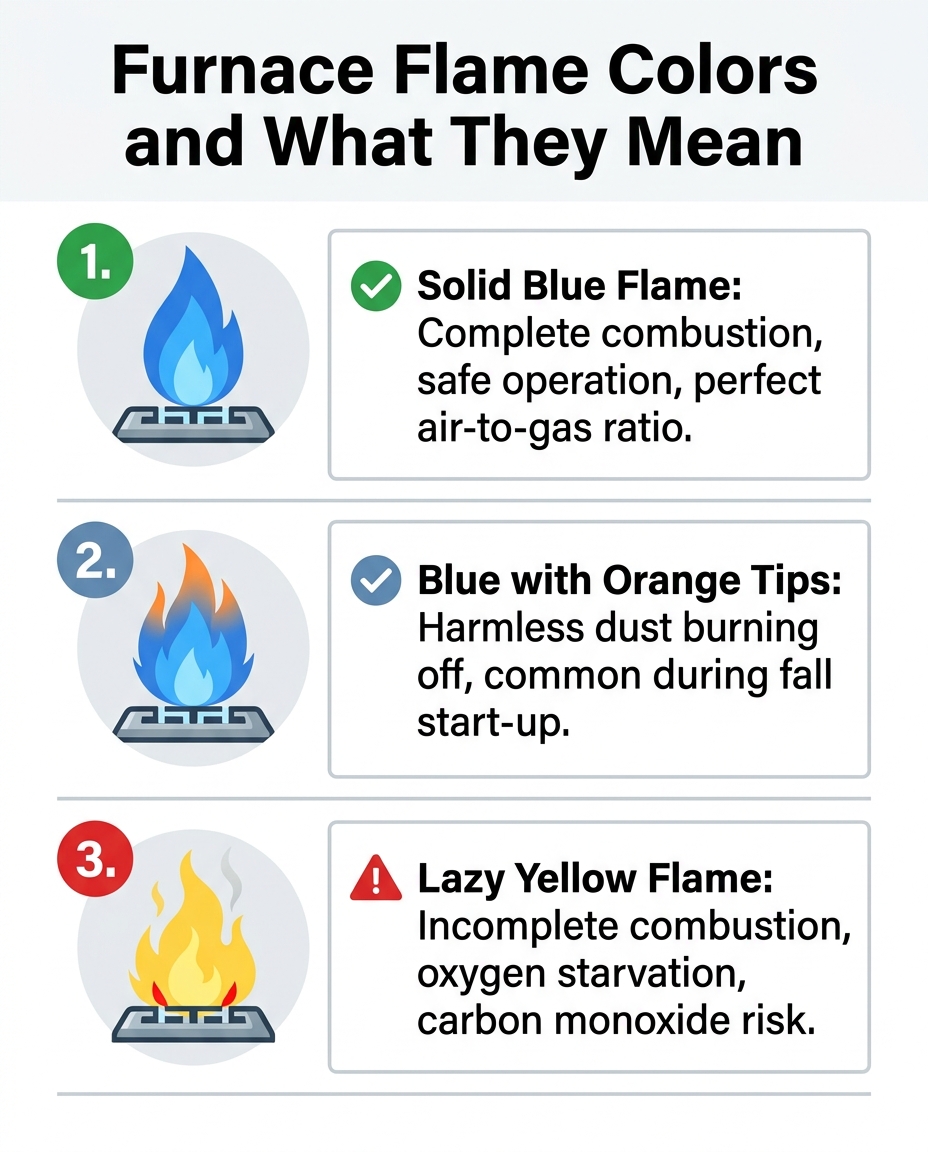
A properly functioning gas furnace produces a highly distinct flame structure. When you look through the sight glass of a healthy system, you should see:
• A sharp, defined shape: The flame should look focused and intentional, not wavering wildly or rolling out of the burner tube.
• A light blue inner core: The hottest part of the flame sits right at the base and should be a bright, almost translucent light blue.
• A darker blue outer halo: Surrounding the core is a steady, darker blue edge that indicates the gas is burning entirely.
• A steady, roaring sound: A healthy blue flame produces a consistent, low roar, which indicates proper gas pressure and a strong draft pulling the exhaust gases through the heat exchanger.
Why Oxygen Starvation Causes a Yellow Burn
When the oxygen supply is choked off, the natural gas cannot fully ignite. This starvation is usually caused by physical obstructions. Over the spring and summer, dirt, dust, pet dander, and rust can accumulate directly on the burner orifices or inside the air intake pipes. Even a microscopic layer of oxidation on the burner face can disrupt the precise flow of gas and air.
Without enough oxygen, the unburned carbon particles in the natural gas heat up and glow. That glowing carbon is exactly what produces the lazy, flickering yellow color. Unlike the forceful roar of a blue flame, an oxygen-starved yellow flame often looks soft, tall, and wavering, much like a candle flame dancing in a draft. This indicates that the fuel is being wasted and the combustion process is failing.
Distinguishing Harmless Dust from Oxygen Starvation
In our years of maintaining heating systems across Jeannette, we've learned that it is important to acknowledge that seeing some minor color variation is incredibly common during the very first run of the season. During an October heating start-up, a furnace that has sat dormant for six months will have collected a fine layer of household dust on the burners. When the gas ignites for the first time, this dust is instantly incinerated.
The harmless signs: Brief orange streaks, tiny flashes of color, or slight orange tips on an otherwise sharp blue flame are typically just harmless dust particles burning off. This phenomenon usually lasts for only a few minutes. Once the dust is cleared, the flame should return to a solid, steady blue.
The danger signs: You must contrast those brief orange flashes with a solid, lazy yellow flame that persists long after the furnace has been running. If the furnace has been operating for ten minutes and the flame is still entirely yellow, rolling, or producing soot, you are not dealing with dust. You are dealing with oxygen starvation. There is a false comfort in assuming a persistent yellow flame will simply "burn itself clean" over time. It will not. In fact, running a system in this state will only make the blockage worse.
The best way to prevent the confusion between harmless dust and dangerous combustion issues is through routine care. Keeping your system clean year-round is the foundation of our preventative maintenance plan.

Why Incomplete Combustion Creates Carbon Monoxide Dangers
The transition from a blue flame to a yellow flame is not just a loss of efficiency; it is a severe safety hazard. To understand why, we have to look at the chemical shift that occurs when incomplete combustion takes over. When a furnace has plenty of oxygen, the natural gas burns completely and produces two primary byproducts: water vapor and carbon dioxide (CO2). Both of these are safely vented out of your home through the flue pipe.
However, when the burners are starved of oxygen, the chemical equation changes drastically. Instead of producing harmless carbon dioxide, the incomplete combustion process produces carbon monoxide (CO). Carbon monoxide is an odorless, colorless, and tasteless gas that cannot be detected by human senses. Without specialized equipment, you will never know it is in the air until physical symptoms begin to appear.
• Complete Combustion — Flame Color: Sharp Blue — Primary Byproducts: Water vapor, Carbon Dioxide (CO2) — Safety Risk Level: Low (Safe operation)
• Incomplete Combustion — Flame Color: Lazy Yellow — Primary Byproducts: Heavy Soot, Carbon Monoxide (CO) — Safety Risk Level: High (Immediate danger)
Because carbon monoxide is invisible, a yellow flame is often the only visual warning sign homeowners have before their CO detectors trigger. If your furnace is producing a yellow flame, it is actively generating higher levels of carbon monoxide. If there is even a microscopic crack in your heat exchanger, that toxic gas can be pushed directly into your home's ductwork and circulated into your living spaces. Ignoring a yellow flame puts the entire household at severe risk of CO exposure. For a deeper understanding of how these risks compound over time, you can read more about carbon monoxide leaks in aging furnaces.
The Cascading Effect of Soot on Furnace Efficiency
Beyond the immediate, life-threatening danger of carbon monoxide, incomplete combustion creates a secondary problem that will rapidly destroy your heating equipment: soot. When natural gas fails to burn completely, the unburned carbon molecules bind together to form heavy, black soot. This soot does not just disappear up the chimney; it coats the inside of your furnace.
The primary victim of this soot buildup is the heat exchanger. The heat exchanger is a series of metal coils or tubes that separates the toxic combustion gases from the breathable air in your home. The metal is designed to absorb the heat from the burners and transfer it to the air blowing across the outside of the tubes. However, soot is an incredible insulator.
The destructive cycle of soot buildup:
• Heat trapping: As soot coats the inside of the heat exchanger, it traps the heat inside the metal tubes, preventing it from transferring to your home's air.
• Efficiency loss: Because the heat cannot escape into the ductwork, your furnace has to run longer and burn more gas to satisfy the thermostat, rapidly driving up your utility costs.
• Thermal stress: The trapped heat causes the metal of the heat exchanger to reach temperatures far beyond its design limits.
• Catastrophic failure: As the overheated metal expands and contracts unevenly, it eventually cracks. A cracked heat exchanger is a fatal failure for a furnace and allows carbon monoxide to pour into the home.
Running a furnace with a yellow flame guarantees that you are packing your heat exchanger full of soot, drastically shortening the lifespan of the equipment while paying more for worse heating performance.
How Freezing Pennsylvania Winters Escalate Combustion Issues
Contextualizing this problem within our local climate reveals why early detection in autumn is absolutely critical. Having prepared countless homes for the cold across Jeannette and Greensburg, our technicians know firsthand how rapidly our local weather can change. A slight combustion issue noticed during a mild October evening will compound exponentially as temperatures drop and the furnace is forced to run continuously.
During the early fall, your furnace might only cycle on for ten to fifteen minutes at a time to take the chill out of the air. A yellow flame during these short cycles will produce a small amount of soot. But as we move into December and January, when freezing Pennsylvania winters set in, that same furnace might run for hours at a time to combat the bitter cold. Heavy winter heating loads accelerate soot buildup at a terrifying rate. What started as a minor yellow flame in October can quickly choke the system entirely by mid-winter.
The risk here is twofold. First, the carbon monoxide production increases as the system runs longer. Second, the heavy soot buildup virtually guarantees that the furnace will overheat and shut down on a high-limit safety switch. Experiencing a total heating failure during a freezing night due to neglected burner issues is a miserable and entirely preventable situation. The rapid temperature drops in Westmoreland County make October the narrow, critical window to resolve combustion issues before peak heating loads hit.
Our Methodology: How Professionals Analyze Burner Performance
In our experience servicing furnaces across Westmoreland County, the crew at Cochran Heating & Cooling knows that diagnosing a yellow flame is never a matter of just wiping down the burners with a rag. Because of the severe safety risks involved with natural gas and carbon monoxide, burner adjustments and gas valve calibrations require specialized licensing, strict adherence to local codes, and highly sensitive diagnostic equipment. This is never a DIY project.
Here is how our professionals safely analyze and correct burner performance:
1. Digital Combustion Analysis: We do not rely on just looking at the flame. Technicians use digital combustion analyzers inserted into the flue pipe to measure the exact parts-per-million (PPM) of oxygen, carbon monoxide, and carbon dioxide in the exhaust. This tells us exactly how the chemical reaction is performing.
2. Draft and Pressure Testing: We measure the gas pressure coming from the valve to the manifold to ensure it matches the manufacturer's exact specifications. We also test the draft pressure to ensure exhaust gases are being safely pulled out of the house.
3. Burner and Orifice Inspection: We carefully remove the burner assembly to inspect for rust, spider webs, and oxidation. Even a tiny piece of debris inside the gas orifice can alter the fuel trajectory and starve the flame of oxygen.
4. Heat Exchanger Integrity Check: Because a yellow flame produces soot and excess heat, we perform a visual and camera inspection of the heat exchanger to ensure the metal has not cracked under thermal stress.
Our commitment to family safety and technical expertise means we want homeowners to understand the "why" behind their HVAC systems so they can spot dangers early. But when it comes to fixing the chemistry of a gas furnace, precision is mandatory. If you suspect an issue, our technicians are ready to perform comprehensive furnace repairs to restore a safe, clean burn.
Frequently Asked Questions About Furnace Flame Colors
Why is my furnace flame yellow instead of blue?
A yellow flame indicates incomplete combustion due to a lack of oxygen mixing with the natural gas. This oxygen starvation is most often caused by dirty burners, rusted burner faces, or blocked air intakes that disrupt the precise air-to-gas ratio required for a clean burn.
Is a yellow furnace flame dangerous?
Yes, a yellow flame is a significant safety hazard that should never be ignored. Incomplete combustion produces high levels of carbon monoxide gas and excessive soot, which can lead to severe health risks for your family and catastrophic damage to your heating equipment.
What is the difference between an orange and yellow furnace flame?
Brief orange flashes or orange tips on a blue flame are usually harmless dust particles incinerating upon start-up, especially early in the heating season. In contrast, a steady, lazy yellow flame that persists while the furnace runs indicates serious oxygen starvation and incomplete combustion.
Is it safe to run a furnace with a yellow flame?
No, it is not safe to run a furnace with a persistent yellow flame. Continuing to operate the system in this state risks carbon monoxide exposure in your living spaces and will rapidly pack the heat exchanger with soot, leading to overheating and cracked metal.
How do you fix a yellow flame on a furnace?
Fixing a yellow flame requires a licensed professional to clean the burner assembly, measure and adjust the gas-to-air ratio, and perform a digital combustion analysis. Because of the risk of gas leaks and carbon monoxide, this should never be attempted as a DIY repair.
Prioritize Combustion Safety Before the Freezing Temperatures Arrive
When it comes to the safety of your home, the visual cues your equipment provides are invaluable. A sharp, roaring blue flame means a safe home and an efficient system, while a lazy yellow flame is an urgent call for help. Understanding the difference between harmless dust burning off and dangerous incomplete combustion empowers you to make the right call during the critical October heating start-up window.
There is immense peace of mind in knowing your heating equipment is running cleanly, efficiently, and safely before the freezing temperatures arrive. If you observe any signs of oxygen starvation or simply want the reassurance of a professional combustion analysis, do not wait for the deep winter freeze. Schedule a professional inspection of your heating system today to ensure your home stays warm and safe all season long.