The First-Turn-On Smell: What Happens When You Switch from Cooling to Heating
That Sudden Late September Chill: Why Your First Heating Cycle Causes Alarm
Late September in Jeannette, PA, brings a familiar weather whiplash. The days still hold onto summer warmth, but as the sun drops, overnight temperatures can suddenly plunge into the 40s or 50s. This abrupt shift forces you to walk over to the thermostat and make a sudden transition. Within minutes of the system firing up, you encounter the first-turn-on smell: what happens when you switch from cooling to heating for the very first time each season.
Almost immediately, a distinct, singed odor begins wafting out of your air vents. It smells faintly of something burning, and it spreads through the house quickly. If you are like most homeowners, your first reaction is a spike of anxiety. You find yourself standing near a vent, trying to decide whether this is just normal seasonal dust burning off or a hazardous situation that requires you to shut down the system immediately.
For comprehensive support through this seasonal transition, exploring professional heating services is always a smart first step.
The good news is that in the vast majority of cases, this sudden scent is a harmless, temporary event. However, knowing exactly how to tell the difference between normal dust burn-off and a true mechanical emergency is critical for your home's safety. When that late September first chilly night arrives, you need to know exactly what to expect from your ductwork.
The Science Behind the Scent: Summer Dust and Your Heat Exchanger
To understand why your house suddenly smells like a hot hair dryer, you have to look at what your furnace has been doing for the last four to six months. During the long summer stretch in Jeannette, PA, your heating components sit entirely dormant in the dark, damp environment of your basement or utility closet.
If you want to bypass this smell entirely next year, scheduling a comprehensive furnace inspection and service before the cold weather hits is the most effective strategy.
How Inactivity Leads to Buildup
Even in the most meticulously cleaned homes, indoor air is filled with microscopic particles. As your air conditioner runs throughout the summer, the indoor blower fan constantly circulates air over the dormant heating components. Over time, this leads to a predictable buildup:
1. Continuous particle circulation: Dust mites, pet dander, human skin cells, and airborne cooking oils constantly cycle through your return ducts.
2. Settling on cold metal: Because the furnace burners and the metal heat exchanger remain cold and unused all summer, they act as a landing pad for these microscopic particles.
3. The sudden ignition: When you finally switch the thermostat to heat, the burners ignite, and the metal heat exchanger rapidly climbs to temperatures exceeding 140 degrees Fahrenheit.
4. Instant incineration: The extreme, sudden heat instantly bakes and incinerates the thin layer of organic debris that has settled on the metal over the past half-year.
This process is a completely normal physical reaction. The smell is simply the byproduct of that organic matter turning to ash and being pushed out through your supply vents. It is crucial to note that you should never attempt to open the furnace cabinet to wipe down or clean these internal components yourself. The heat exchanger and burner assembly are highly sensitive, and cleaning them requires a licensed professional to ensure no gas lines or safety sensors are damaged.
The 15-to-30 Minute Rule: Monitoring Normal Dust Burn-Off
When you fire up the system on that late September first chilly night, you need a reliable way to triage the situation. The most effective method for diagnosing a harmless burning dust smell is to watch the clock. HVAC professionals rely on a standard timeline to determine if a system is operating normally during its first seasonal cycle.
• Minutes 1 to 5: The initial wave. The smell will be at its absolute strongest right after the blower motor kicks on. The odor should resemble singed dust, a hot clothing iron, or a warm hair dryer. It should be earthy and dry, never sharp or chemical.
• Minutes 5 to 15: The ventilation phase. The scent will spread through the house as the ductwork distributes the warm air. To help clear the air quickly, crack open a few windows on opposite sides of your home to create a cross-breeze. This helps ventilate the incinerated dust particles outside.
• Minutes 15 to 30: The rapid fade. By the time the furnace completes its first full heating cycle, the smell should be noticeably dissipating. The heat exchanger has burned off the accumulated debris, and fresh, odorless warm air should now be circulating.
• Minute 30 and beyond: The clear zone. If the smell is completely gone by the half-hour mark, your system is operating normally.
The golden rule of the first run: Always monitor the situation closely during this initial half-hour window. Never turn on your furnace for the first time right before leaving for work, and never switch it on right before going to sleep. Stay awake, stay in the house, and use your senses to confirm the smell fades as expected.
Red Flag Odors: When to Shut Down Your System Immediately
While a brief, dusty odor is harmless, your furnace can produce other smells that demand immediate emergency action. If you encounter any of the following scents, do not wait for the 30-minute mark. Walk to your thermostat, switch the system to the "off" position, and contact a professional.
The Difference Between Dust and Danger
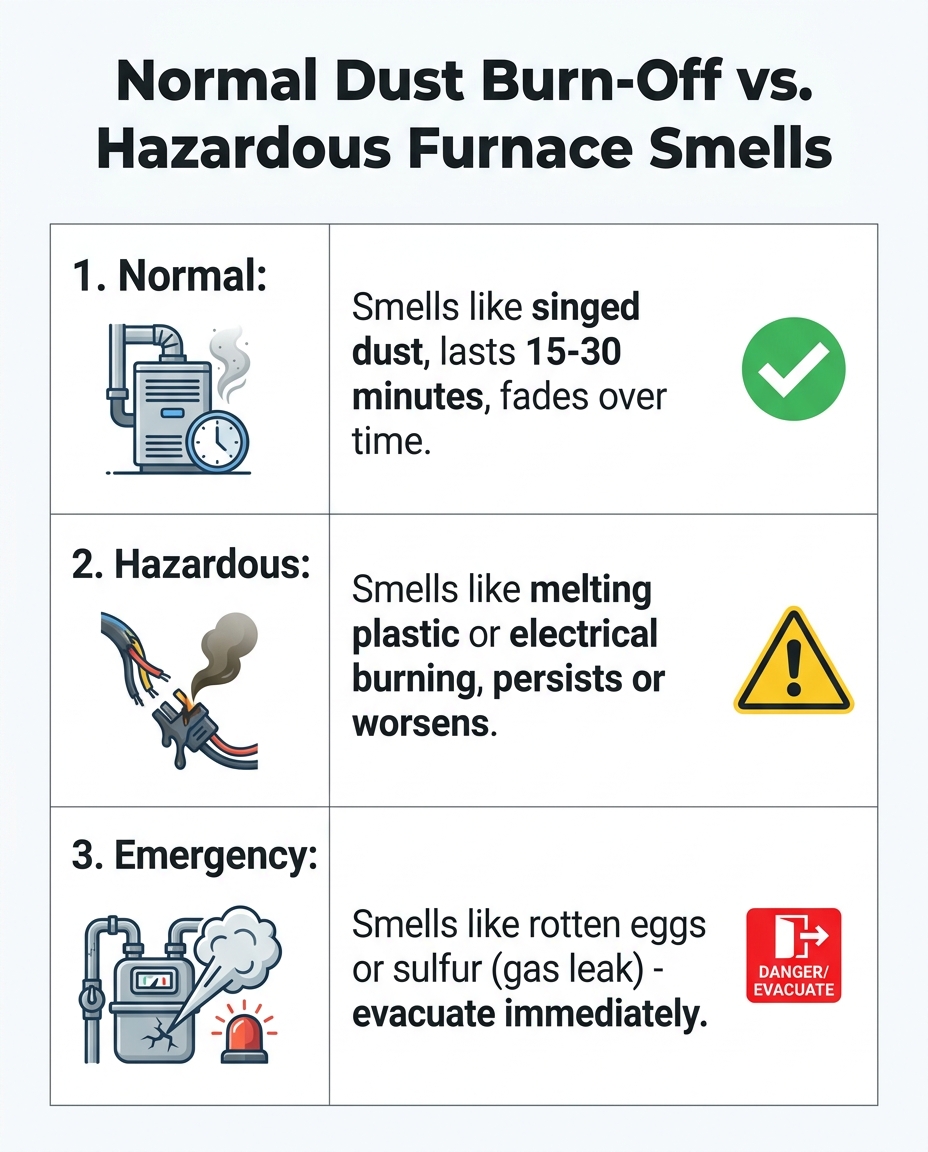
Understanding the subtle differences in odors can save your furnace from catastrophic damage and keep your family safe. Here is a breakdown of what different smells indicate and how you should react.
• Singed Dust / Hot Iron — Likely Cause: Normal accumulation of summer dust burning off the heat exchanger. — Required Action: Monitor for 15-30 minutes. Open windows. No immediate danger.
• Melting Plastic / Burning Wire — Likely Cause: Failing blower motor, seized bearings, or melting electrical wire insulation. — Required Action: Shut off the system at the thermostat immediately. Call a licensed HVAC technician.
• Rotten Eggs / Sulfur — Likely Cause: Natural gas leak. Utility companies add mercaptan to gas to make it smell this way. — Required Action: Evacuate the home immediately. Leave the door open. Call your gas company from outside.
• Acrid Chemical / Ozone — Likely Cause: An overheating transformer or a failing circuit board inside the cabinet. — Required Action: Shut off power at the breaker panel. Do not attempt to reset the system.
Persistent burning smells that do not fit the profile of a gas leak or an electrical fire can also be problematic. If that dry, dusty odor lasts longer than an hour, or if it returns every single time the furnace cycles on over the next few days, it points to a deeper mechanical issue. This often indicates that the system is overheating due to severely restricted airflow, which requires professional diagnosis. Never attempt DIY repairs on gas or electrical components.

How Your Air Filter Impacts Fall Transition Smells
The severity of that first-turn-on smell is directly tied to how you managed your system during the summer. One of the biggest culprits behind an overwhelming burning odor in late September is a neglected air filter. After months of heavy air conditioning use, your filter is likely packed with pollen, dust, and debris.
When you transition to heating without changing that clogged filter, you create a bottleneck in your ductwork. The furnace needs a massive volume of air moving over the heat exchanger to keep the metal at a safe operating temperature. A dirty filter restricts this airflow, causing the furnace to run significantly hotter than designed. This excessive heat bakes the settled dust much harder, creating a stronger, more pungent burning smell that lingers longer in the home.
We highly recommend starting the heating season with a fresh, high-quality pleated filter. Proper filtration minimizes the amount of dust that can bypass the filter and settle on the heat exchanger in the first place. If your household struggles with seasonal allergens or if the burning dust smell is particularly bothersome, upgrading your filtration strategy is a wise move. Exploring professional indoor air quality solutions can dramatically reduce the volume of particulate matter circulating through your home year-round.
Beyond the Smell: What If the Air Isn't Actually Warm?
Sometimes, the first heating cycle in Jeannette, PA, delivers the expected burning dust smell, but fails to deliver the one thing you actually want: heat. You might stand over the vent, smell the singed dust, but realize the air blowing against your hand is uncomfortably cool.
This is a frustrating secondary problem that often accompanies the seasonal transition. If your system is running but failing to produce warm air, it usually points to an ignition failure. In older models, an unlit standing pilot light is a common culprit. In modern, high-efficiency systems, the issue is frequently a dirty flame sensor. When the flame sensor becomes coated in carbon buildup, it fails to detect the burner flame and automatically shuts off the gas supply for safety, leaving the blower fan to circulate unheated air.
Before calling for help, perform a few basic homeowner checks. Ensure your thermostat is firmly switched to the "Heat" setting and that the fan switch is set to "Auto" rather than "On." If the fan is set to "On," it will blow continuously, even when the burners are resting, which feels like cold drafts between heating cycles. If you have verified these settings and the house is still chilly, you will need to dig a little deeper into why your heating vents might be blowing cold air.
Preventing the Panic: The Value of Pre-Season Preparation
The absolute best way to handle the anxiety of the first-turn-on smell is to prevent it from happening in the first place. You do not have to wait for that late September first chilly night to cross your fingers and hope your system operates safely. Proactive preparation eliminates the guesswork.
A professional pre-season tune-up addresses the root cause of the burning smell before you ever touch the thermostat. During a comprehensive maintenance visit, a licensed technician safely and meticulously cleans the burner assembly and the heat exchanger, removing the summer dust buildup so there is nothing left to burn off. More importantly, this visit provides true peace of mind. The technician will test the electrical components for signs of failure, inspect the heat exchanger for microscopic, dangerous cracks, and verify that all gas connections are secure and leak-free.
For homeowners who want to completely automate this preparation, enrolling in a structured program like the Cochran Comfort Contract is the ideal solution. This proactive approach ensures your system receives priority cleaning and safety checks long before the cold weather hits. Investing in a reliable preventative HVAC maintenance plan means you can switch your thermostat to heat with total confidence, knowing the equipment is clean, calibrated, and safe.
Frequently Asked Questions About Fall Furnace Smells
Is it normal for a heater to smell like burning when first turned on?
Yes, a brief burning smell is a completely normal part of the seasonal transition. Over the summer months, dust, pet dander, and microscopic debris settle on the cold metal of your furnace's heat exchanger. When you turn on the heat for the first time, the sudden high temperatures instantly incinerate this thin layer of dust, producing a dry, earthy burning odor that travels through your vents.
How long does the burning smell last when you turn on the heater?
A normal dust burn-off smell should begin to dissipate within 15 to 30 minutes of the first heating cycle. By the time the furnace completes its first full run, the odor should be noticeably fading. If the smell persists for more than an hour, or if it returns every time the system kicks on over the next few days, it indicates a problem that requires professional attention.
Can a dirty furnace filter cause a burning smell?
Absolutely. A clogged air filter restricts the volume of air flowing through your ductwork. Without enough cool air moving over the heat exchanger to regulate its temperature, the furnace runs much hotter than it should. This excessive heat exacerbates the burning dust smell and can eventually cause the system to overheat and shut down entirely.
What does a gas leak smell like from a furnace?
A natural gas leak smells distinctly like rotten eggs or sulfur. Because natural gas is naturally odorless, utility companies add a harmless chemical called mercaptan to give it this highly noticeable, unpleasant scent for safety detection. If you ever smell rotten eggs near your furnace or vents, evacuate the home immediately and call your gas provider from outside.
Should I open my windows when turning on the heater for the first time?
Yes, opening a few windows is a great strategy during that first 30-minute run. Creating a cross-breeze helps ventilate the incinerated dust particles and clears the harmless odor out of your home much faster. Once the smell has faded, you can close the windows and let the system bring the house up to your desired temperature.
When should I worry about a burning smell from my heater?
You should worry and take immediate action if the smell resembles melting plastic, burning electrical wires, or an acrid chemical odor. These scents indicate failing motors, melting wire insulation, or overheating circuit boards. If you detect any of these sharp, unnatural smells, turn off the system at the thermostat immediately and contact a licensed HVAC technician.
Enjoy a Safe, Odor-Free Winter
Experiencing a brief burning dust smell on that late September first chilly night is a completely normal part of owning a home. By understanding the 15-to-30 minute rule and knowing exactly what scents to watch out for, you can navigate the seasonal transition calmly and safely.
However, true peace of mind comes from knowing your equipment is safe, rather than just guessing. Clear, immediate reassurance is what every homeowner deserves when the temperatures drop. Don't wait until the deep winter freeze sets in to find out if your system is struggling. Schedule your professional fall preparation services today, ensure your heat exchanger is clean and safe, and enjoy a warm, odor-free home all season long.