The Hidden Cost of Delaying a 24-Hour HVAC Repair Call Until Morning
The Midnight Dilemma: Recognizing a Hidden HVAC Threat
Your furnace kicks on to fight off a sudden chill, but instead of a steady flow of warm air, you notice weak airflow and a faint, acrid electrical odor coming from the vents. It is a stressful, frustrating scenario that forces a tough late-night choice. Understanding The Hidden Cost of Delaying a 24-Hour HVAC Repair Call Until Morning is critical for any homeowner facing a sudden system malfunction. Many people debate whether an unusual noise or a slight burning smell is a true emergency, or if they can just shut the bedroom door and wait for regular business hours to save the hassle.
For comprehensive support when these issues strike, professional HVAC services can triage the problem before it escalates into a catastrophic failure.
While personal comfort is certainly a major factor in this decision, the real danger is not just waking up to a cold house. The true threat lies in the unseen, cascading mechanical and electrical damage happening inside your unit's cabinet. When a component begins to fail, it rarely fails in isolation. A struggling part forces other components to work harder, pulling more electricity and generating dangerous levels of heat. Here in Jeannette, our team at Cochran Heating & Cooling sees this exact scenario every year. A sudden September early fall cold snap often catches homeowners off guard, prompting them to turn on a system that has been dormant for months. When that system exhibits warning signs, brushing them off until morning is a gamble that puts your most expensive equipment at risk.
What Happens During a Blower Motor Short?
To understand why waiting is so dangerous, you have to look at the mechanics of your system's hardest-working component: the blower motor. The blower motor is responsible for pushing conditioned air through your home's ductwork. It interacts with the broader system constantly, acting as the lungs of your HVAC setup. When this motor is healthy, it spins freely and draws a predictable, safe amount of electricity.
However, when a minor electrical short occurs within the motor housing—often due to degraded insulation on the copper windings or worn-out bearings creating internal friction—the motor suddenly has to fight just to turn. This creates a serious problem. A struggling motor begins pulling an excessive electrical amperage draw to keep functioning. It demands more and more power from your home's electrical panel to overcome the internal resistance. In our years of dispatching emergency repair crews, we have found that this excessive electrical draw is the root cause of many major fall heating breakdowns.
The problem: The motor is shorting out and demanding dangerous levels of electricity.
The cause: Internal wear, friction, or degraded wiring insulation forces the motor to pull more current to maintain its required speed.
The solution: Shutting the system down immediately and bringing in a professional to measure the amperage and replace the failing motor before the overdraw damages other parts.
The Invisible Strain on Your System
The most deceptive part of a blower motor short is how quietly it can happen. Electrical resistance builds up inside the failing motor, generating intense heat within the metal casing. You might only notice a subtle warning sign, like a faint burning plastic smell or a low humming noise.
Many homeowners assume that if an electrical issue were truly dangerous, the circuit breaker would trip immediately. Unfortunately, this is a dangerous misconception. Circuit breakers are designed to protect your home's main wiring from catching fire, not to protect the highly sensitive microelectronics inside your HVAC cabinet. A motor can pull an excessive electrical amperage draw for hours—enough to melt internal HVAC components—without ever crossing the threshold required to trip the main household breaker. This allows the invisible strain to continue unchecked all night long.
Why Early Fall Heating Cycles Are Particularly Vulnerable
HVAC emergencies do not happen in a vacuum; they are heavily influenced by seasonal transitions. During the long summer months, dust, pet dander, and microscopic debris settle onto the dormant components of your heating system. Additionally, off-season humidity can cause slight corrosion on sensitive electrical contacts and relays.
When a sudden September early fall cold snap hits Pennsylvania, it prompts the very first furnace cycles of the year. This initial wake-up call forces the system to power through months of settled dust and dormant electrical connections. The sudden demand often exposes hidden electrical faults that developed over the summer. Because these cold snaps frequently happen overnight, homeowners are caught off guard by a system that worked perfectly last spring but is now struggling to operate.
Addressing these dormant issues safely requires a professional touch. Securing expert heating system repair during this critical transition period is frequently needed to ensure that a minor off-season electrical fault does not turn into a major safety hazard. As local HVAC professionals, we always advise our customers that the first few heating cycles are a stress test for your equipment, and ignoring the warning signs during this vulnerable time is a recipe for a severe breakdown.
The 8-Hour Domino Effect: Frying the Control Board
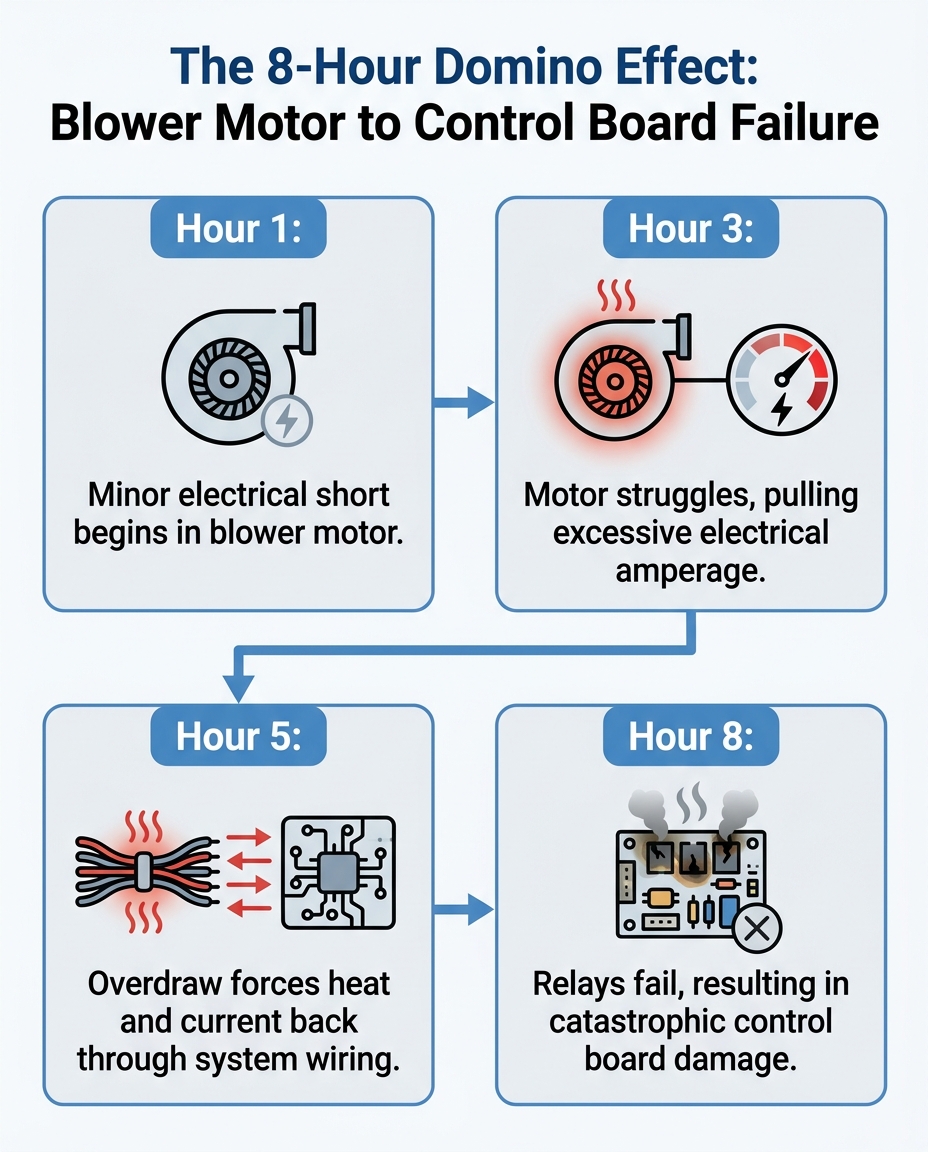
Making the decision to leave a struggling, shorting blower motor running overnight sets a catastrophic chain reaction into motion. What begins as an isolated issue with a single moving part quickly spreads through the system's electrical pathways. The main control board, which acts as the brain of your furnace, is highly sensitive to electrical overloads. Based on the fried control boards our technicians frequently replace, here is the exact timeline of what happens when a minor short is left to run for an 8-hour stretch.
Hour 1-3: The Initial Overload
1. RPM Drop: The blower motor begins to struggle against internal friction or a minor short, causing its rotations per minute (RPMs) to drop.
2. Current Spike: To compensate for the loss of speed, the motor demands more power, resulting in an excessive electrical amperage draw.
3. Heat Generation: The internal copper windings and surrounding wiring begin to overheat as they carry more electrical current than they were designed to handle.
Hour 4-8: Cascading Component Failure
1. Thermal Pushback: The excessive load forces intense heat and electrical current to travel back up the wiring harness toward the main control board.
2. Relay Melting: The electrical relays on the control board—small switches designed to handle precise amounts of current—begin to overheat and melt.
3. Catastrophic Failure: The relays weld shut or fail completely, permanently damaging the board's complex circuitry. What was originally a straightforward motor swap is now a massive, multi-part failure.

Comfort Emergencies vs. Mechanical Preservation
To make the right call in the middle of the night, it is helpful to shift your perspective on what actually constitutes an HVAC emergency. Homeowners typically judge an emergency solely by the temperature of the house. However, from a technical standpoint, emergencies are divided into two distinct categories: comfort emergencies and mechanical-preservation emergencies.
If you are experiencing a mechanical-preservation emergency, turning the system off entirely at the thermostat is the most critical step you can take if you are waiting for a technician. Just as a neglected, grinding noise in July requires extensive air conditioning service because it destroys the compressor, ignoring furnace warning signs in the fall leads to severe winter breakdowns.
• Comfort Emergency — Typical Symptoms: System won't turn on at all; house is gradually getting chilly. — Primary Risk: Uncomfortable indoor temperatures. — Recommended Action: Safe to wait until morning if outdoor weather permits.
• Mechanical Preservation — Typical Symptoms: System is running but emitting burning smells, loud grinding, or buzzing. — Primary Risk: Cascading electrical damage; fire hazard; ruined control board. — Recommended Action: Shut system off immediately; call for 24-hour intervention.
Warning Signs That Demand Immediate 24-Hour Intervention
Knowing exactly when to pick up the phone can save your equipment from total failure. If you observe any of the following symptoms, the situation has escalated past a simple comfort issue. These are technically grounded criteria indicating that your system is actively damaging itself.
• A distinct burning electrical or ozone smell: While a brief, dusty smell is normal during the very first cycle of the year, a persistent odor of melting plastic or ozone emanating from the vents means wires or relays are actively overheating.
• Loud humming, buzzing, or grinding noises: A low, vibrating hum from the blower compartment usually means a motor is receiving power but cannot spin, causing an immediate and massive amperage spike. Grinding indicates destroyed bearings.
• Continuous running without reaching the set temperature: If your system runs for hours but the house is not warming up, it indicates a severe internal struggle. The equipment is working at maximum capacity without moving enough conditioned air.
When these signs appear, securing prompt 24-hour HVAC repair stops the electrical overdraw in its tracks before it reaches the highly sensitive control board.
How Prompt Professional Action Protects Your Investment
A midnight service call is not just about restoring heat to your home; it is about critical system triage. When a professional arrives, their first priority is to diagnose the electrical flow of the system. Technicians carry specialized diagnostic tools, such as digital multimeters, to identify amperage spikes instantly. By measuring exactly how much power the blower motor is pulling, they can pinpoint the short before it causes secondary damage.
Addressing the root cause safely preserves the expensive control board. Homeowners relying on emergency HVAC services in Westmoreland County benefit from our localized expertise that understands the unique demands of the region. During the fall transition, temperatures in Jeannette PA and surrounding Westmoreland County can drop sharply into the 40s overnight. This sudden demand makes reliable, immediate heating essential.
More importantly, choosing a family-owned intervention like Cochran Heating & Cooling means you are getting a protective approach to service. The goal of a prompt, late-night repair is to isolate a failing part and save the customer from the massive expense of a full-system replacement. It is about protecting your long-term investment, not just applying a quick bandage.
Frequently Asked Questions About HVAC Emergencies
Can a bad blower motor ruin a furnace control board?
Yes, a failing blower motor can absolutely ruin a furnace control board. When a motor struggles to spin, it draws excess electrical amperage from the system to compensate. This excessive current travels back through the wiring harness, which can overheat and permanently melt the sensitive relays on the main control board, turning a single-part repair into a major system failure.
Is a burning smell from a furnace an emergency?
It depends on the type of smell and how long it lasts. While an initial dust burn-off smell is completely normal during the first heating cycle of early fall, a persistent electrical, metallic, or plastic burning smell is a clear emergency. This specific odor indicates that internal components are overheating and actively melting, requiring immediate shutdown and professional diagnosis.
What is considered an HVAC emergency?
An HVAC emergency is any situation that threatens the safety of your home or the mechanical survival of the equipment. Any situation involving electrical burning smells, visible sparking, loud grinding noises, suspected gas leaks, or a complete loss of heat during freezing temperatures requires immediate professional attention. These issues should never be left to run overnight.
Is it safe to run a furnace that smells like burning?
No, it is not safe to continue running a furnace that emits an electrical burning odor. If the smell is electrical in nature, running the system risks cascading damage to the control board or causing a serious fire hazard. You should shut the system down completely at the thermostat and call a professional technician to safely locate the source of the overheating.
How quickly can an electrical short damage my HVAC system?
Significant electrical damage can occur within just a few hours. In our experience, leaving a shorted component, like a struggling blower motor, running overnight is often more than enough time to cause catastrophic secondary failures. The continuous excessive amperage draw generates intense heat that quickly overwhelms the system's relays and circuit boards.
Making the Smart Call for Your System's Longevity
Ultimately, waiting until morning to address a strange noise or an electrical odor is a gamble that often results in extensive electrical damage. The hidden cost of delaying a 24-hour HVAC repair call until morning is almost always paid in the form of ruined control boards, melted wiring, and premature system replacements. A clear, technically grounded understanding of your system's limits is your best defense against these cascading failures.
At Cochran Heating & Cooling, we encourage homeowners to prioritize mechanical preservation. By seeking an expert diagnosis the moment warning signs appear, you ensure that a minor component issue is caught early. Having the definitive criteria to make that emergency call gives you the power to protect your home, your comfort, and your investment for years to come.