Navigating Permits for AC Installation in Historic Cochrane Neighborhoods

The Challenge of Upgrading HVAC Systems in Regulated Neighborhoods
Your aging climate control system is finally struggling to keep up, but finding a replacement isn't as simple as swapping out the outdoor unit. When you are navigating permits for AC installation in historic Cochrane neighborhoods, you are immediately confronted with a strict set of municipal codes and preservation guidelines. At Cochran Heating & Cooling, a pattern we see often during the September pre-heating-season transition is that standard, off-the-shelf exterior units frequently violate the aesthetic and structural rules designed to protect the character of older districts. Instead of a straightforward swap, replacing an aging unit becomes a complex negotiation between modern technology and historical preservation.
This creates a significant decision point: you must carefully select an equipment profile that satisfies both your modern comfort needs and the stringent local regulations. Upgrading your system requires more than just picking a reputable brand; it requires a strategic approach to municipal compliance, focusing heavily on footprint, decibel ratings, and visual sightlines. If you need assistance planning your next project, explore our Air Conditioning Services to ensure your home remains comfortable without running afoul of the local historical review board. Acting proactively during the early fall transition is crucial before winter heating demands begin and emergency replacements become impossible to push through slow municipal approval processes.
Understanding Aesthetic and Structural Regulations
The baseline rules for exterior alterations in older neighborhoods are designed to maintain the architectural integrity of the community. Historical preservation boards evaluate any exterior modifications with a strict focus on public sightlines. If a piece of modern mechanical equipment can be seen from the street, the sidewalk, or a public alleyway, it is subject to intense scrutiny. For historic districts in Jeannette PA, these aesthetic guidelines dictate exactly where a new outdoor unit can be placed, often restricting installations entirely to the rear of the property or deep within a side yard.
Beyond just the placement of the unit itself, structural regulations heavily limit how the system connects to the inside of your home. Standard installations often involve running copper line-sets and electrical conduits up the exterior siding of a house. Over our years of serving the Jeannette area, our team has learned that in regulated neighborhoods, this is frequently rejected. Preservation boards require that historical building materials—such as original brickwork, stone masonry, or century-old wood siding—be protected from unnecessary penetrations. Line-sets must often be routed internally through basements or concealed within existing architectural features, which requires careful planning before a central air installation can even be proposed to the city.
Furthermore, visual screening is almost always a mandatory condition for permit approval. Even if a unit is placed in a side yard, the municipality will likely require a detailed screening plan. This typically involves:
• Custom lattice fencing: Built to match the historical era of the home and painted in approved historical color palettes.
• Evergreen landscaping: Planting dense shrubs that provide year-round concealment of the mechanical equipment.
• Masonry walls: Constructing low brick or stone barriers that match the home's original foundation materials.
These structural and aesthetic rules directly impact the physical footprint available for new outdoor units. If you are required to build a fence around the system while maintaining the manufacturer's required airflow clearances, a traditional bulky cube unit may simply not fit in the allowable space.
Acoustic Compliance: Meeting Municipal Noise Ordinances
While visual aesthetics are the most obvious hurdle, acoustic compliance is often the unseen barrier that causes permit applications to be denied. Noise ordinances are strictly enforced in older neighborhoods because homes are typically built much closer together than in modern subdivisions. When houses are separated by only a narrow alley or a few feet of side yard, the hum of a large compressor can easily become a nuisance to neighbors, violating local noise statutes.
Municipal codes generally measure decibels at the property line, not right next to the unit. This means that the sound your system makes must dissipate significantly before it reaches your neighbor's yard. In historic districts in Jeannette PA, the dense layout and abundance of hard surfaces like brick and stone foundations can actually amplify sound. When an outdoor unit kicks on, the sound waves bounce off the masonry walls, creating a reverberation effect that pushes the decibel reading higher at the property line than it would be in an open field.
The acoustic solution our technicians typically recommend: Modern, high-efficiency heat pumps are engineered to address this exact challenge. Many top-tier models utilize inverter-driven compressors and swept-wing fan blades that allow them to operate at sound levels as low as 50 decibels. For context, 50 decibels is roughly equivalent to the sound of a quiet conversation or a gentle rainfall. By selecting equipment specifically rated for ultra-quiet operation, homeowners can easily satisfy strict acoustic requirements and maintain good relationships with their neighbors.
Proper positioning also plays a vital role in acoustic compliance. Installers must evaluate the acoustic properties of the proposed location. Placing a unit in a narrow corridor between two brick walls will trap and amplify the sound. Instead, units should be positioned in areas with softer landscaping to absorb sound waves, or fitted with specialized acoustic blankets if local codes require even further noise reduction.
Equipment Selection: Profiles Designed for Regulatory Compliance
In highly regulated neighborhoods, equipment selection must be viewed as a compliance strategy rather than just a comfort choice. You cannot simply purchase the largest, most powerful unit available; you must choose a system whose physical and acoustic profile aligns perfectly with the restrictions of your property line and the historical review board's guidelines.
Side-Discharge vs. Traditional Units
One of the most effective solutions we install for historic homes is the side-discharge heat pump. Unlike traditional cube-style central units that exhaust air out the top and require massive amounts of vertical and horizontal clearance, side-discharge units are built with a slim, suitcase-like profile. They draw air in through the back and blow it out the front, allowing them to be installed much closer to exterior walls and tucked into narrow side yards where traditional units would never fit.
• Physical Footprint — Traditional Cube Unit: Large and bulky; requires significant yard space. — Side-Discharge Heat Pump: Slim and compact; ideal for narrow property lines.
• Visual Profile — Traditional Cube Unit: Difficult to hide; requires extensive screening. — Side-Discharge Heat Pump: Low profile; easily concealed behind small shrubs.
• Decibel Output — Traditional Cube Unit: Often 70+ decibels; risks noise ordinance violations. — Side-Discharge Heat Pump: Can operate as low as 50 decibels; highly compliant.
• Clearance Needs — Traditional Cube Unit: Requires wide vertical and horizontal airflow space. — Side-Discharge Heat Pump: Requires minimal clearance; can be placed near walls.
This slim profile provides massive visual benefits for historical sightline compliance. Because they are shorter and narrower, they require far less aggressive visual screening. A simple row of small evergreen bushes is often enough to completely hide a side-discharge unit from the street, satisfying the preservation board without eating up valuable outdoor living space.
Additionally, these modern systems are highly energy-efficient. Upgrading to advanced side-discharge or ultra-quiet models may qualify you for general energy rebates or federal tax credits designed to encourage the adoption of high-efficiency heat pumps. We always recommend exploring HVAC financing options and verifying current incentive programs with your utility provider or a tax professional to maximize your investment.
Timing the Installation: The Early Fall Window
Over years of submitting applications, we've found that securing an HVAC permit in a historic district is not a rapid process. While a standard suburban replacement might be approved over the counter in a single afternoon, historic district applications often require review board meetings. These boards typically meet only once a month, meaning that a single missing document or rejected site plan can delay your installation by four to eight weeks.
This bureaucratic reality makes the September pre-heating-season transition the most critical window of the year for homeowners. As the region transitions from humid summer cooling to the need for reliable winter heating in Jeannette, PA, securing permits for dual-purpose heat pumps becomes an urgent priority. If your aging system has been struggling through August, waiting until the first frost to initiate a replacement is a risky gamble.
The risks of waiting:
• Winter emergencies: If your system fails completely in December, you will be left without heat while waiting for municipal approvals. Emergency replacements are severely complicated by slow review boards.
• Contractor availability: Once the cold weather hits, HVAC technicians are booked solid with emergency no-heat calls, making it harder to schedule the meticulous, code-compliant installation required for a historic home.
• Temporary heating costs: Relying on inefficient space heaters while waiting for a permit can cause your winter electricity bills to skyrocket.
By submitting your application in early fall, you build a buffer for the bureaucratic process. Even if the board requests a revision to your visual screening plan, you will still have time to secure approval and complete the installation before the deep freeze arrives. If you find yourself dealing with sudden breakdowns during this transition period, our team can provide emergency AC repair in Westmoreland County to keep your current system limping along while your new permit is being processed.
Navigating the Application and Approval Process
Securing a permit in a strictly regulated zone requires meticulous attention to detail. A haphazard application will almost certainly be rejected, causing weeks of unnecessary delays. By following a structured, expert approach, you can navigate the municipal hurdles smoothly.
Here are the standard steps required for a successful application in older districts:
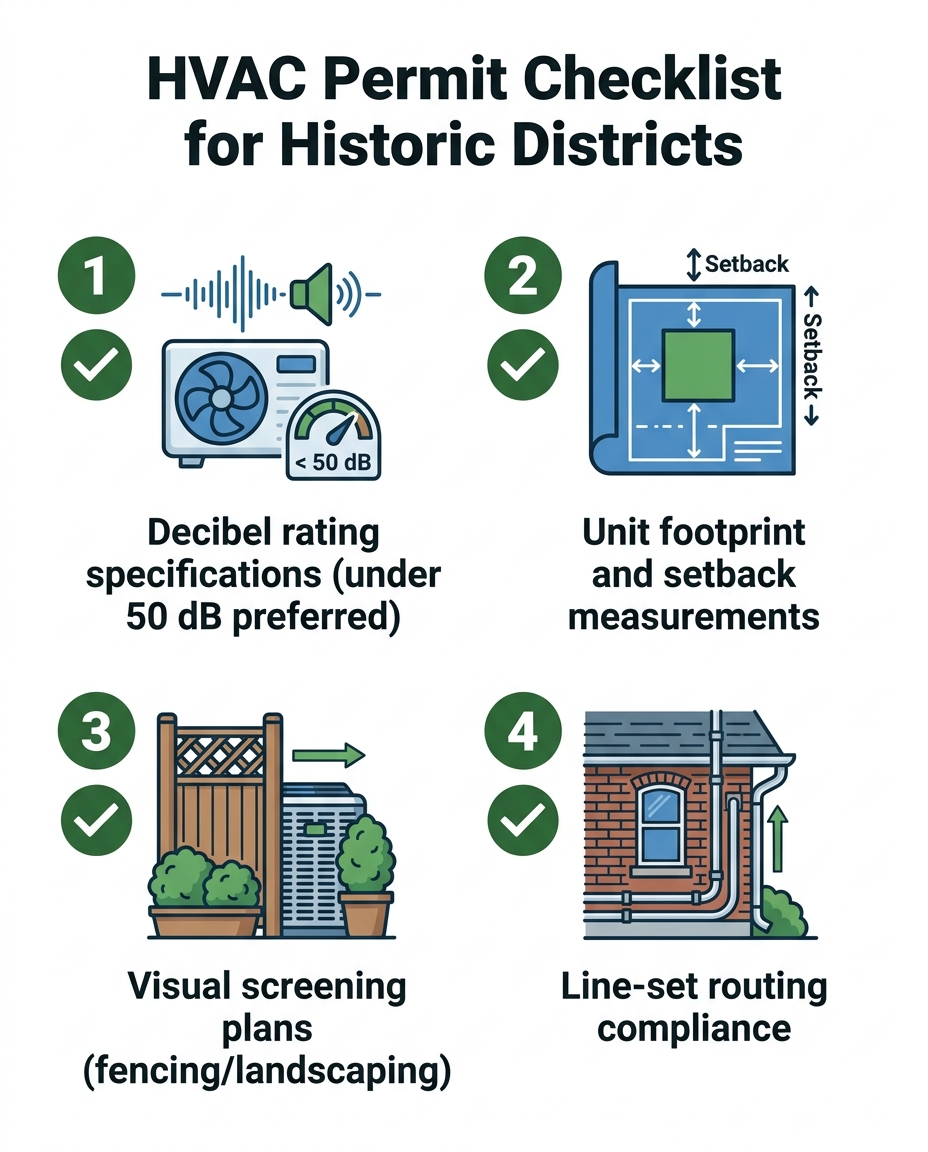
1. Gather comprehensive equipment specifications: The review board will not take your word that the unit is quiet and small. You must submit official manufacturer spec sheets detailing the exact dimensions, airflow clearance requirements, and certified decibel (dBA) ratings.
2. Develop a detailed site plan: This is often the most scrutinized document. Your site plan must show the exact property lines, the setbacks from neighboring structures, the proposed location of the outdoor unit, and the precise routing of the line-sets to avoid damaging historic brickwork.
3. Design a visual screening proposal: Include drawings or photographs of the proposed lattice fencing or landscaping that will obscure the unit from public sightlines. Ensure the materials proposed match the historical era of the home.
4. Submit an acoustic impact assessment: In highly dense historic districts in Jeannette PA, you may need to demonstrate that the 50-decibel output of your chosen unit will not violate the property line noise ordinance when factoring in the distance to the neighbor's home.
Working with the Cochran Heating & Cooling team ensures you have technicians with first-hand experience navigating Jeannette and Cochrane municipal codes to produce accurate, compliant permit applications. Technicians who understand the specific quirks of local review boards know exactly how to format site plans and which equipment profiles are most likely to be approved on the first pass. This local expertise prevents common pitfalls, such as submitting incomplete paperwork or proposing structural modifications that ignore preservation guidelines. To see if your historic home falls within our primary coverage zones, check our local service areas.

Secure Your Permit and Upgrade Your Comfort Before Winter
Successfully upgrading an HVAC system in an older neighborhood requires a delicate balance between leveraging modern climate technology and respecting strict historical compliance. From managing decibel outputs to designing creative visual screening, every step of the process must be carefully planned to satisfy local municipal codes.
The September pre-heating-season transition is your best opportunity to navigate these bureaucratic hurdles without the stress of looming winter weather. Do not wait for your aging system to fail when the temperatures drop. At Cochran Heating & Cooling, we encourage you to consult with local experts who understand the specific municipal requirements of your area, ensuring your permit application is approved smoothly and your home remains perfectly comfortable all winter long.
Frequently Asked Questions
How do I get HVAC approved in a historic district?
Getting approval requires submitting a highly detailed application to your local historical preservation board. You must provide a site plan showing exact property lines, manufacturer spec sheets proving low decibel ratings, and a clear proposal for visual screening. Working with a contractor familiar with local municipal codes is the best way to ensure your application meets all structural and aesthetic requirements on the first try.
What is the quietest outdoor AC unit?
The quietest outdoor units are typically modern, inverter-driven side-discharge heat pumps and variable-speed air conditioners. These systems utilize swept-wing fan blades and sound-dampening compressor blankets to operate at sound levels as low as 50 decibels. Choosing one of these ultra-quiet models is often necessary to comply with strict property-line noise ordinances in dense, older neighborhoods.
Do you need a permit to replace a heat pump in PA?
The short answer is yes, virtually all municipalities require a building or mechanical permit to replace a heat pump or central AC system. In historic districts, this process is even more rigorous, often requiring additional approval from an architectural review board. Skipping the permit process can result in heavy fines, forced removal of the equipment, and complications when trying to sell the property.
Can you put central air in a historic home?
Yes, you can install central air in a historic home, but it requires careful planning to protect the building's architectural integrity. Installers often use slim-profile outdoor units to minimize the exterior footprint and route line-sets internally to avoid drilling through original brick or stone. In homes without existing ductwork, small-duct high-velocity systems or ductless mini-splits are frequently used to provide cooling without destroying original plaster walls.
What are the noise regulations for outdoor AC units?
Noise regulations vary by municipality but generally restrict the amount of sound that can cross your property line, often capping it between 50 and 60 decibels (dBA). In densely packed older neighborhoods, standard cube-style units that generate 70+ decibels will frequently violate these ordinances. Upgrading to a low-decibel, variable-speed unit is the most reliable way to stay compliant and avoid noise complaints from neighbors.
How do you properly hide an AC unit to meet historic district guidelines?
Historic guidelines usually require that outdoor mechanical equipment be completely obscured from public sightlines like streets and sidewalks. This is typically achieved by installing custom lattice fencing painted in approved historical colors or planting dense, evergreen landscaping around the unit. The screening must be designed carefully to hide the equipment while still allowing the manufacturer-required clearances for proper airflow.