

AC Installation in Cedar Manor: Navigating Late-Summer Replacements Before Fall
The Dilemma of the Lingering Heat: Pushing Through or Upgrading Now
If your aging unit is audibly struggling against the heavy humidity, planning an AC Installation in Cedar Manor: Navigating Late-Summer Replacements Before Fall is the smartest move you can make for your home's long-term comfort. Your air conditioner might be running nonstop, but the house still feels uncomfortably warm. You are facing a tough decision: push this failing system through the rest of the season and risk a total breakdown, or replace it right now. The late summer to early fall transition in September offers a narrow, ideal window to address this problem properly, forcing a choice between a rushed emergency fix or a calculated, high-efficiency upgrade.
When you need reliable air conditioning services, securing a proper central air installation ensures your home stays comfortable year-round.
In our years of experience serving the Jeannette, PA area, our team at Cochran Heating & Cooling has seen firsthand the specific climate realities local homeowners face. The late summer heat often lingers heavily through August, but it transitions quickly into a crisp autumn. This rapid shift creates a very specific timeline for homeowners. If your system is failing now, trying to squeeze a few more weeks of life out of it is a gamble we rarely advise our customers to take. A sudden failure on an 85-degree day leaves your family sweating, while waiting too long pushes your installation into the heating season.
Older homes present unique challenges that make rushed, peak-season replacements incredibly risky. When a contractor is hurrying to get your cooling back on during a heatwave, they rarely have the time to evaluate the surrounding infrastructure. They focus entirely on swapping the broken machine. However, modern high-efficiency systems interact differently with older homes. Rushing this process almost guarantees that underlying airflow issues will be ignored, leading to a new system that underperforms from day one.
The necessity of proper evaluation:
• Airflow mapping: Older ductwork must be measured to ensure it can handle modern blower speeds.
• Load calculations: Your home's cooling requirements change over time as windows are replaced or insulation is added.
• Transition timing: Using the late summer to early fall transition in September gives technicians the time to perform these critical evaluations without leaving your home dangerously hot.
Understanding Cedar Manor's Unique Architectural Challenges
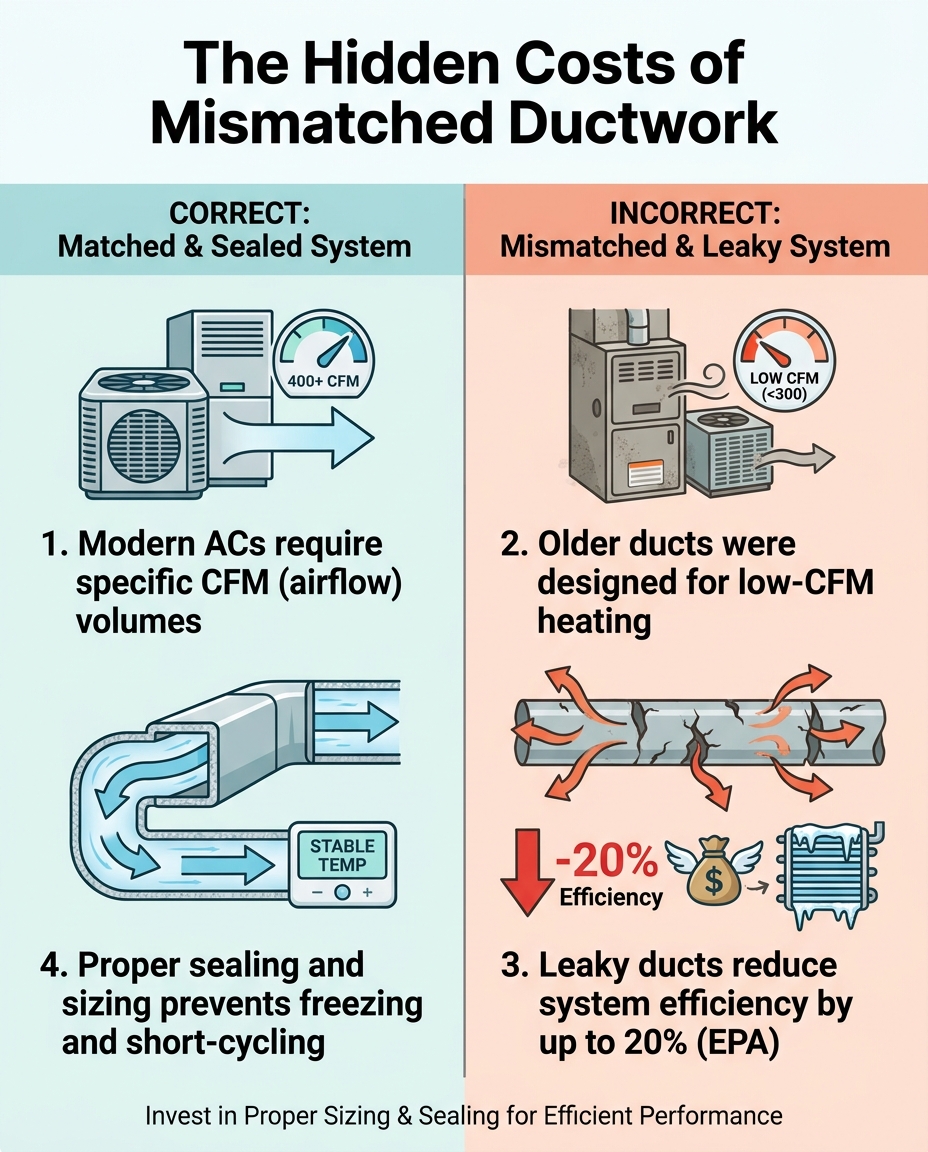
Every neighborhood has its own construction history, and the housing stock in Cedar Manor dictates exactly how your HVAC infrastructure behaves. In our time working inside these historical builds, we've noticed that many of these homes were constructed during eras when central cooling was an afterthought, or when heating was the primary focus of the ductwork design. This legacy ductwork was often sized for lower-CFM (Cubic Feet per Minute) heating systems. Furnaces push very hot air slowly, while modern air conditioners need to push a massive volume of cooler air quickly to dehumidify and cool the space.
Working with a family-owned business that understands Cedar Manor's specific historical builds means your new system is designed to match your home's unique footprint, rather than just forcing a generic unit into an old space. Ignoring the original architectural design during a retrofit is a recipe for disaster. When a powerful modern system tries to force high volumes of air through narrow, legacy ducts, the system chokes. This leads to poor airflow in upstairs bedrooms, uneven cooling across the main floor, and premature wear on the new equipment.
Because these homes span different construction eras, the ductwork materials and layouts vary wildly. Some feature rigid sheet metal that has settled and leaked over decades, while others have early flexible ducting that has degraded. A thorough evaluation of your home's specific layout is required before any new equipment is selected. If you are exploring our local service areas, you will find that homes in this specific neighborhood require a tailored approach to airflow management.
The Mismatch Between Old Ducts and Modern Blowers
Modern high-efficiency units push a significantly higher volume of air than older, single-stage systems. They use variable-speed blowers designed to run longer cycles at lower speeds to maximize dehumidification. However, connecting a powerful new variable-speed blower to undersized ducts creates severe static pressure issues. Think of static pressure like blood pressure for your HVAC system; if the arteries (ducts) are too narrow, the heart (blower motor) has to work dangerously hard to circulate the air.
How proper airflow adjustments protect your system:
• Prevents system freezing: If air cannot move across the indoor coil fast enough, the coil drops below freezing and turns into a block of ice, shutting down your cooling entirely.
• Stops short-cycling: High static pressure causes the system to overheat and shut off prematurely, a process called short-cycling that destroys motors.
• Lowers energy consumption: A blower motor fighting against tight ducts draws significantly more electricity, erasing the energy savings you expected from a new unit.
• Airflow Volume (CFM) — Legacy Ductwork Design: Designed for low-volume, high-heat air delivery. — Modern High-Efficiency Requirements: Requires high-volume, rapid air circulation to cool.
• Static Pressure Tolerance — Legacy Ductwork Design: Built for single-speed, low-pressure motors. — Modern High-Efficiency Requirements: Highly sensitive; high pressure damages variable-speed motors.
• Dehumidification — Legacy Ductwork Design: Relied on short, intense bursts of cooling. — Modern High-Efficiency Requirements: Relies on continuous, steady airflow over the indoor coil.
• Duct Sealing — Legacy Ductwork Design: Often unsealed, allowing air to escape into walls. — Modern High-Efficiency Requirements: Requires airtight seals to maintain strict pressure balances.
Why the 'Box-Swap' Approach Fails in Older Homes
The Problem: A "box-swap" is an industry term for a lazy installation where a technician removes the old air conditioner and furnace and slides the new equipment into the exact same spot, hooking it up to the existing ductwork without any evaluation or modification. In a historical neighborhood like Cedar Manor, our installation team considers this approach a massive red flag. We frequently find that the old system was likely sized incorrectly to begin with, and the ductwork has aged, shifted, and degraded.
The Cause: Contractors often resort to box-swaps to save time and lower their initial bid. However, modern SEER2 efficiency ratings are completely dependent on the surrounding infrastructure. A unit rated for 18 SEER2 will only perform at 10 SEER2 if it cannot breathe. The EPA Energy Star program notes that leaky ducts can reduce system efficiency by up to 20 percent. When you combine leaky ducts with undersized returns, the new equipment is strangled from the moment it is turned on.
The Solution: A successful retrofit requires a comprehensive process of ductwork evaluation, sealing, and modification. Before a single piece of equipment is ordered, the installation team must measure the static pressure of the existing ductwork. They must calculate the exact cooling load of the home. Finally, they must widen return air drops, seal accessible duct seams with mastic, and ensure the airflow matches the manufacturer's strict specifications. This meticulous process ensures the system delivers the comfort and efficiency you paid for.

The Strategic Advantage of a September Installation
Timing your HVAC replacement is just as important as choosing the right equipment. The late summer to early fall transition in September is the absolute optimal time for complex HVAC retrofits. During this window, the weather in Western Pennsylvania undergoes a rapid shift. The sweltering highs drop from the upper 70s and 80s down into the comfortable 60s. This temperature shift creates the perfect shoulder season for major home improvements.
This shoulder season allows for complex, multi-day ductwork modifications without leaving your home dangerously hot or freezing. When a proper installation requires custom sheet metal work, widening return drops, and sealing attic ductwork, the process takes time. If you attempt this in mid-July, your house will quickly reach 90 degrees inside, putting stress on your family and pets. If you wait until November, you risk freezing temperatures at night while the heating system is offline.
Contrast planned shoulder-season replacements with the stress of needing an emergency AC repair in Westmoreland County during a peak summer heatwave. Emergency replacements are inherently rushed. You are forced to make rapid decisions based on whatever equipment happens to be in stock that day. By proactively scheduling your installation during the late summer to early fall transition in September, you ensure thorough, unhurried workmanship. The technicians have the time to calibrate the system perfectly, adjust the blower speeds, and verify the refrigerant charge without racing to the next emergency call. Furthermore, completing the work now ensures everything is locked in before the first deep freeze hits the region.
Preparing Your Entire HVAC System for the Heating Season
It is easy to view an air conditioning installation as a summer-only project, but replacing your cooling system in the fall is actually the ultimate preparation for winter heating. Your central air conditioner and your furnace share the exact same ductwork and the exact same indoor blower motor. When you upgrade your AC, the modifications made to support it directly impact your heating performance.
The ductwork modifications made for the new AC will immediately benefit the home's furnace or heat pump. By widening the return air drops to lower static pressure for the air conditioner, the furnace blower will also operate with much less resistance during the winter. This means warmer air reaches the furthest rooms of your house faster and more quietly. Additionally, sealing the ductwork to prevent cold air from escaping in the summer also prevents warm air loss during the upcoming winter, keeping your utility bills in check year-round.
A comprehensive system evaluation during an AC install can catch underlying furnace issues before winter arrives. Because the technicians must disassemble the indoor plenum to install the new evaporator coil, they get a clear look at your furnace's heat exchanger. This is the perfect time to identify rust, cracks, or wear that might pose a safety risk in January. Using the late summer to early fall transition in September to handle this work gives you total peace of mind. To protect this newly upgraded system, enrolling in a preventative maintenance plan ensures both the heating and cooling cycles remain optimized season after season.
Navigating Energy Efficiency Incentives for Your Upgrade
Upgrading from an outdated, struggling system to a modern high-efficiency unit is a significant investment in your home. Fortunately, navigating this process in Cedar Manor often opens the door to various energy efficiency incentives designed to offset those initial costs. Utility providers and government programs actively encourage homeowners to reduce their energy consumption by switching to modern, load-reducing equipment.
Generic federal tax credits may apply to qualifying high-efficiency AC or heat pump installations under current energy transition programs. These programs are designed to reward homeowners who install equipment meeting strict SEER2 and HSPF2 efficiency standards. However, simply buying a high-efficiency box is not enough to claim these benefits. The system must be installed according to strict guidelines to actually achieve those ratings in the real world.
Proper installation and duct sealing are often prerequisites for maximizing these efficiency benefits. If a unit is installed on leaky, undersized ductwork, it will fail the performance testing required by many incentive programs. We strongly advise homeowners to consult with their utility providers or tax professionals to verify current programs and eligibility requirements before finalizing their equipment choices. By taking a comprehensive approach to your Cedar Manor home's airflow and insulation, you ensure that your new system not only keeps you comfortable but also qualifies for the maximum available incentives.
Frequently Asked Questions
Can I connect a new AC to old ductwork in my historic home?
The short answer is yes, but rarely without modifications. Older ductwork was typically designed for lower airflow volumes, while modern high-efficiency air conditioners require much more air to function properly. Connecting a new unit directly to old, undersized ducts causes high static pressure, which can freeze the system or burn out the blower motor. A thorough evaluation and custom modifications are required for a safe fit.
Why is early fall a good time to replace my air conditioner?
Early fall offers mild temperatures, making it the ideal shoulder season for HVAC replacements. Because your home won't quickly overheat or freeze while the system is turned off, technicians have the time to perform complex, multi-day ductwork modifications without rushing. It also allows you to prepare your entire system for the upcoming winter heating season proactively.
What happens if my ductwork is too small for a new AC?
If your ductwork is too small, the new air conditioner will struggle to push air through the narrow spaces, leading to a spike in static pressure. This causes the blower motor to overwork, resulting in loud whistling noises, uneven cooling in distant rooms, and a drastically shortened lifespan for the equipment. The system will likely short-cycle, turning on and off rapidly without ever dehumidifying the home.
Do I need to replace my furnace when I replace my AC?
While it is not strictly mandatory, replacing both at the same time is highly recommended. The air conditioner and furnace share the same indoor blower motor and ductwork. Matching a brand-new, high-efficiency AC with an aging, inefficient furnace blower often prevents the AC from reaching its rated efficiency and can lead to communication errors between the old and new technology.
How does duct sealing improve my new air conditioner's efficiency?
Duct sealing prevents cooled, conditioned air from escaping into uninsulated spaces like attics, basements, or inside wall cavities. The EPA estimates that leaky ducts can waste up to 20 percent of a system's efficiency. By sealing the seams with mastic or metal tape, all the air you pay to cool is delivered directly to your living spaces, lowering your run times and utility bills.
How long does a complex ductwork and AC retrofit take?
A standard "box swap" might take a single day, but a complex retrofit involving ductwork modifications usually takes two to three days. The process includes measuring airflow, fabricating custom sheet metal transitions, widening return air drops, installing the new equipment, and performing rigorous start-up testing to ensure the static pressure is balanced perfectly.
Expert Guidance for Your Late-Summer Transition
Navigating an AC replacement in older Cedar Manor homes requires precise attention to legacy ductwork and airflow dynamics. By choosing to upgrade during the September shoulder season, you avoid the rush of emergency breakdowns and secure a meticulous, high-efficiency installation. You deserve clear, expert guidance on retrofitting your home properly—ensuring your new system delivers reliable comfort through the lingering heat and perfectly prepares your home for the winter ahead.
