Protecting Your Heat Pump Compressor from Early Frost Accumulation
The Hidden Threat of Late Fall Freezing Rain on Your HVAC
When late October weather shifts suddenly in southwestern Pennsylvania, protecting your heat pump compressor from early frost accumulation becomes a top priority for local homeowners. The late October transition period often brings a volatile mix of dropping temperatures and heavy precipitation. You might go to bed with clear skies and wake up to find your outdoor unit completely encased in a thick, unyielding shell of ice. While a thin, powdery layer of white frost is a completely normal byproduct of transferring heat, heavy freezing rain introduces a severe mechanical threat to your equipment.
The sudden accumulation of dense ice blocks the airflow your system desperately needs to function. As a result, your equipment works twice as hard to produce half the heat. In our years of experience servicing heat pump systems across Westmoreland County, our technicians have found that the difference between a harmless weather event and a ruined compressor comes down to a single decision point. Homeowners must know exactly when to let the system run its automated clearing process and when to intervene. Ignoring the signs of a struggling unit during a late-fall storm can turn a minor inconvenience into a major mid-winter breakdown.
Normal Frost Formation vs. Dangerous Ice Buildup
To protect your equipment, you first need to understand why frost happens in the first place. When outdoor temperatures drop below 40 degrees Fahrenheit, the refrigerant inside your outdoor coil is even colder. As the fan pulls outside air across these freezing coils to extract ambient heat, any moisture in that air condenses and freezes on the metal fins.
Our team sees this process constantly across our service area. In our experience, the sharp late-October transition in southwestern PA, combined with the high humidity and near-freezing precipitation typical in Jeannette and Greensburg, creates the perfect environment for rapid frost development. A normal layer of frost looks like a light dusting of snow or white powder evenly coating the sides of the unit. Your system is designed to handle this effortlessly.
Dangerous ice buildup, however, is a completely different story. When unpredictable freezing rain coats the unit, it does not form a light powder. Instead, it creates a solid, clear casing of heavy ice. This dense layer bridges the gap between the aluminum fins, completely suffocating the airflow. While a standard automated cycle easily melts away morning frost, we frequently see systems severely struggle against the solid ice armor left behind by a freezing rainstorm.
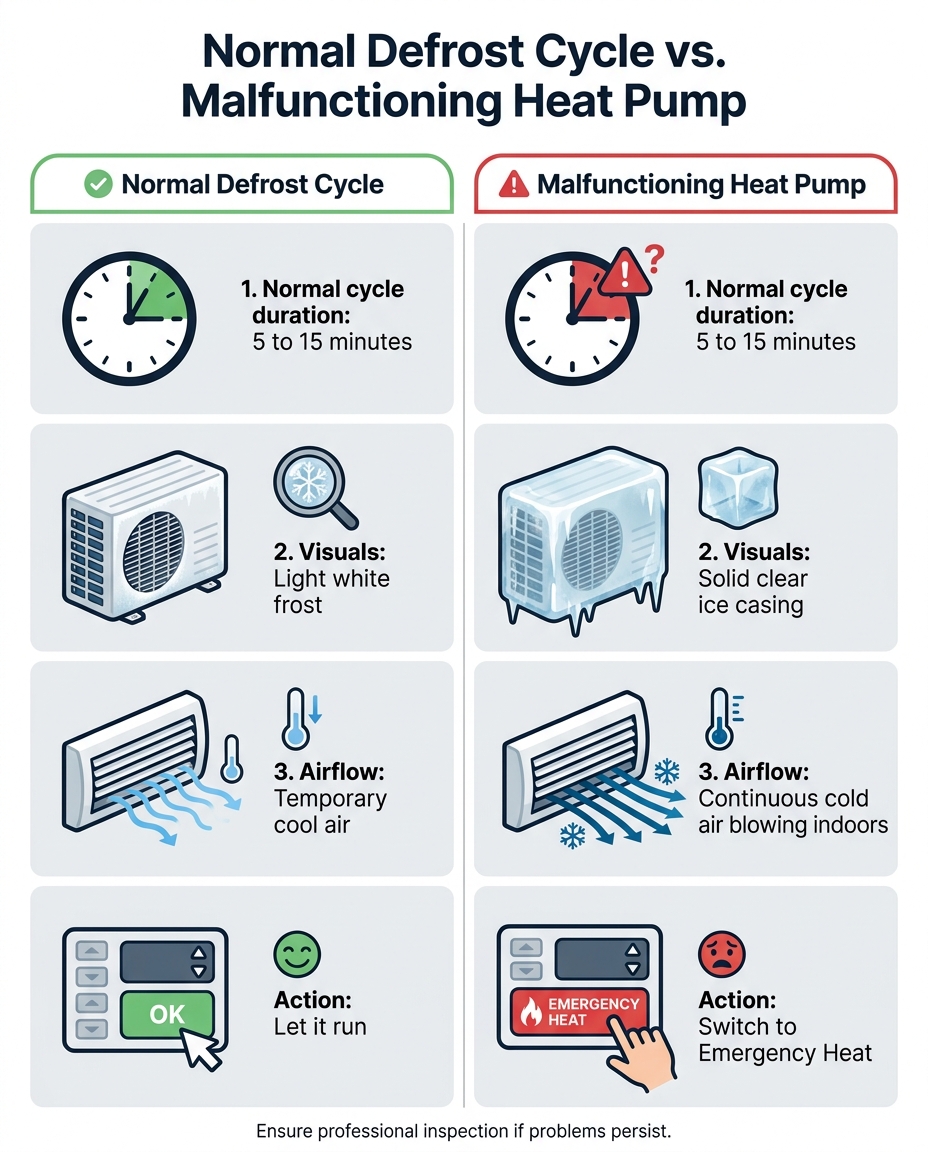
• Appearance — Normal Frost Formation: Light, white, powdery dusting resembling snow. — Dangerous Ice Buildup: Solid, clear, or milky thick casing of hard ice.
• Airflow Impact — Normal Frost Formation: Minimal; air still pulls through the metal fins easily. — Dangerous Ice Buildup: Severe; fins are completely blocked and suffocated.
• Weather Trigger — Normal Frost Formation: High humidity combined with temperatures between 30°F and 40°F. — Dangerous Ice Buildup: Freezing rain, sleet, or heavy wet snow melting and refreezing.
• System Response — Normal Frost Formation: Clears completely within a standard 5 to 15-minute window. — Dangerous Ice Buildup: Fails to melt; system runs constantly without clearing the coil.
How Excessive Defrost Cycles Strain Your Compressor
When your system detects that airflow is restricted by ice, it triggers a built-in defense mechanism. However, when freezing rain continually coats the unit faster than it can melt, your equipment gets trapped in a damaging loop. When we field frantic late-fall service calls, homeowners often report their unit constantly shifting gears as it struggles with excessive defrost cycles. Every time the system tries to melt heavy ice, it undergoes a massive mechanical shift. The reversing valve engages, temporarily turning your heating system back into an air conditioner. It takes the warm air from inside your house and sends that heat outdoors to thaw the frozen coil.
This process takes a significant energy and mechanical toll when the system is forced to repeat it back-to-back. The compressor, which is the heart of your HVAC system, is forced to run at maximum capacity under extreme pressure. If the unit cannot successfully clear the solid ice, the compressor risks overheating, seizing up, or failing entirely.
You may also notice symptoms indoors, such as lukewarm air blowing from your vents, as the system struggles to balance melting the outdoor ice and keeping your living room warm. The stress on the system can sometimes mimic or exacerbate other issues, which is why our technicians advise homeowners to also be aware of heat pump refrigerant leak warning signs if the unit fails to produce heat even after the ice is completely gone.
The Anatomy of a Defrost Cycle
To recognize when something is wrong, you need to know what right looks and sounds like. A healthy, normal cycle is brief and efficient.
1. The mechanical shift: You will hear a distinct "whoosh" sound as the reversing valve changes the flow of the pressurized refrigerant.
2. The intentional pause: The outdoor fan will stop spinning. This allows the heat to build up inside the metal housing to rapidly melt the frost.
3. The visual cue: As the frost melts away, you will likely see steam rising from the top of the outdoor unit. This is harmless water vapor, not smoke.
4. The duration: The entire process should take anywhere from 5 to 15 minutes. Once the sensors detect the coil is clear, the fan kicks back on, and normal heating resumes.
Recognizing the Warning Signs of a Stuck Defrost Cycle
When a late-fall ice storm hits, your equipment might not be able to keep up. Our service team always advises homeowners to learn clear, non-technical thresholds for identifying a malfunction to save themselves from a catastrophic compressor failure. If you notice any of the following symptoms, your system is likely stuck and requires immediate intervention.
• Loud, struggling noises: While a normal cycle has a brief whooshing sound, a stuck system will often cause the compressor to buzz loudly, grind, or sound like it is laboring under heavy strain.
• Extended cycle durations: If you time the clearing process and it lasts longer than 15 minutes repeatedly without successfully clearing the ice, the built-in sensors or the control board may be failing.
• Consistent cold air indoors: It is normal to feel a brief draft of cooler air during a healthy cycle. However, if your vents are blowing cold air consistently for extended periods, the system is trapped in cooling mode.
• An unmelting block of ice: Observe the outdoor unit. If it looks like a thick, solid block of ice that never melts—despite the system running constantly—the automated clearing process has been defeated by the weather.

Why DIY De-Icing is a Costly Mistake
When you look out the window and see your expensive outdoor unit suffocating under an inch of solid ice, the natural instinct is to go outside and fix it yourself. Unfortunately, our technicians frequently respond to service calls where well-meaning homeowners attempted DIY de-icing, which is one of the fastest ways to destroy your equipment. The internal components of your system are incredibly fragile, and we see aggressive removal tactics result in severe damage almost every season.
Beneath that thick layer of ice sits a delicate network of thin aluminum fins and pressurized copper tubing. Never use sharp objects, ice picks, screwdrivers, or shovels to chip away the ice. The aluminum fins bend easily, which permanently ruins the airflow, and one misplaced strike with a tool can puncture a copper coil. If you rupture the coil, the refrigerant will vent into the atmosphere, turning a simple freezing issue into a massive, expensive repair project.
Another common mistake we see is pouring hot water over the freezing unit. While this might seem like a harmless, chemical-free solution, it introduces the extreme danger of thermal shock. Throwing boiling or hot water onto freezing, pressurized metal causes rapid, violent expansion. This sudden temperature swing can crack the metal lines, snap valves, and destroy the structural integrity of the coils. As a general rule for your home heating solutions, you should never attempt repairs or aggressive de-icing methods that require a licensed professional. If the automated systems cannot handle the weather, it is time to step back and take a safer approach.
Taking Action: When to Switch to Emergency Heat
If your outdoor unit is completely encased in ice and the automated cycle has failed, you must act quickly to protect the compressor from burning out. The safest and most effective immediate step you can take is utilizing your thermostat's emergency heat setting. This feature is specifically designed to bypass a struggling outdoor unit during severe weather events.
Here is exactly what we recommend you do when the ice wins the battle:
1. Switch the thermostat setting: Locate the "EM HEAT" or emergency heat setting on your indoor thermostat and activate it immediately.
2. Understand what happens next: Engaging this setting completely shuts down the outdoor compressor, stopping the mechanical strain. It simultaneously engages the electric backup resistance strips located inside your indoor air handler.
3. Monitor the indoor temperature: The backup strips will generate heat directly, much like a giant space heater, keeping your home warm while the outdoor unit rests safely.
You should make this switch as soon as solid ice encases the unit and you verify that the automated defrosting process is no longer working. However, it is crucial to understand that emergency heat is a temporary bridge, not a permanent winter solution. Because electric resistance strips use significantly more energy than a heat pump compressor, running them continuously will cause a massive spike in your utility bills.
Once the system is safely switched over and the immediate threat to your compressor is neutralized, you need to call our team for professional diagnostics. A trained technician from Cochran Heating & Cooling can safely thaw the unit and determine why the system failed to keep up. Relying on professional heat pump repair services ensures that any underlying sensor or control board issues are resolved before you switch the system back to its normal operating mode.
Professional Fall Maintenance to Prevent Winter Breakdowns
The best way to handle a late-fall ice storm is to prepare your system before the freezing rain ever starts falling. Transitioning from summer cooling to winter heating requires more than just flipping a switch on the thermostat. Preventive care and thorough pre-winter inspections are essential to ensuring your equipment can withstand the harsh weather ahead.
During a comprehensive fall tune-up, our technicians conduct routine checks to verify that the defrost control board and temperature sensors are operating correctly. These tiny electronic components are the brains of the operation; if they are out of calibration, the system will not know when to melt the ice. We also make it a point to explain the importance of clearing fall debris, such as wet leaves, pine needles, and broken branches, away from the base of the outdoor unit. When organic debris piles up against the metal fins, it traps moisture against the coils, dramatically accelerating ice buildup when the temperature drops.
Furthermore, having our experts verify your system's refrigerant levels is vital before the heavy winter workload begins. A system that is even slightly low on refrigerant will struggle to generate enough heat to melt the ice during a storm. As a trusted, family-owned local provider in Westmoreland County, Cochran Heating & Cooling takes pride in offering reliable, neighborly advice on seasonal preparation. We know exactly what the local climate throws at your equipment, and a routine HVAC maintenance plan is your best defense against unexpected breakdowns when you need your heat the most.
Securing Your Comfort Before Winter Arrives
Monitoring your outdoor unit during late fall storms is one of the most important responsibilities of owning a modern heating system. The transition into winter can be unpredictable, but your comfort does not have to be. By taking the time to observe your equipment and understanding how it reacts to freezing rain, you put yourself in control of the situation.
Reassure yourself that identifying the difference between a normal layer of frost and a severe malfunction is the key to saving your compressor from an early grave. When you know what to look for, you can act confidently, switching to your backup systems before any permanent damage occurs. Ultimately, protecting your heat pump compressor from early frost accumulation starts with proactive care.
Do not wait until your outdoor unit is buried under an inch of solid ice to find out if your sensors are working. Schedule a comprehensive fall inspection with our team before the severe winter weather sets in, and enjoy the peace of mind that comes with a fully prepared, reliable heating system.
Frequently Asked Questions
How do I know if my heat pump is stuck in defrost mode?
A heat pump stuck in defrost mode will continuously blow cold air from your indoor vents for much longer than the standard 15-minute cycle. You may also notice the outdoor fan remains off indefinitely while the compressor continues to run. If your home's temperature is steadily dropping and the system refuses to switch back to normal heating, the control board or sensors have likely failed and require professional attention.
When should I use emergency heat during an ice storm?
You should switch to emergency heat the moment you notice a thick, solid block of ice encasing your outdoor unit that the system cannot melt on its own. Activating this setting immediately shuts down the outdoor compressor, preventing it from overheating or suffering catastrophic mechanical failure. Keep in mind that this is a temporary solution to keep your house warm until a technician can safely de-ice and repair the outdoor unit.
What does a normal heat pump defrost cycle sound like?
A normal defrost cycle begins with a distinct, somewhat loud "whoosh" sound as the internal reversing valve shifts the flow of refrigerant. Following this initial sound, the outdoor fan will shut off, leaving only the low hum of the compressor running. You might also hear a sizzling or dripping sound as the frost melts off the coils and hits the ground below.
Is it normal for my heat pump to have frost on it?
Yes, a light, powdery coating of white frost on the outdoor coils is completely normal when temperatures drop below 40 degrees Fahrenheit. The system naturally pulls moisture from the ambient air, which freezes against the cold metal fins. As long as the automated cycle kicks on and clears the frost within 15 minutes, your equipment is operating exactly as designed.
Should I turn off my heat pump if it is covered in ice?
If your unit is entirely encased in solid, clear ice from freezing rain, you should immediately switch your thermostat to the emergency heat setting rather than turning the system completely off. This action stops the outdoor compressor from destroying itself while engaging your indoor backup heating strips. Once the outdoor unit is safely shut down, contact a professional to diagnose why the system failed to clear the ice.
Why does chipping ice off my heat pump void the warranty?
Chipping ice off your unit often causes irreversible damage to the delicate aluminum fins and pressurized copper tubing hidden just beneath the surface. Manufacturers void warranties for this type of damage because it is considered improper maintenance and physical abuse of the equipment. A single misplaced strike with an ice pick can rupture a coil, instantly venting your refrigerant and causing extensive and avoidable damage.