Standalone HEPA Filters vs. Whole-House AC Air Purifiers for Jeannette Homes
Are You Ready for the Autumn Indoor Air Shift?
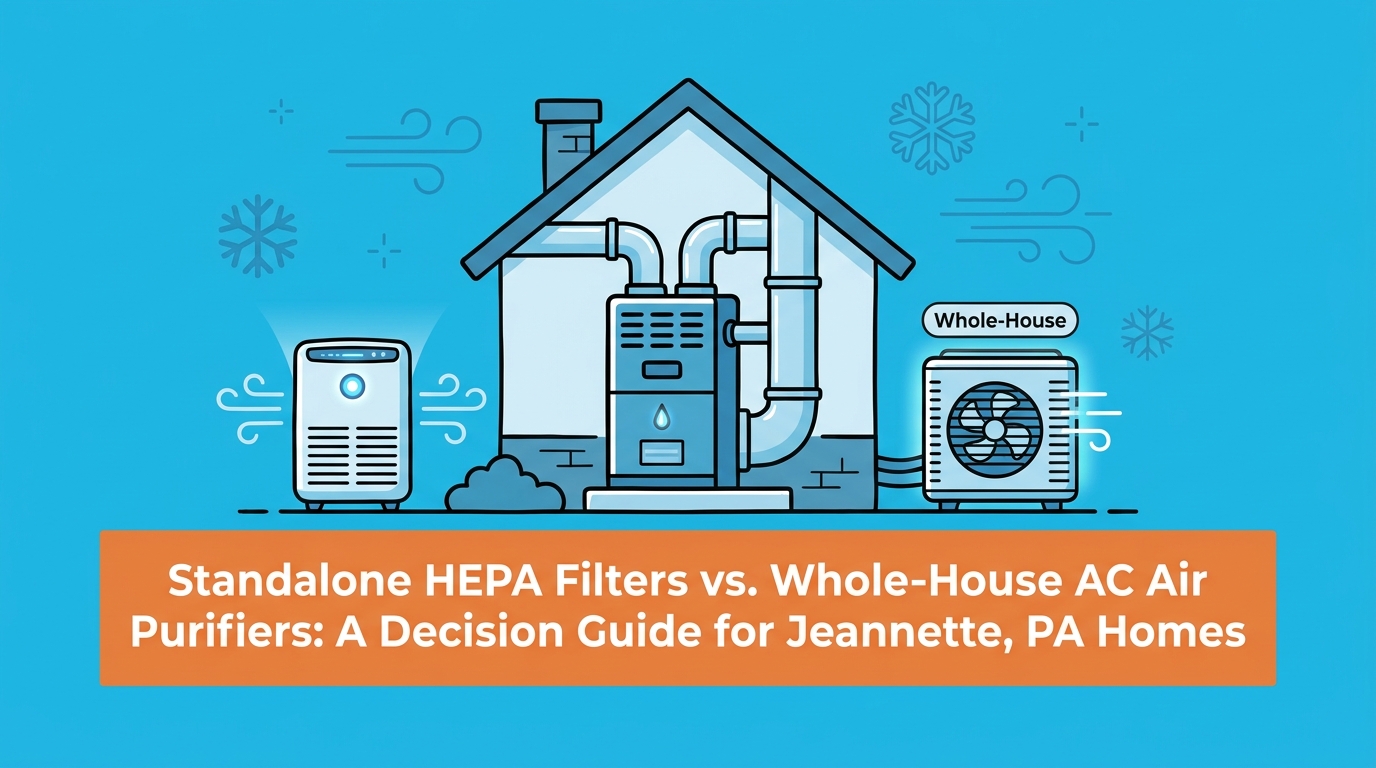
Have you noticed an increase in sneezing, coughing, or lingering dust as the evenings start to cool down? Here at Cochran Heating & Cooling, our team typically fields a surge of indoor air quality questions as September arrives. We are entering the early fall closed-window season, a time when homes are sealed tightly to keep the chill out. Unfortunately, shutting those windows also traps stale air and seasonal allergens inside with you. If you are comparing Standalone HEPA Filters vs. Whole-House AC Air Purifiers for Jeannette Homes, you are already on the right track to solving this concrete problem. The decision point comes down to whether you want to manage your air quality room by room, or if you prefer a comprehensive system that cleans the air across your entire floor plan.
Choosing the right filtration method is critical for your comfort and your home's energy efficiency. If you are ready to explore your options, our experts can help you navigate the best indoor air quality solutions for your specific layout, including advanced whole-house air purifiers.
Why Tightly Sealed Homes Trap Fall Allergens
Most homeowners do not realize that the air inside their living room can be two to five times more polluted than the air outside. According to guidelines from the Environmental Protection Agency (EPA), indoor air quality plummets when homes lack proper ventilation. This is especially true in Jeannette and surrounding Westmoreland County, where our specific climate dictates how we manage our homes. In our years of servicing local HVAC systems, we've seen firsthand how heavily weatherized, insulated, and sealed off these homes must be to keep energy bills manageable during our sticky summers and biting winters.
While this tight sealing is fantastic for energy efficiency, it significantly reduces the natural indoor-outdoor air exchange. When September rolls around, it brings the peak season for ragweed and mold spores in Pennsylvania. These microscopic irritants hitch a ride indoors on your shoes, your clothes, and your pets.
Once inside a tightly sealed home, these pollutants have nowhere to go. They circulate through your living spaces, settling into carpets and upholstery, only to be kicked up again when you walk through the room. Common trapped pollutants our team encounters during the seasonal transition include:
• Ragweed pollen: A highly aggressive fall allergen that peaks in September and October.
• Mold spores: Thriving in damp fall foliage outside, these spores easily drift indoors and multiply in humid areas like bathrooms or basements.
• Pet dander: As pets shed their summer coats, excess dander accumulates in stagnant indoor air.
• Volatile Organic Compounds (VOCs): Off-gassing from cleaning supplies, fresh paint, and new furniture that gets trapped without fresh air ventilation.
• Dust mites: Microscopic pests that thrive in the dust that settles when air circulation is poor.
Proper filtration is the only way to mitigate these localized environmental challenges. The question is simply how you choose to capture them before you breathe them in.
Standalone HEPA Filters: Targeted Relief for Specific Rooms
Standalone HEPA filters are portable air purification units designed to clean the air in a single, enclosed space. To earn the "True HEPA" (High-Efficiency Particulate Air) designation, a filter must be capable of capturing 99.97% of airborne particles that are 0.3 microns in diameter. This includes dust, pollen, mold, and pet dander. Because these units plug directly into a standard wall outlet, our technicians often see them used as an immediate, localized solution during the early fall closed-window season.
However, the effectiveness of a portable unit depends entirely on its CADR (Clean Air Delivery Rate). The CADR rating tells you exactly how much filtered air the unit can push into a room over a specific period. If you place a unit with a low CADR in a large, open-concept living room, it will barely make a dent in the air quality. You must carefully match the unit's capacity to the square footage of the room you intend to treat.
Pros and Cons of Portable Units
Like any home appliance, portable air purifiers come with distinct advantages and drawbacks. Understanding these can help you decide if they fit your lifestyle.
The advantages of standalone units:
• Immediate setup: You simply take the unit out of the box, remove the plastic from the filter, and plug it in. Zero professional installation is required.
• Targeted relief: They are excellent for focused air cleaning. If you only suffer from allergies while sleeping, placing a unit on your nightstand provides concentrated relief right where you need it.
• Portability: You can move the unit from the home office during the day to the bedroom at night.
The limitations of standalone units:
• Limited coverage area: A single unit will not clean the air in multiple rooms. Achieving whole-home coverage requires purchasing, running, and maintaining several different units simultaneously.
• Noise levels: Because the fan is located directly in your living space, portable units can be quite loud, especially when running on their highest settings.
• Floor space: These units take up physical space in your room and require clearance on all sides to pull in air effectively, which can clutter your floor plan.
• Higher cumulative maintenance: Replacing multiple small HEPA filters every few months across several units quickly becomes a tedious and ongoing chore.
Whole-House AC Air Purifiers: Seamless and Comprehensive
If managing multiple portable units sounds exhausting, our installation team frequently recommends a whole-house air purifier for a completely different approach. Instead of treating the air room by room, these integrated systems are installed directly into your existing HVAC ductwork, typically in the return air plenum just before the air reaches your furnace or air handler.
Every time your HVAC system cycles on to heat or cool your home, it pulls air from every room through the return ducts. This air passes through the whole-house purifier, gets scrubbed of contaminants, and is then pushed back out through your supply vents. This creates a continuous cycle of comprehensive, multi-room coverage. Whether you are upgrading your current setup or installing new air conditioning systems, integrating a dedicated media cabinet or electronic air cleaner ensures that every breath you take is filtered.
For homeowners in Jeannette and surrounding Westmoreland County, we've found this seamless integration provides massive aesthetic and acoustic advantages. Because the filtration happens down in the basement or inside the utility closet, the operation is completely invisible. There are no bulky plastic towers taking up floor space in your living room, and there is zero added noise to disrupt your family movie night or your sleep.
It is important to note that whole-house systems are not plug-and-play. They require professional installation to ensure the cabinet is properly sealed against the ductwork and that the specific filtration technology is fully compatible with your existing blower motor and HVAC equipment.
Head-to-Head: Comparing Maintenance, Coverage, and Value
To make the best decision for your home during the early fall closed-window season, you need an objective look at how these two approaches stack up against each other. Both systems require an upfront investment, but the dynamics are very different. Buying one portable unit is a small initial commitment, but outfitting an entire four-bedroom house with portable units can quickly equal the investment of a single, integrated whole-home system.
When evaluating which system offers better long-term value, you must consider the size of your home, the severity of your indoor air quality needs, and your willingness to keep up with routine filter replacements. If you are looking for specific model recommendations for integrated systems, reviewing the best whole-home air purifiers can provide deeper insights into the technologies available.
System Comparison Overview
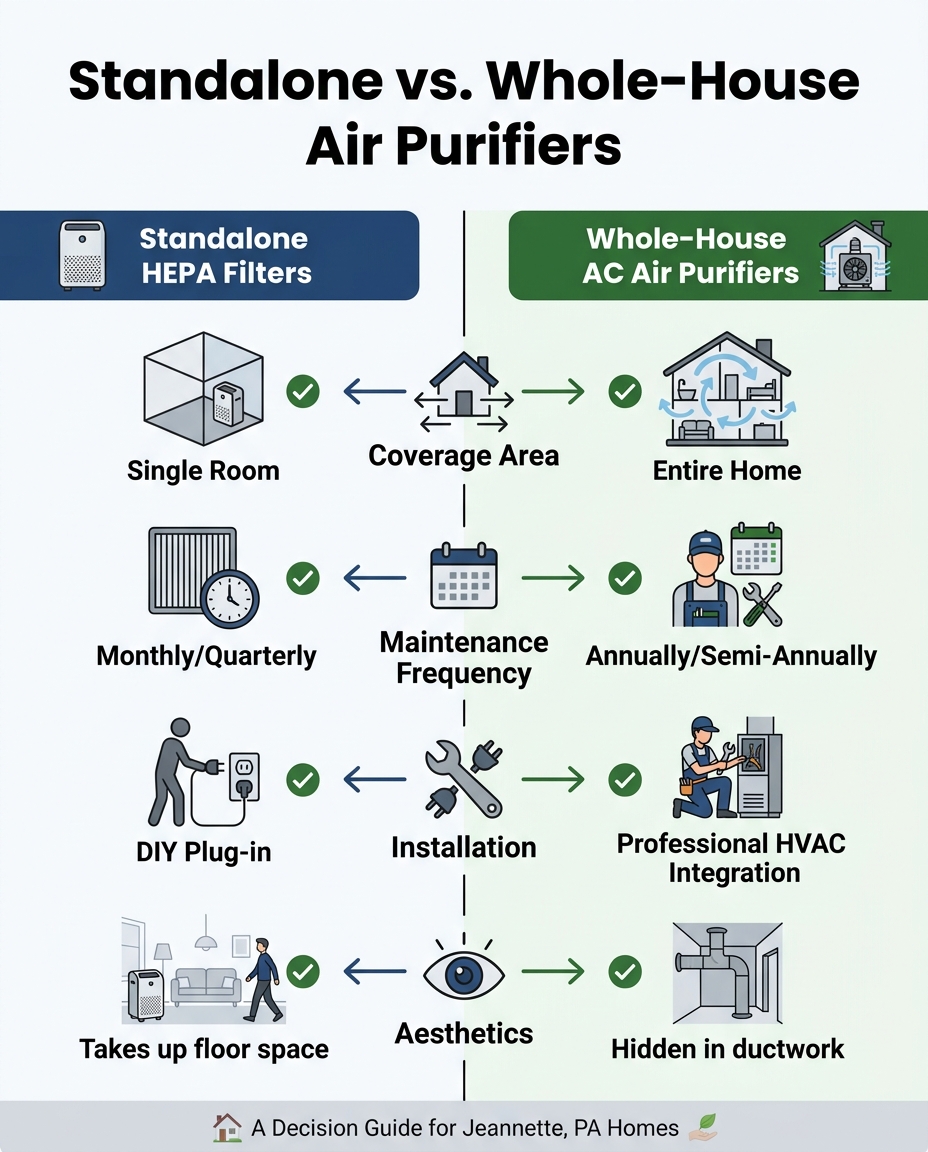
• Coverage Area — Standalone HEPA Filters: Single room or specific zone (depends on CADR rating). — Whole-House AC Air Purifiers: Entire home (every room connected to HVAC ductwork).
• Maintenance Routine — Standalone HEPA Filters: Frequent (every 3-6 months) for multiple separate units. — Whole-House AC Air Purifiers: Infrequent (annually or semi-annually) for one central filter.
• Installation — Standalone HEPA Filters: DIY plug-and-play into any standard electrical outlet. — Whole-House AC Air Purifiers: Professional HVAC integration into existing ductwork required.
• Aesthetics & Space — Standalone HEPA Filters: Takes up floor space and must remain visible to function. — Whole-House AC Air Purifiers: Completely hidden inside the basement or utility closet.
• Noise Level — Standalone HEPA Filters: Noticeable fan noise directly inside the living space. — Whole-House AC Air Purifiers: Silent operation; utilizes the existing, remote HVAC blower.
• Ozone Emissions — Standalone HEPA Filters: Some models with ionizers may emit trace amounts of ozone. — Whole-House AC Air Purifiers: Most modern media cabinets are 100% ozone-free.

The Hidden Factor: Why HVAC Airflow Verification is Non-Negotiable
One of the biggest mistakes our service team sees homeowners make is attempting to DIY a highly dense filter into their standard central AC filter slot. You cannot simply buy a 1-inch thick filter with an incredibly high MERV rating, slide it into your furnace, and expect whole-home purification. In fact, doing so can cause catastrophic damage to your equipment.
Dense filtration media restricts airflow. Your HVAC system was designed to operate under a specific amount of static pressure. Think of static pressure like breathing through a straw. If you replace a standard, porous filter with a highly restrictive HEPA-level filter without modifying the ductwork, it is like pinching that straw shut while trying to take a deep breath. The system simply cannot pull enough air through the dense material.
The risks of restricted airflow are severe. In the summer, insufficient airflow causes the evaporator coil to freeze solid, completely halting your cooling. In the winter, it can cause the heat exchanger to overheat and crack. Year-round, it forces your blower motor to work twice as hard, driving up your energy bills and significantly reducing the lifespan of the equipment.
This is why a professional assessment from the Cochran Heating & Cooling team is mandatory before installing whole-home filtration. One of our HVAC technicians must measure the static pressure of your existing ductwork in Jeannette and surrounding Westmoreland County to ensure the blower motor can handle the added resistance. Often, installing a whole-house purifier involves adding a wider media cabinet (typically 4 to 5 inches thick). This wider surface area allows the filter material to be pleated in an accordion shape, providing massive surface area to catch particles without choking off the airflow.
Framing this airflow verification as a standard part of your pre-heating-season preparations is a smart move. When you schedule your routine HVAC maintenance for the fall, ask your technician to evaluate your system's static pressure and discuss your filtration options.
Making the Right Choice for Your Home Layout
Synthesizing all this information comes down to looking closely at your unique home layout, your family's health needs, and your daily routines. There is no universal "best" choice—only the choice that best aligns with how you live.
Standalone units are fantastic for specific scenarios. If you live in a smaller apartment, or if you only need single-room allergy relief for one family member, a high-quality portable HEPA filter is likely all you need. They are also excellent temporary fixes if you are renting and cannot modify the home's ductwork.
On the other hand, whole-home systems are vastly superior for homeowners seeking a true set-it-and-forget-it solution. If you want comprehensive indoor air quality management that protects every square foot of your home without the clutter, noise, or constant filter changes, integrating a system into your central HVAC is the clear winner. This is especially true during the early fall closed-window season when you want the peace of mind that your entire home is protected from trapped allergens.
As a local, family-owned business serving Jeannette, our team at Cochran Heating & Cooling believes in providing honest, tailored advice rather than pushing a high-pressure upsell. If a standalone unit is truly the best fit for your current situation, that is exactly what we will recommend. However, if your home's layout and your family's allergy symptoms demand a more robust solution, we are here to design a system that works flawlessly with your existing equipment. We encourage you to schedule a professional assessment to determine the best fit for your specific ductwork and lifestyle, ensuring you breathe easier all season long.
Frequently Asked Questions
Is a whole house air purifier better than a standalone HEPA unit?
It depends entirely on your goals, but whole-house purifiers offer far broader coverage. Because they integrate into your ductwork, they clean the air in every room simultaneously, whereas standalone units only treat the specific room they are placed in. Whole-house systems also operate silently and require less frequent maintenance, making them a better long-term investment for comprehensive air quality.
Can you put a HEPA filter directly in your central AC?
No, you should never insert a true HEPA filter into a standard 1-inch HVAC filter slot. HEPA filters are incredibly dense and will severely restrict the airflow your system needs to function properly. Attempting this can cause your air conditioner's evaporator coil to freeze or burn out your blower motor; professional modifications are required to accommodate dense filtration.
Do whole house air purifiers really work for fall allergies?
Yes, they are highly effective at capturing the specific irritants that trigger fall allergies. High-quality media cabinets and electronic air cleaners trap ragweed pollen, mold spores, and pet dander as they circulate through your ductwork. By removing these particles before they settle into your living spaces, they significantly reduce indoor allergy symptoms.
How often do I need to replace the filter in a whole-home system?
Most whole-home media filters only need to be replaced once or twice a year. Because these filters are typically 4 to 5 inches thick and heavily pleated, they possess a massive surface area that can hold a large volume of dust and debris before becoming clogged. This is a major convenience compared to portable units that often require monthly or quarterly filter changes.
Will adding an air purification system increase my energy bills?
A properly installed whole-house air purifier will not significantly impact your energy bills. While a highly restrictive filter can force your blower motor to work harder and consume more electricity, a professionally installed media cabinet is designed to maintain proper static pressure. In fact, by keeping your HVAC system's internal components cleaner, a good purifier can actually help your system run more efficiently over time.