Upgrading to a Two-Stage Furnace vs. Single-Stage for Unpredictable Pennsylvania Autumns
Tired of Sweating When the Heat Kicks On During Early Fall?
Are you constantly adjusting your thermostat because your home gets uncomfortably hot, leaving you weighing the benefits of upgrading to a two-stage furnace vs. single-stage for unpredictable Pennsylvania autumns? At Cochran Heating & Cooling, we hear this frustration from our customers every September. You are certainly not alone. During the mild 50-degree days of early fall, a standard heating system often feels like it is working entirely too hard. The house is chilly in the morning, so you bump the thermostat up a degree or two. Minutes later, you are throwing open a window because the living room feels like a sauna.
This "all-or-nothing" heat blast is a common structural problem with older, traditional systems. They are designed to fight off the bitter cold of a January blizzard, which means they deliver far too much power for a crisp September afternoon. If you are tired of this constant temperature seesaw, it is time to evaluate your options. Exploring comprehensive heating services and considering furnace installation and upgrades can help you find a system that adapts to the weather, rather than overpowering it.
The decision point for many homeowners comes down to understanding how different gas valves operate. By looking closely at how heating technology has evolved, our team can help you choose a solution that delivers consistent, gentle warmth exactly when you need it, without the overwhelming blasts of hot air.
The Mechanics of Single-Stage Heating: Why 100% Capacity Feels Overwhelming
To understand why your home feels so stuffy during the fall, you have to look at how a traditional single-stage furnace operates. The term "single-stage" refers directly to the gas valve inside the unit. This valve only has one operational setting: fully open. There is no middle ground, no low gear, and no way for the system to modulate its output based on the weather outside. It is either running at maximum capacity or it is completely turned off.
Because we serve Jeannette PA and the surrounding areas, we know firsthand that your heating system must be sized to keep your home warm when the outside temperature drops below freezing. The equipment has the raw power required to fight off severe winter weather. However, when the outside temperature is a mild 50 degrees, your home only needs a fraction of that power to stay comfortable. Because a single-stage furnace cannot adjust its output, it delivers that same blizzard-level heat on a mild autumn day.
Here is exactly what our technicians see happening during a single-stage heating cycle in mild weather:
1. The thermostat detects a slight drop: Your indoor temperature falls one degree below your setting.
2. The system fires at maximum output: The gas valve opens fully, and the burners ignite at 100% capacity.
3. A massive blast of heat enters the room: The blower motor forces a high volume of intensely hot air through your vents.
4. The thermostat is rapidly satisfied: Within just a few minutes, the area around the thermostat reaches the target temperature.
5. The system abruptly shuts down: The furnace turns off before the warm air has a chance to circulate evenly throughout the rest of the house.
This rapid on-and-off sequence is known as "short-cycling." It is the primary reason you feel a sudden wave of heat followed by a lingering chill just a short time later.
The Problem with 'All-or-Nothing' Heat
When a furnace operates at 100% capacity in mild weather, it creates distinct hot and cold spots throughout your home. The rooms closest to the furnace receive an overwhelming amount of heat, while rooms further away remain chilly because the system shuts off before the air can reach them. You end up walking from a sweltering hallway into a freezing bedroom.
Furthermore, because the system is running at absolute maximum output, the blower motor operates at full speed. This creates excess noise. Every time the system kicks on, you hear a loud whoosh of air that can interrupt conversations, wake you up at night, and constantly remind you that the heating system is running. Comfort should be invisible and silent, but a single-stage system makes its presence known every time it cycles on.
How a Two-Stage Gas Valve Delivers Gentle, Consistent Warmth
In our experience, the definitive solution to the mild-weather overheating problem is a two-stage gas valve. Unlike a traditional system, a two-stage furnace has two distinct levels of operation: a low setting and a high setting. This simple but highly effective mechanical difference completely changes how the equipment interacts with the air inside your home.
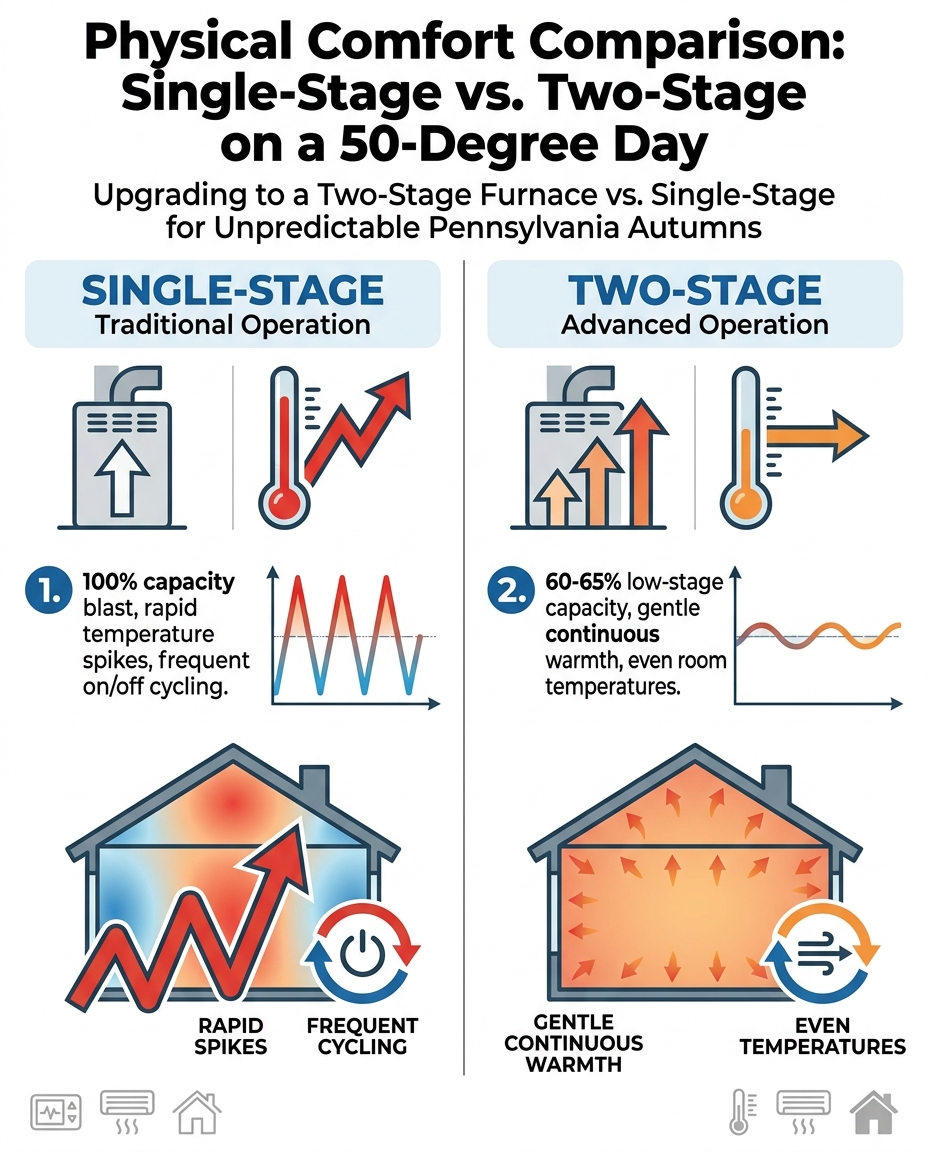
The low setting typically operates at roughly 60% to 65% of the furnace's total capacity. This stage is designed specifically for mild weather. When the temperature outside is hovering around 50 degrees, the furnace defaults to this low gear. It uses less fuel, runs the blower motor at a quieter speed, and delivers a gentle, continuous stream of warm air.
The high setting is the 100% capacity mode. The furnace holds this stage in reserve, only activating it when the low setting cannot keep up with the demand—such as during a severe winter freeze or when you manually bump the thermostat up several degrees at once.
Because the low setting perfectly matches the heating load required for the mild 50-degree days of early fall, the furnace runs for longer, slower cycles. This longer run time allows the air to mix thoroughly throughout the entire house. It pushes air gently into the furthest corners of your home, eliminating the hot and cold spots that plague single-stage systems. If you have ever wondered why your heating vents blow cold air or feel drafty between cycles, it is often because short, aggressive heating cycles fail to properly circulate the air.
Solving the Shoulder-Season Comfort Gap
Many homeowners carry a common misconception about continuous operation. They assume that if a furnace is running for a longer period of time, it must be wasting energy and working too hard. In reality, longer run times at a lower capacity actually feel significantly better and operate more efficiently. (Additionally, upgrading to high-efficiency two-stage models may qualify you for general utility rebates or federal tax credits, though we always recommend verifying current incentive programs with your utility provider or tax professional.)
Think of it like driving a car on the highway. Maintaining a steady speed of 55 miles per hour is much smoother and more efficient than constantly slamming on the gas pedal and then slamming on the brakes. By operating at 60% capacity, a two-stage furnace maintains your indoor temperature with precision. It prevents the stuffy, overwhelming feeling associated with single-stage blasts, providing a level of physical comfort that feels natural and unobtrusive.
Side-by-Side Comparison: Upgrading to a Two-Stage Furnace vs. Single-Stage for Unpredictable Pennsylvania Autumns
When you place these two technologies side by side, the differences in your daily physical comfort become incredibly clear. It is not just about the internal mechanics; it is about how your living room feels when you are trying to relax on a crisp October evening.
A single-stage system reacts to the weather in Jeannette PA with brute force, while a two-stage system reacts with measured precision. The table below breaks down exactly how these operational differences translate to your physical experience indoors.
• Temperature Consistency — Single-Stage Furnace (100% Capacity): Severe fluctuations. The house gets too hot quickly, then cools down rapidly between cycles. — Two-Stage Furnace (60% / 100% Capacity): Even temperatures. The system matches the mild weather, keeping the room within one degree of the setting.
• Cycle Length — Single-Stage Furnace (100% Capacity): Frequent, short blasts. The system turns on and off constantly (short-cycling). — Two-Stage Furnace (60% / 100% Capacity): Longer, gentle cycles. The system runs steadily on low, mixing the air thoroughly.
• Air Distribution — Single-Stage Furnace (100% Capacity): Poor. Rooms far from the thermostat stay cold because the system shuts off too quickly. — Two-Stage Furnace (60% / 100% Capacity): Excellent. Extended run times push warm air evenly into every corner of the house.
• Noise Levels — Single-Stage Furnace (100% Capacity): Full-volume operation. A loud rush of air occurs every time the system kicks on. — Two-Stage Furnace (60% / 100% Capacity): Quieter operation. The low stage uses a lower blower speed, creating minimal background noise.
By comparing the two, you can see that the two-stage system actively works to eliminate the friction points of mild-weather heating. It removes the sudden temperature spikes and the disruptive noise, leaving behind a quiet, comfortable environment.

Why Western Pennsylvania Weather Demands Flexible Heating Output
The technology behind a two-stage gas valve is impressive, but it becomes truly essential when you contextualize it within our specific regional climate. Western Pennsylvania is famous for its unpredictable autumn weather. The transition from summer to winter does not happen in a straight line; it happens in wild, daily swings.
During September and October, it is incredibly common to experience massive diurnal temperature variations. You might wake up to frost on the grass and near-freezing temperatures, only to see the afternoon sun push the thermometer back up into the mid-60s. By the time the sun sets, the temperature plummets again. These sharp transitions—from mild autumn afternoons to freezing nights—create a highly volatile heating load for your home.
A single-stage system simply cannot keep up with this volatility without making you uncomfortable. If it is sized to handle the morning frost, it will absolutely cook you out of the living room during the mild 50-degree days of early fall. You end up playing a constant game of thermostat roulette, turning the system on, turning it off, and opening windows to vent the excess heat.
A flexible heating system adapts automatically to these wild swings. When the morning is bitterly cold, the two-stage furnace utilizes its 100% high gear to quickly warm the house. As the afternoon warms up, the system seamlessly drops into its 60% low gear, maintaining a gentle warmth without overheating the space. You never have to adjust the thermostat; the equipment senses the demand and adjusts its own output.
This is where our team's local Jeannette and Westmoreland County expertise makes a massive difference. National advice often focuses strictly on peak winter performance, but our local HVAC recommendations at Cochran Heating & Cooling always account for these specific, unpredictable weather patterns. Flexibility is the key to comfort in this region. Alternative flexible heating solutions, such as modern heat pumps, operate on similar principles, modulating their output to match the precise demands of a mild autumn day while keeping the heavy power in reserve for the deep freeze.
Preventing Short-Cycling and Reducing Mechanical Wear
Beyond the immediate physical comfort, upgrading from a single-stage to a two-stage system provides significant mechanical benefits. To understand why, you have to look at the physical toll that mild weather takes on an inflexible heating system.
As we discussed earlier, single-stage furnaces are prone to short-cycling during the fall. They turn on, blast the house with heat for five minutes, and shut off. Ten minutes later, they do it all over again. Frequent on/off cycling is the absolute hardest thing a furnace can do mechanically. The startup sequence is the most stressful part of the heating cycle.
Every time a single-stage furnace in Jeannette PA kicks on during a mild day, our technicians typically observe several high-stress actions occurring inside the unit:
• The ignitor undergoes thermal shock: It rapidly heats up to glow white-hot, then cools down just minutes later.
• The draft inducer motor surges: It pulls heavy electrical current to start spinning from a dead stop.
• The heat exchanger expands and contracts: The metal rapidly heats up and expands, then quickly cools and contracts, causing metal fatigue over time.
• The blower motor strains: It requires a massive surge of power to push a heavy volume of air instantly.
By utilizing longer, slower cycles, a two-stage furnace drastically reduces this mechanical wear and tear. Because it stays on longer at a lower capacity, the components are not subjected to the constant stress of starting and stopping. The heat exchanger maintains a more consistent temperature, the motors run smoothly without constant electrical surges, and the ignitor is used far less frequently.
Protecting Your Investment Before Winter
Our technicians always advise that early fall is the critical time to address short-cycling issues before the peak heating season begins. If your current single-stage system is constantly turning on and off to battle the mild weather, it is accumulating unnecessary wear right before it needs to perform at its absolute best during the winter.
Connecting mechanical health to longevity is simple: systems that run smoothly and avoid short-cycling simply last longer and experience fewer emergency breakdowns. Reducing this stress during the fall protects the system for the harsh winter ahead. Of course, multi-stage components are more sophisticated, which emphasizes the importance of professional upkeep. Ensuring that both stages of the gas valve are firing correctly and that the control board is properly communicating requires a diligent HVAC maintenance plan to keep everything calibrated.
Make the Right Choice for Your Home's Comfort This Season
Navigating the transition from summer to winter does not have to involve a daily battle with your thermostat. Upgrading to a two-stage furnace vs. single-stage for unpredictable Pennsylvania autumns is the definitive solution to mild-weather overheating. By replacing the brute force of an "all-or-nothing" system with the measured precision of a two-stage gas valve, you eliminate the sudden temperature spikes, the disruptive blower noise, and the frustrating hot and cold spots.
You deserve a home that feels consistently comfortable, regardless of whether it is 30 degrees or 55 degrees outside. Upgrading provides a clear, highly effective path to better physical comfort. Take the time to evaluate your current system's performance during the mild 50-degree days of early fall. If you find yourself constantly adjusting the dial or throwing off blankets because the heat is simply too intense, it is time for a change. Reach out to our team at Cochran Heating & Cooling to discuss your specific comfort needs with local experts who understand exactly how to match the right technology to our unique regional climate.
Frequently Asked Questions
What is the difference between a single-stage and two-stage furnace?
The primary difference lies in the gas valve and how the system controls its heat output. A single-stage furnace only operates at 100% capacity, delivering a maximum blast of heat every time it turns on. A two-stage furnace has a low setting (usually around 60% capacity) for mild weather and a high setting (100% capacity) for extreme cold, allowing it to adapt to the temperature.
Why does my furnace turn on and off so much in the fall?
This rapid on-and-off process is called short-cycling, and it happens because your furnace is too powerful for mild weather. When a system sized for freezing winter temperatures operates on a 50-degree day, it heats the space around the thermostat incredibly fast and shuts down. The heat dissipates quickly, causing the system to turn right back on.
Does a two-stage furnace run constantly?
While it does not run constantly, a two-stage furnace will run for longer, slower cycles than a traditional system. During mild weather, it operates on its low setting, providing a gentle, continuous stream of warm air. These longer run times are intentional and highly efficient, as they prevent hot and cold spots and reduce mechanical wear.
Why is my house too hot when the furnace turns on?
Your house gets too hot because a single-stage furnace delivers all of its heating capacity at once, regardless of the outdoor temperature. On a mild day, this 100% output overwhelms the room before the thermostat can properly register the change. This results in a sudden, stuffy blast of heat that makes you uncomfortable.
How does a two-stage furnace work during mild weather?
During mild weather, a two-stage furnace automatically defaults to its lower capacity setting. Instead of blasting hot air at full volume, it gently pushes a smaller amount of warm air through your ductwork over a longer period. This perfectly matches the lower heating demand of a crisp autumn day, keeping your indoor temperature perfectly stable.
What are the physical comfort benefits of a two-stage furnace upgrade?
The physical comfort benefits include perfectly even room temperatures, the elimination of drafty cold spots, and significantly quieter operation. Because the system runs on a lower setting, you will not experience the sudden, overwhelming wave of heat that forces you to constantly adjust your thermostat or open windows during the fall.