Why September is the Safest Time to Schedule a Mini Split Installation in Westmoreland County
The Hidden Risks of Waiting for the First Freeze
Before the autumn leaves start turning, there is a brief, critical window of opportunity for local homeowners. Understanding exactly why September is the safest time to schedule a mini split installation in Westmoreland County comes down to avoiding the frantic rush that hits the moment temperatures drop. In our experience serving the local community, a pattern we see often is that most homeowners do not think about their winter heating needs until they are shivering in their living room. By the time that first cold snap arrives, our dispatch board lights up as the entire region suddenly realizes their outdated systems are not up to the task, creating a massive, overnight bottleneck for local contractors.
When you wait until the last minute to upgrade your home's climate control, you are gambling with your family's comfort. Delaying an installation often leads to rushed timelines, limited equipment choices, and extended wait periods while you sit in a freezing house. A proactive approach changes everything. Choosing to book your upgrade during the September shoulder-season provides a massive strategic advantage for your personal schedule, your overall comfort, and the quality of the service you receive. If you want to explore your options, securing reliable heating services now ensures your home is fully prepared long before the winter weather becomes a threat.
The cascading effects of procrastination include:
• Limited scheduling flexibility: You are forced to take whatever appointment slot is left, even if it means taking time off work unexpectedly.
• Equipment shortages: High demand can deplete local warehouse stock of the most popular and efficient heating models.
• Uncomfortable waiting periods: If your current system fails during a freeze, you may spend days relying on dangerous or inefficient space heaters.
Taking action during the early fall lull eliminates these risks entirely, allowing you to approach your home upgrade as a planned improvement rather than a desperate emergency.
How the Fall Shoulder Season Transforms HVAC Availability
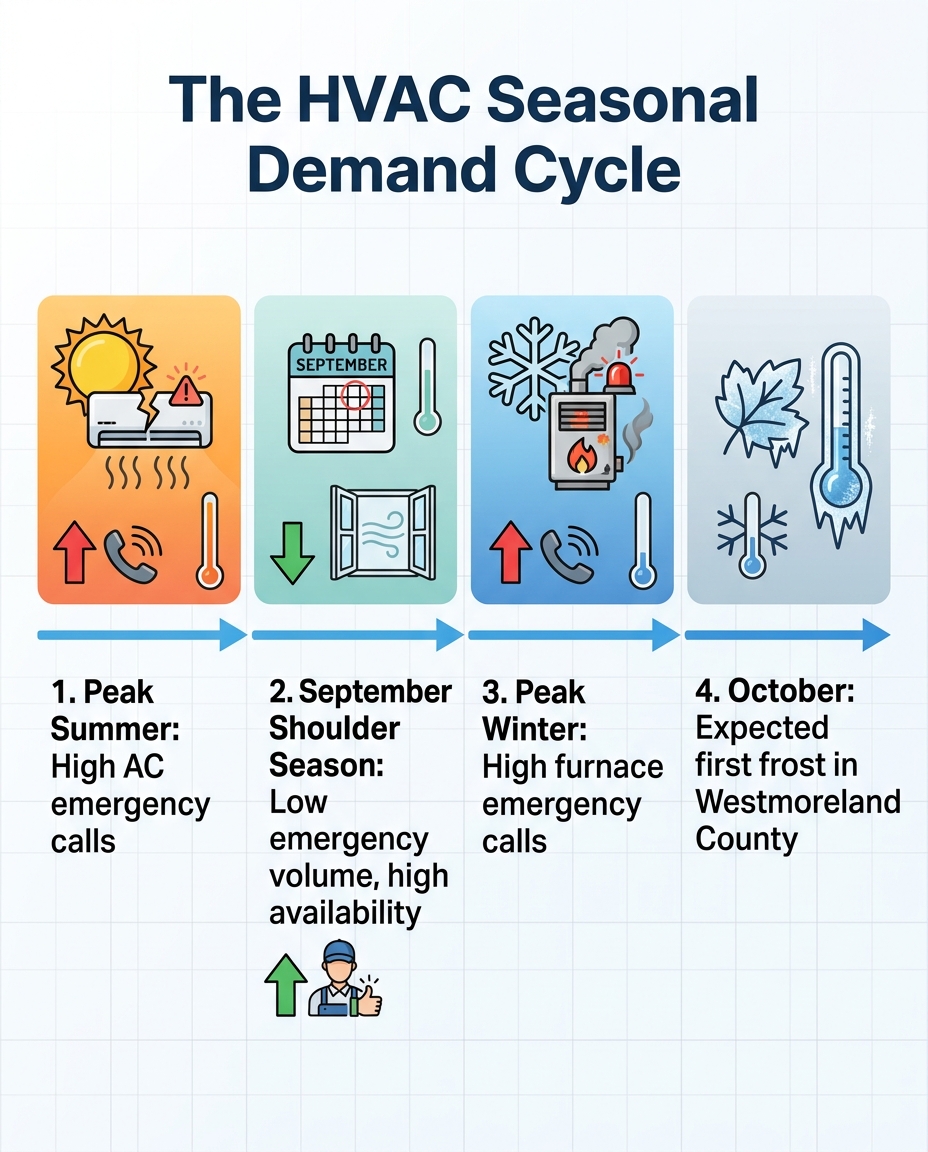
At Cochran Heating & Cooling, we know firsthand that the calendar dictates everything in the home services industry. The "shoulder season" is the industry term for that brief, transitional period between the sweltering peak of summer cooling and the intense rush of winter heating. During this time, extreme temperatures subside, and systems across Westmoreland County / Jeannette PA catch a much-needed break. This natural lull in the weather creates the perfect environment for major home upgrades.
When the weather is mild, systems are not breaking down under maximum strain. This drop in urgent, frantic service requests completely clears up our daily dispatch board. Instead of constantly reacting to sudden failures, our technicians have the breathing room to focus on planned, comprehensive installations. This availability translates directly into a better, more relaxed experience for the homeowner.
The Dip in Emergency Call Volume
Our crews experience their absolute highest volume of urgent service requests during severe temperature shifts. When a heat wave strikes, AC units fail; when a blizzard hits, furnaces quit. During the September shoulder-season, this chaos temporarily pauses. The dramatic reduction in emergency HVAC calls means that our technicians are not scrambling from one neighborhood to the next trying to restore basic life-safety comfort to freezing or overheating families.
This operational window is rare. It means that when our crew arrives at your home for an installation, they are there for the entire day, completely focused on your property. They are not receiving urgent radio calls to hurry up and move to the next breakdown. The lack of emergency interruptions ensures a smooth, continuous workflow from the moment they unbox your new equipment to the final system walkthrough.
Dispatcher Schedules Explained
A clear dispatch board is a homeowner's best friend. In the middle of January, if you need a new system, you are entirely at the mercy of a tightly packed schedule. We always hate having to tell a freezing family that the only available time slot is a Tuesday morning three weeks from now.
In September, the dynamic flips. Because the schedule is open, you get to dictate the terms. You can choose an installation date that perfectly aligns with your work schedule, your kids' school hours, or your upcoming vacation. You avoid the stressful "take whatever appointment is left" scenario and maintain complete control over who is in your home and when.
• Scheduling — Peak Winter Season: Rigid, long wait times, limited options — September Shoulder Season: Highly flexible, homeowner chooses the date
• Crew Focus — Peak Winter Season: Rushed, managing constant emergency calls — September Shoulder Season: Dedicated solely to your installation project
• Home Comfort — Peak Winter Season: Freezing indoors while system is powered down — September Shoulder Season: Comfortable, mild indoor temperatures

Mild Weather Means Zero Downtime Discomfort
Installing a brand-new climate control system is a major construction project that requires temporarily shutting off your home's primary heating and cooling. The old equipment must be safely disconnected, electrical circuits must be powered down, and the new components must be securely mounted and wired. This process takes several hours, and during that time, your home is entirely at the mercy of the outdoor weather.
If you wait until January to schedule your mini split installation, your house will rapidly lose its residual heat. Within an hour, the indoor temperature can drop to uncomfortable or even dangerous levels, forcing you to bundle up in heavy coats just to sit in your own living room. Conversely, a September installation in Westmoreland County typically aligns with beautiful, mild 60-to-70-degree days. We consistently see that homes remain perfectly comfortable while the power is off and the system is being swapped out.
Open-Door Installations in 60-Degree Weather
The physical logistics of an installation require our technicians to move in and out of your house frequently. They are carrying heavy equipment, running copper line sets, and transporting tools from their service vans to your living spaces.
The seasonal steps of an open-door installation include:
1. Equipment staging: Technicians must prop doors open to safely carry in the bulky indoor air handlers and outdoor compressor units.
2. Running line sets: Drilling and sealing the small holes required for the refrigerant lines means the home is temporarily exposed to the outside air.
3. Frequent transit: Crews will walk in and out dozens of times to retrieve specialized tools, gauges, and electrical supplies.
During the September shoulder-season, having your front door propped open for thirty minutes is actually pleasant, letting in a cool autumn breeze. In the dead of winter, that same open door invites a freezing wind that chills your home to the bone and causes massive energy loss. Taking advantage of mild weather ensures the installation process is entirely painless for you and your family.
Why the Absence of Emergency Calls Equals Meticulous Workmanship
The quality of any mechanical installation is heavily dependent on the environment in which the technicians are working. When crews are fatigued by weeks of back-to-back emergency repairs, working late into the night to restore heat to freezing homes, the risk of burnout increases. A rushed environment is the enemy of precision. By scheduling your upgrade when the emergency call board is empty, you guarantee that the technicians arriving at your home are rested, focused, and ready to perform their best work.
As a trusted local, family-owned provider in Jeannette, PA, Cochran Heating & Cooling values this unhurried pace. In our years of keeping Pennsylvania homes comfortable, we've learned that meticulous workmanship cannot be rushed. The September lull allows our teams to ensure reliable, transparent service and strict quality control before the chaotic winter rush hits. An unhurried installation means optimal placement of your indoor air handlers, perfectly leveled outdoor compressors, and flawlessly routed line sets that look clean and professional.
Reducing Crew Fatigue
Well-rested technicians perform better, safer, and more precise work. HVAC installation involves high-voltage electricity, pressurized refrigerants, and complex digital communications wiring. We strongly believe these are not tasks that should be performed by someone who has been working 14-hour days for three straight weeks.
The benefits of a rested installation crew include:
• Sharper attention to detail: Ensuring every wire is perfectly stripped, seated, and secured.
• Better aesthetic finishing: Taking the extra time to hide line sets beautifully and ensure the indoor units sit perfectly flush against your walls.
• Enhanced safety protocols: Double-checking all electrical connections and breaker sizings without the pressure of a ticking clock.
Focus on Precision and Testing
Extra time on-site allows our team to conduct rigorous, uncompromising system testing. Once a ductless system is physically mounted, the internal copper lines must be pressure-tested with nitrogen to check for microscopic leaks, and then vacuumed down to remove all moisture. These critical steps take time. When our crews are not rushed, they let the vacuum pump run exactly as long as the manufacturer specifies, ensuring the long-term reliability of your compressor.
Furthermore, an unhurried schedule means our technicians have ample time to walk you through your new investment. They can show you how to clean the reusable filters, explain the different heating and cooling modes on your remote, and help you set up any smart-home Wi-Fi applications—ensuring you feel completely confident operating your new system.
Preparing Your Home Before the October Frost
The calendar is moving faster than you think. Our team typically sees Western Pennsylvania's first freezing temperatures arrive by October. Once that first frost coats the grass in Westmoreland County / Jeannette PA, the window for proactive preparation slams shut, and the region officially enters emergency heating season.
Upgrading proactively ensures your home is armed and ready the precise moment that first cold front drops down from the north. You won't have to cross your fingers and hope your old baseboards or aging furnace will survive another year. Modern heat pump systems provide incredibly robust, efficient heating, but they can only protect your family if they are fully installed, tested, and operational before the severe weather strikes.
The Transition to Efficient Winter Heating
Many homeowners still mistakenly believe that ductless mini-splits are primarily for summer air conditioning. In reality, modern inverter-driven systems are incredibly powerful primary heating solutions. They can extract ambient heat from the outdoor air even when temperatures plummet well below freezing, delivering consistent, cozy warmth to your living spaces.
By completing your installation before the October frost, you give yourself a grace period. You get to familiarize yourself with the heating modes, adjust the louver directions, and find your perfect temperature settings during the mild autumn evenings. When the true winter blizzards finally arrive, you will already be an expert at managing your home's new, highly efficient comfort system.
Planning Your Upgrade Without the Panic
We always advise our customers that making a major financial decision about your home is stressful enough without the added pressure of a failing heating system. Emergency replacements often force homeowners into a corner. When your furnace dies in December, you do not have the luxury of spending a week researching equipment brands, comparing efficiency ratings, or looking into utility incentives. You are forced to buy whatever is available immediately, which often means missing out on better, more efficient technology.
Planning your upgrade during the September shoulder-season gives you the breathing room to make a smart, calculated investment. You have the time to sit down, review the specifications, ask detailed questions, and choose a system that perfectly matches your home's square footage and your family's specific comfort needs.
Exploring Tax Credits and Rebates
One of the greatest advantages of planning ahead is the ability to thoroughly research financial incentives. Upgrading to high-efficiency electric heating often qualifies homeowners for various generic energy rebates and federal tax credits designed to promote energy conservation.
When you are not rushing an emergency install, you have the time to consult with your utility provider or a qualified tax professional to verify which current programs you might be eligible for. Taking the time to properly document your installation and submit the correct generic rebate forms can significantly offset the initial investment, making your upgrade much more cost-effective in the long run.
Flexible Payment Timelines
Reviewing your budget is infinitely less stressful when you are not shivering in a cold living room. Planned upgrades allow you to explore various HVAC financing options at your own pace. You can review different payment terms, calculate your expected monthly energy savings, and choose a plan that comfortably fits your household budget ahead of the expensive holiday season. The peace of mind that comes from a well-planned, financially sound decision is just as valuable as the physical warmth the system provides.
Frequently Asked Questions About Fall Mini-Split Installations
When is the best time of year to install a mini split?
In our experience, the absolute best time to install a mini split is during the spring or fall shoulder seasons. During these transitional months, local HVAC contractors experience a significant drop in emergency repair calls. This lower demand provides homeowners with maximum scheduling flexibility, ensuring that crews can take their time to perform a meticulous, unhurried installation.
Why is fall a good time for HVAC replacement?
Fall is ideal for HVAC replacement because the outdoor weather is mild, meaning your home won't become uncomfortably hot or freezing cold while the system is temporarily powered down. Additionally, completing the replacement in the fall ensures your new, highly efficient heating equipment is fully operational and tested long before the first severe winter weather arrives.
Can you install a mini split in the winter?
Yes, mini splits can technically be installed during the winter, but it is far from ideal. Winter installations require technicians to work in freezing outdoor temperatures and often involve leaving your doors open to run line sets, which rapidly drains the heat from your home. Furthermore, winter is peak emergency season, meaning you may face long wait times just to get an installation on the schedule.
How long does it take to install a mini split system?
A standard single-zone mini split installation typically takes a professional crew between four to eight hours to complete. Complex multi-zone systems, which require running line sets to several different rooms across the house, can take one to three full days. Scheduling during the fall ensures crews can work continuously without being pulled away for emergency furnace repairs.
Are there generic incentives for upgrading to a heat pump before winter?
Yes, upgrading to a high-efficiency heat pump often qualifies homeowners for various broadly available utility incentives and federal tax credits. Because these programs frequently change and have specific equipment requirements, planning your installation in the fall gives you the necessary time to consult with a tax professional and verify your eligibility before making a purchase.
Secure Your Pre-Winter Installation Today
The transition from summer to winter happens fast, and the window to upgrade your home on your own terms is closing. Booking your installation during the September shoulder-season guarantees a better, faster, and more flexible experience, free from the stress of emergency breakdowns. You deserve the peace of mind that comes from knowing your home is fully prepared for whatever the Westmoreland County / Jeannette PA winter brings.
Do not wait for the first October frost to reveal that your old heating system is failing. Take advantage of the current lull in seasonal demand while the dispatch board remains flexible. Reach out to Cochran Heating & Cooling today to schedule a comprehensive consultation, and enjoy a clear, logical explanation of how our team can transform your home's comfort with unhurried, meticulous workmanship before the winter rush begins.