Smart Thermostats vs. Programmable Thermostats for Radiant Heat Systems
The Fall Heating Myth: Why Upgrading Your Thermostat Can Leave You Freezing
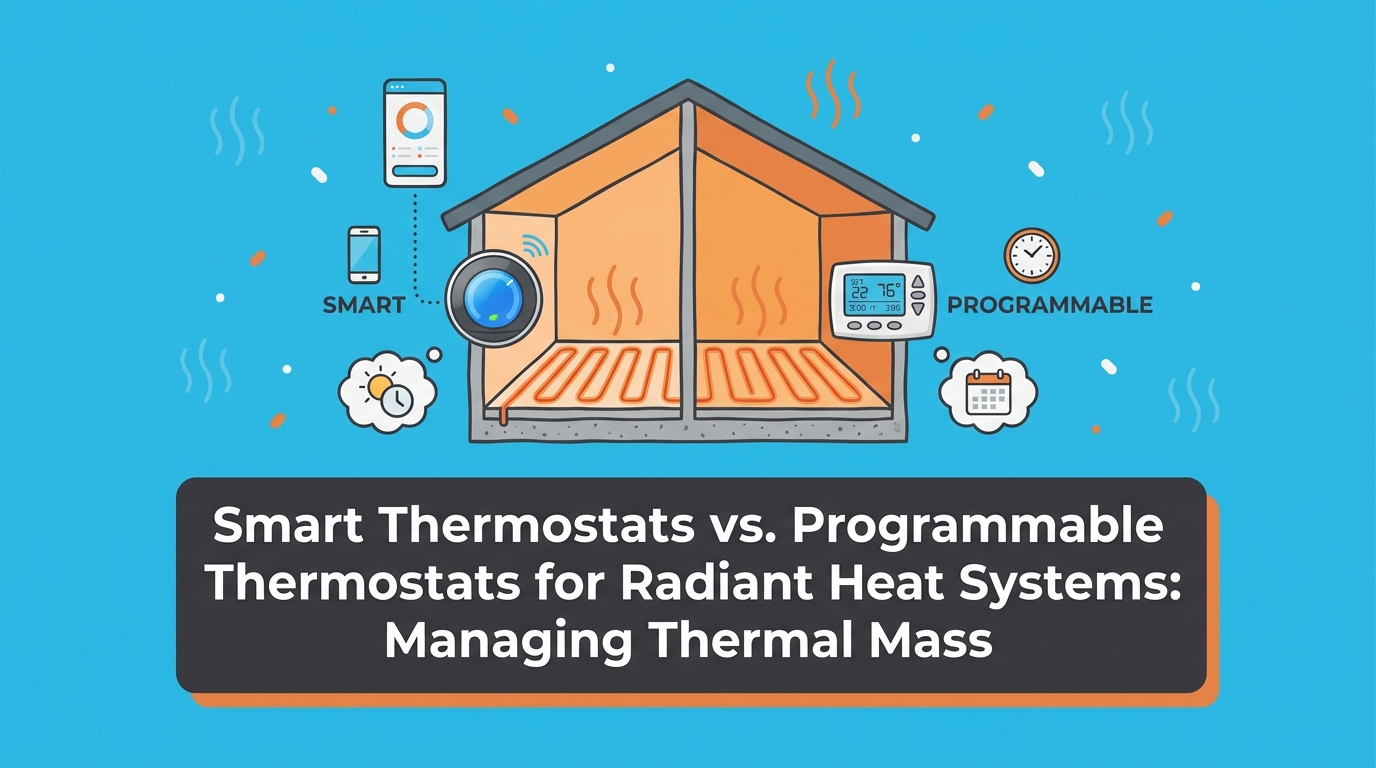
Upgrading your home's technology doesn't always guarantee better comfort, especially when evaluating smart thermostats vs. programmable thermostats for radiant heat systems. A common myth among homeowners is that installing a highly rated, Wi-Fi-enabled smart thermostat will automatically optimize their heating, improve comfort, and save energy. However, the reality of heating physics often tells a different story. When the October heating-startup period arrives, standard smart-thermostat setback algorithms frequently leave homes with radiant heat feeling uncomfortably cold.
The core issue lies in the fundamental difference between how modern smart technology expects a heating system to behave and how a traditional boiler actually operates. When the first sharp temperature drops hit in the fall, a thermostat that attempts to aggressively lower the temperature overnight will demand a rapid recovery the next morning. Because radiant systems operate on a slow, steady curve, they simply cannot catch up in time. Homeowners are then forced into a frustrating decision point: do you disable the expensive "learning" features you just paid for, or do you rely on a traditional programmable thermostat instead?
In our experience servicing boilers throughout the region, we see this exact scenario play out every autumn. A perfectly functioning boiler is often blamed for a cold house when the real culprit is a mismatched thermostat sending the wrong signals. Understanding how to pair your control system with your heating equipment is the key to true winter comfort.
If you are struggling to achieve consistent comfort and need professional guidance with your heating systems, or if you are looking to explore advanced radiant heating and cooling solutions, our team is ready to help you find the perfect match for your home.
The Physics of Thermal Mass: Forced Air vs. Radiant Heating
To understand why thermostats behave differently depending on the equipment they control, you have to look at the physics of thermal mass. Thermal mass refers to the ability of a material to absorb, store, and slowly release heat energy. Forced-air furnaces and radiant boiler systems handle thermal mass in two completely opposite ways, which fundamentally changes how a thermostat must operate to keep you comfortable.
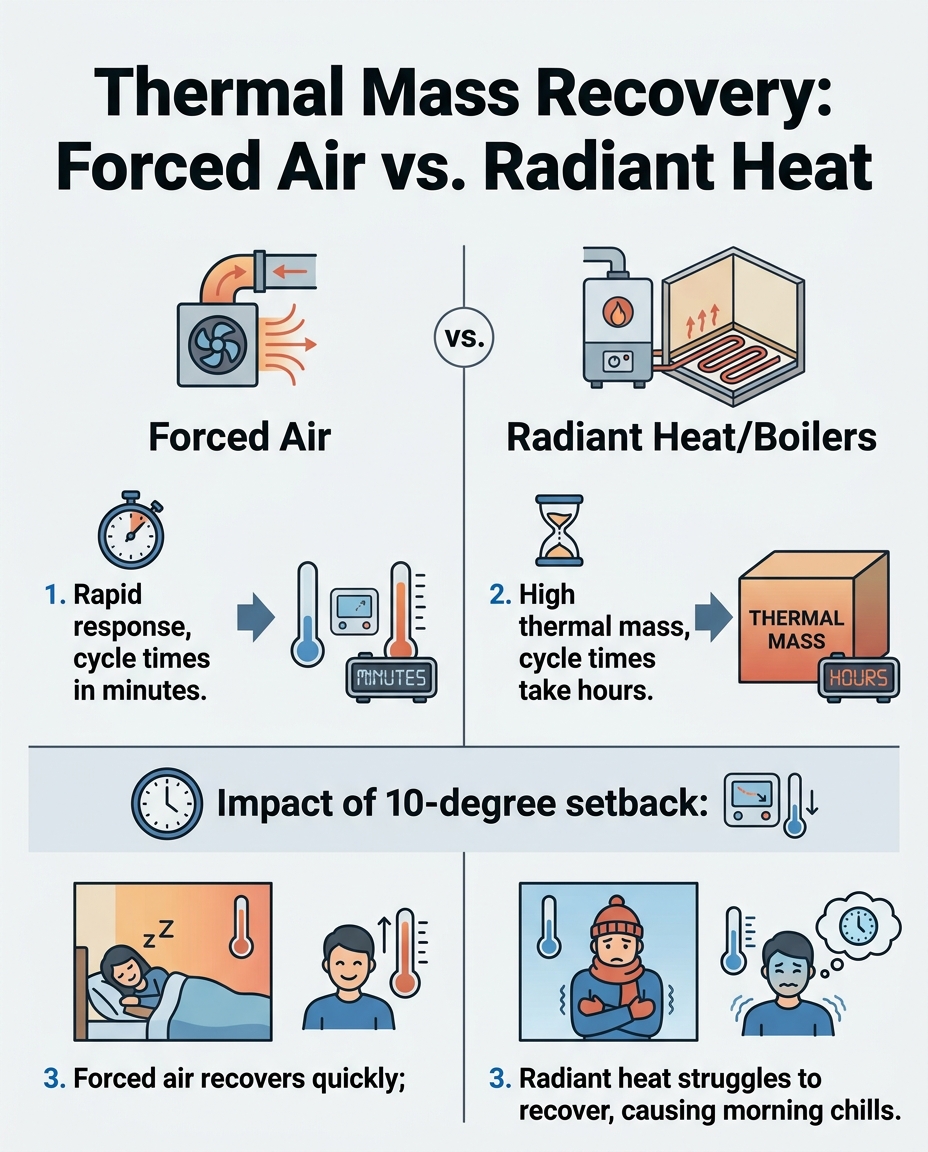
Forced-air systems are designed for rapid response. When a thermostat calls for heat, the furnace ignites, the blower turns on, and hot air immediately fills the room. Because air has very low thermal mass, the room heats up quickly. However, the moment the blower shuts off, that warm air begins to dissipate. The thermostat manages this by cycling the system on and off several times an hour, maintaining the temperature through rapid bursts of energy.
Radiant heating systems, on the other hand, rely on high thermal mass. Whether you are using cast-iron radiators, baseboard units, or in-floor piping, a boiler heats water—a substance that is incredibly dense and holds heat exceptionally well. This hot water travels through your home, transferring its thermal energy to the metal radiators or the concrete floor slab. Those objects then radiate that heat outward, warming the solid objects and people in the room rather than just blowing hot air. If you are comparing radiant floor heating to baseboard radiators, you will notice both share this fundamental characteristic: they take a long time to heat up, but they hold onto that heat for hours.
Understanding the 'Low and Slow' Heating Approach
Because water takes significant time to absorb heat and transfer it to a room's solid surfaces, radiant systems operate on a "low and slow" principle. Altering a room's temperature by just three or four degrees with radiant heat can take several hours.
• Superior comfort at a steady state: Once a high-thermal-mass system reaches the target temperature, it provides incredibly even, draft-free warmth.
• Poor response to sudden adjustments: Because it takes hours to alter the temperature of a heavy floor slab or a large volume of water, radiant systems cannot quickly recover from a deep temperature drop.
This slow recovery time is exactly why the rapid-cycle logic of standard thermostats completely fails when applied to a boiler system.

Why Standard Smart Thermostat Algorithms Fail Boiler Systems
Most off-the-shelf smart thermostats are engineered with the assumption that they will be controlling a forced-air furnace. Their algorithms are optimized to save energy by letting the house cool down dramatically when you are asleep or away at work, and then blasting the heat just before you wake up or return home. While this works perfectly for a furnace, it is a recipe for disaster with a boiler.
Standard smart thermostat algorithms fail radiant systems because they do not account for the massive lag time of thermal mass. If a smart thermostat's "eco" mode drops the temperature from 70°F to 60°F at 10:00 PM, the heavy materials in your home will slowly cool down. When the thermostat decides it is time to warm the house back up at 5:30 AM, it expects the system to accomplish the task in thirty minutes. For typical Jeannette and Greensburg area homes utilizing traditional boiler systems, recovering ten degrees of thermal mass might take four to six hours.
This dynamic becomes painfully obvious during sharp Pennsylvania temperature drops in October and the dead of winter. These sudden cold snaps expose the slow recovery times of radiant systems. The Department of Energy explicitly advises against aggressive temperature setbacks for radiant floor heating, noting that the slow response time makes deep setbacks impractical and counterproductive.
The Morning Freeze: The Danger of Aggressive Setbacks
When an aggressive setback schedule is applied to a boiler, the results are uncomfortable and inefficient. Here is what typically happens:
1. The Deep Drop: The smart algorithm drops the house temperature by 8 to 10 degrees overnight to save fuel.
2. The Delayed Call: At 6:00 AM, the thermostat calls for heat, expecting the house to be warm by 6:30 AM.
3. The Morning Chill: The boiler fires up, but the cold water and cold radiators take hours to absorb and radiate enough heat. At 7:00 AM, you are waking up to a freezing house.
4. The Energy Waste: To recover those lost degrees, the boiler must run continuously at maximum output for hours. By noon, the house finally reaches 70°F, but the algorithm has actually wasted more energy trying to overcome the massive thermal deficit than it saved overnight.
The Programmable Thermostat Advantage for Radiant Heat
Given the physics of thermal mass, many heating professionals recommend traditional programmable thermostats as the superior choice for radiant heat. A programmable thermostat does exactly what you tell it to do, when you tell it to do it, without a hidden algorithm trying to "learn" or "optimize" your schedule behind the scenes.
Programmable thermostats allow homeowners to set rigid, predictable schedules that perfectly match the steady operational needs of traditional boiler systems. Because there is no artificial intelligence attempting to maximize away-time savings, the boiler is allowed to maintain the consistent baseline temperature it needs to operate efficiently.
The primary advantage here is simplicity and control. By maintaining a steady temperature, the boiler only needs to fire in short, gentle increments to replace the heat lost through the walls and windows. The water in the system stays warm, the radiators stay warm, and the ambient temperature of the room never experiences a harsh drop.
Setting the Right Schedule for Steady Warmth
To get the most out of a programmable thermostat paired with radiant heat, you must adjust how you think about scheduling:
• Avoid deep setbacks: Never drop the temperature by more than 2 to 3 degrees overnight or while you are at work.
• Keep adjustments minimal: If your ideal daytime temperature is 70°F, set your nighttime temperature no lower than 68°F.
• Start early: If you do drop the temperature by 2 degrees at night, program the thermostat to start recovering the heat at least two hours before you wake up.
By keeping temperature adjustments minimal, you maximize both your boiler's energy efficiency and your indoor comfort.
Can You Make a Smart Thermostat Work with a Boiler?
If you already own a smart thermostat, or if you strongly prefer the convenience of controlling your heating from your smartphone, you can make it work with a boiler system. However, it requires careful configuration and an understanding of your system's wiring.
In our experience bridging the gap between off-the-shelf smart home technology and the traditional radiant heating systems common in older Westmoreland County homes, the key is disabling the features designed for forced air. If your smart thermostat does not have specific settings for radiant heat, you must manually disable the "auto-schedule" and "eco-mode" learning features. You must then treat the smart device exactly like a basic programmable thermostat, setting a rigid schedule with minimal temperature fluctuations.
Additionally, you must consider the wiring. Smart thermostats have bright screens and constant Wi-Fi connections, which require continuous 24-volt power. This power is typically supplied by a "C-wire" (Common wire). Older boiler systems often operate on a simple two-wire system (R and W) that only acts as an on/off switch. Without a C-wire, a smart thermostat will attempt to steal power from the heating circuits, which can cause the boiler to short-cycle, chatter, or fail entirely. Installing a smart thermostat on an older boiler frequently requires a professional to run new thermostat wire or install a power isolation module.
Configuring 'True Radiant' Features
Some high-end smart thermostats offer specialized settings—often called "True Radiant" or "Radiant Ready"—specifically designed to learn the lag time of high-thermal-mass systems.
• Historical tracking: These features track historical weather data and monitor exactly how many hours it takes your specific boiler to raise the indoor temperature by one degree.
• Predictive activation: Instead of waiting until 6:00 AM to turn on, a True Radiant algorithm might turn the boiler on at 3:30 AM to ensure the house hits the target temperature exactly on time.
• Learning phase: This requires patience. During the first few weeks of the heating season, the thermostat will likely overshoot or undershoot the target temperature as it learns the unique thermal mass of your home.
Side-by-Side Comparison: Smart vs. Programmable for Radiant Systems
To help you make a definitive choice for your home's heating control, we have synthesized the technical differences into a clear side-by-side comparison. The right choice ultimately depends on your willingness to navigate advanced settings versus your desire for simple, reliable comfort.
• Upfront Simplicity — Smart Thermostats: Low. Requires careful configuration, disabling default eco-settings, and enabling radiant-specific modes. — Programmable Thermostats: High. Works exactly as programmed out of the box with no hidden algorithms.
• Energy Efficiency Approach — Smart Thermostats: Algorithm-driven. Attempts to save energy through dynamic setbacks, which can backfire on boilers if not configured perfectly. — Programmable Thermostats: Steady baseline. Saves energy by preventing the boiler from having to overcome massive temperature deficits.
• Installation Ease — Smart Thermostats: Complex. Almost always requires a C-wire for continuous Wi-Fi and screen power, which many older boilers lack. — Programmable Thermostats: Simple. Often runs on standard AA batteries or a basic two-wire connection, making retrofits incredibly easy.
• Best Homeowner Profile — Smart Thermostats: Tech-savvy users who want remote access and are willing to endure a multi-week "learning phase" for the algorithm. — Programmable Thermostats: Homeowners who want reliable, "set it and forget it" comfort without waking up to a cold house during a freeze.
If you prioritize remote control and data tracking, a properly configured smart thermostat with a True Radiant setting is an excellent tool. If you simply want your home to be consistently warm without fighting an algorithm, a programmable thermostat remains the gold standard for boiler systems.
Frequently Asked Questions About Thermostats and Radiant Heat
Can you use a smart thermostat with radiant heat?
The short answer is yes, but it requires specific features and careful configuration. You must choose a model equipped with a "True Radiant" or similar boiler-specific setting that accounts for slow heating times. If you install a standard smart thermostat without these features, you will need to manually disable its learning algorithms to prevent it from applying forced-air logic to your boiler.
What is the best thermostat setting for a boiler?
The best setting for a boiler is a consistent, steady temperature with very minimal adjustments. Most heating professionals recommend setting your baseline comfort temperature (for example, 70°F) and never dropping it by more than 2 to 3 degrees at night or when you leave the house. This "low and slow" approach keeps the thermal mass of the home warm and prevents the boiler from overworking.
Why is my radiant heat not getting warm enough with a smart thermostat?
If your house is cold, your smart thermostat is likely dropping the temperature too low overnight and not giving the boiler enough time to recover. Because radiant heat takes hours to alter the room temperature, an aggressive setback schedule will leave you freezing in the morning. Check your thermostat's app and disable any "eco" or auto-away features that are drastically lowering the target temperature.
Do programmable thermostats work with underfloor heating?
Yes, programmable thermostats are exceptionally well-suited for underfloor heating. Because underfloor systems heat a massive concrete slab or subfloor, they have the highest thermal mass of any heating system and the slowest recovery times. A programmable thermostat allows you to set a rigid, unchanging schedule that perfectly supports the steady-state operation underfloor heating requires.
Should I turn off the 'learning' feature on my thermostat for my boiler?
In most cases, yes. Unless your smart thermostat has a dedicated learning mode specifically engineered for radiant boilers (like True Radiant), the standard learning feature will attempt to apply rapid forced-air setbacks to your system. Turning off the auto-schedule and manually setting a consistent temperature is the best way to ensure your boiler operates efficiently and keeps you comfortable.
How long does thermal mass recovery take during a cold snap?
During a severe cold snap, a radiant heating system can take anywhere from four to eight hours to recover from a deep 10-degree temperature setback. The colder the outdoor temperature, the faster the house loses heat, meaning the boiler has to work even harder just to break even before it can actually raise the indoor temperature. This is why maintaining a steady baseline temperature is critical during deep winter freezes.
Expert Guidance for Optimizing Your Radiant Comfort
Ultimately, the debate between smart thermostats vs. programmable thermostats for radiant heat systems comes down to matching your control device to the physics of your heating equipment. A perfectly functioning boiler can feel completely broken if the thermostat is sending the wrong signals at the wrong times. Whether you choose the reliable simplicity of a programmable unit or the advanced tracking of a properly configured smart device, respecting the slow thermal mass recovery of radiant heat is essential.
As a boiler installation and service specialist, we know that every home's thermal footprint is unique. If you are tired of waking up to a cold house, it may be time to evaluate your current setup, check your wiring compatibility, and align your comfort goals with the right technology. If you need expert assistance, we are ready to help you optimize your existing system or upgrade to highly efficient radiant heating and cooling solutions.