Why October is the Deadline for Checking Your Furnace Heat Exchanger in Jeannette
The Hidden Risk of Skipping October Furnace Safety Checks
The first frost of the season is just weeks away, and your heating system has likely been sitting idle since last spring. Before you switch the thermostat to heat for the long winter ahead, there is one critical component that demands your attention. At Cochran Heating & Cooling, our technicians have seen firsthand how understanding why October is the deadline for checking your furnace heat exchanger in Jeannette can mean the difference between a safe, comfortable winter and a dangerous mid-season breakdown. Aging furnaces often hide compromised components that pose a serious risk of carbon monoxide exposure when pushed into continuous operation.
If you need professional heating services or comprehensive furnace maintenance and repair, scheduling your October pre-winter heating startup check is the most important step you can take.
Many homeowners view fall maintenance as a basic efficiency tune-up—a quick filter change and a dusting of the burners to keep energy bills in check. However, evaluating the heat exchanger is not about efficiency; it is a strict life-safety issue. This metal barrier is the only thing standing between the toxic gases created by burning fuel and the clean air circulating through your living room.
As furnaces age, the constant stress of heating up and cooling down takes a severe toll on this metal. A system that ran perfectly fine at the end of last winter might have developed microscopic weaknesses over the summer, or hairline fractures that only reveal themselves when the metal expands under high heat. We always advise our customers that treating October as a non-negotiable safety deadline ensures any structural failures are identified before the severe cold forces your system to run around the clock.
Understanding Thermal Stress on Your Heat Exchanger
To understand why this inspection is so critical during your October pre-winter heating startup, you first need to understand the mechanical function of the heat exchanger itself. When your furnace turns on, the burners ignite gas to create heat. These combustion gases are incredibly hot and contain dangerous byproducts, including carbon monoxide.
The heat exchanger is a series of metal tubes or coils that contain these toxic gases. As the metal gets hot, your blower motor pushes clean indoor air over the outside of the exchanger. The heat transfers from the metal to the air, warming your home, while the toxic combustion gases remain safely trapped inside the metal chambers and are vented out through your roof or side wall. The breathable air and the combustion gases should never mix.
Because the heat exchanger is subjected to intense heat from the burners and cooler air from the blower simultaneously, it endures a massive amount of physical strain every time the furnace cycles on and off.
The Anatomy of Metal Fatigue in Heating Systems
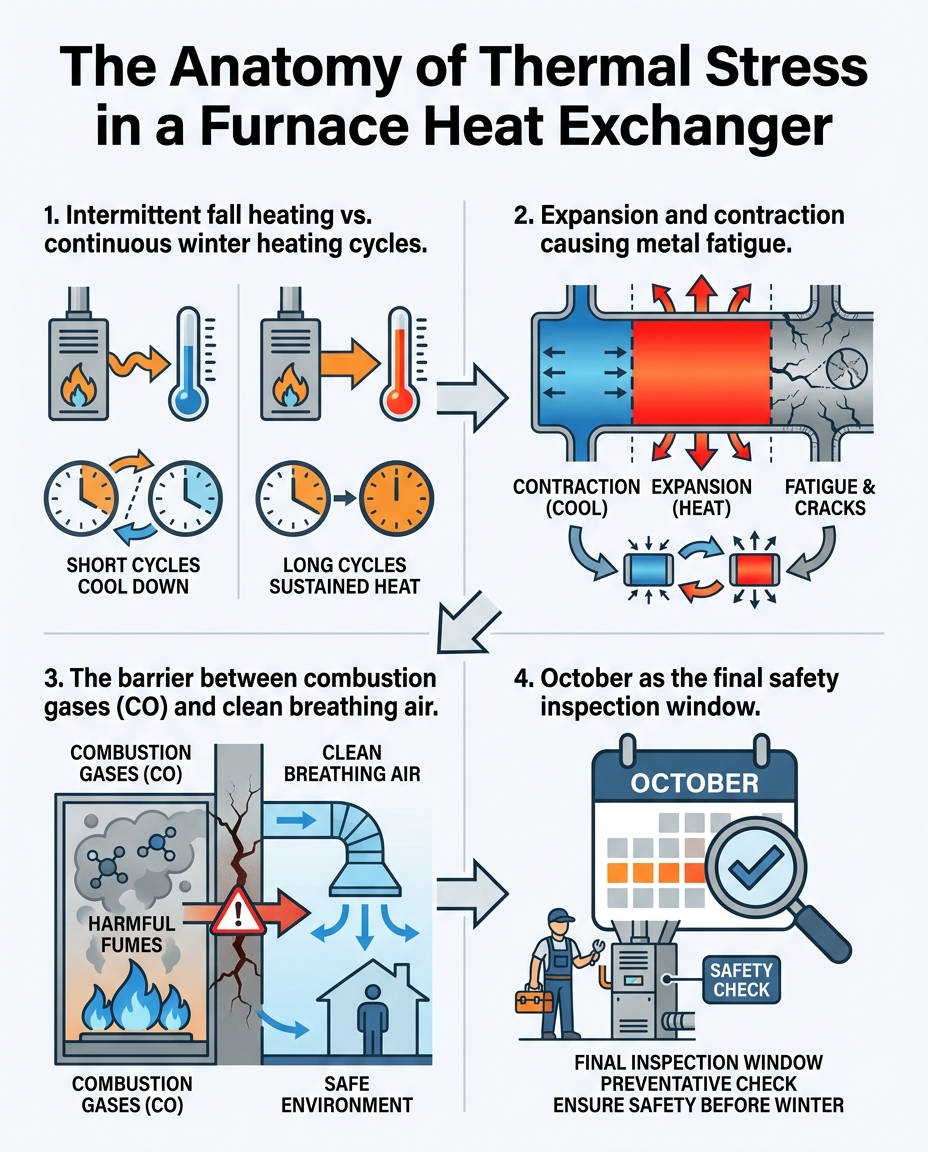
Every time your furnace fires up, the sudden blast of heat causes the metal of the heat exchanger to expand. When the cycle finishes and the burners shut down, the metal cools and contracts. This constant expansion and contraction is known as thermal stress.
Over years of operation, this microscopic movement inevitably leads to metal fatigue. Think of bending a metal paperclip back and forth; eventually, the metal weakens and snaps. The exact same physical process happens inside your furnace. In our years of replacing older heating systems across the Jeannette area, a pattern we see often is hairline cracks beginning to form in the weakest areas of the metal, typically along welded seams or sharp bends.
Factors That Accelerate Metal Fatigue:
• Restricted Airflow: A clogged air filter prevents cool air from flowing over the exchanger, causing the metal to overheat and expand beyond its design limits.
• Oversized Furnaces: A unit that is too large for the home will "short-cycle" (turn on and off rapidly), doubling or tripling the number of expansion and contraction cycles the metal endures.
• Improper Gas Pressure: Burners that are firing too hot will subject the metal to temperatures it was not engineered to withstand.
• Neglected Maintenance: Dirt and soot buildup on the metal acts as an insulator, trapping heat and causing uneven expansion.
The most dangerous aspect of metal fatigue is that these hairline cracks are often completely invisible to the untrained eye when the metal is cold. The fracture only opens up and becomes a leak when the furnace is running and the metal has fully expanded.

Why Intermittent Fall Heating Masks Major Winter Problems
As a local team, we know early autumn in Western Pennsylvania is characterized by unpredictable temperature swings. You might need the furnace for an hour in the early morning, but by noon, the house is comfortable enough to leave the system off. This intermittent, short-cycling furnace use places a very different type of load on your equipment compared to the demands of deep winter.
Historical weather data for the region shows how average overnight temperatures drop significantly between October and November. During the mild weeks of early fall, an aging furnace with an already weakened heat exchanger might easily survive short heating cycles. The metal heats up briefly, the house reaches the target temperature, and the system shuts down before maximum thermal stress is reached. Because the run times are short, a hairline crack might not fully expand, or the amount of gas leaking through might be small enough to go unnoticed.
However, when November arrives and the overnight lows plummet, your furnace is forced into continuous operation. Instead of running for ten minutes at a time, the burners might fire for thirty or forty minutes straight to combat the freezing temperatures outside.
The Shift from Fall to Winter Demands:
• Furnace Run Time — Early Fall (October): Short, intermittent cycles (10-15 mins) — Deep Winter (Dec-Feb): Long, continuous cycles (30-45+ mins)
• Thermal Stress Level — Early Fall (October): Moderate expansion — Deep Winter (Dec-Feb): Maximum expansion and sustained heat
• Crack Behavior — Early Fall (October): Hairline fractures may remain tightly closed — Deep Winter (Dec-Feb): Fractures open fully under sustained heat
• Risk of CO Leak — Early Fall (October): Low to Moderate — Deep Winter (Dec-Feb): Extremely High
This dramatic shift in workload is why waiting until November or December for an inspection is a dangerous gamble. By the time the snow flies in Jeannette PA, the system is already operating under maximum stress. Establishing October as the final window for a safety check ensures your equipment is evaluated before it faces the grueling, round-the-clock demands of winter.
Carbon Monoxide: The Invisible Danger of a Cracked Heat Exchanger
When a heat exchanger fails, it stops being a mechanical problem and immediately becomes a life-safety hazard. The primary danger of a cracked heat exchanger is that it allows combustion gases to escape the sealed exhaust system and mix directly with the breathable air being pushed into your home's ductwork.
The most lethal of these gases is carbon monoxide (CO). According to the Centers for Disease Control and Prevention (CDC) and the EPA, carbon monoxide is an odorless, colorless, and tasteless gas that is responsible for hundreds of non-fire-related incidents annually. Because human senses cannot detect it, a slow leak from a compromised furnace can fill a home with toxic gas while the occupants remain completely unaware.
During an October pre-winter heating startup, our professionals look for the subtle warning signs of incomplete combustion and heat exchanger failure. While you should never wait for symptoms to appear before calling an expert, there are a few visual clues that indicate your furnace is operating dangerously.
Signs of Combustion Issues:
• Yellow or Orange Burner Flames: A healthy gas furnace should burn with a crisp, steady blue flame. A yellow, flickering flame indicates incomplete combustion and a high likelihood of carbon monoxide production.
• Excessive Soot or Rust: Black soot around the burners or unusual rust flaking off the metal components suggests moisture and gas are not venting properly.
• Strange Odors: While carbon monoxide itself has no smell, other combustion gases do. A sharp, chemical smell similar to formaldehyde when the heat turns on is a major red flag.
It is critical to understand that carbon monoxide detectors are your absolute last line of defense. If your CO alarm sounds, the poisonous gas is already occupying your living space in dangerous concentrations. An intact, professionally verified heat exchanger is your primary prevention mechanism. Ensuring this component is structurally sound stops the gas from ever entering your home in the first place.
Why Visual Inspections Require Professional Teardown
With the stakes so high, it is vital to explicitly state that inspecting a heat exchanger is not a DIY task. You cannot simply shine a flashlight into the cabinet of your furnace and declare the metal safe. Because of the complex geometry of the heat exchanger cells and the fact that hairline cracks often remain invisible until the metal is hot, a proper evaluation requires specialized tools, professional training, and a partial teardown of the equipment.
Working with family-owned HVAC professionals in Jeannette like our team at Cochran Heating & Cooling means you receive a level of care and thoroughness that prioritizes your safety over a rushed seasonal checklist. A proper safety evaluation involves several highly technical steps that only a licensed technician can perform safely.
The Professional Inspection Process:
1. Combustion Analysis: Before taking anything apart, our technicians use a digital combustion analyzer. By inserting a probe into the exhaust flue, we can measure the exact parts per million (PPM) of oxygen, carbon monoxide, and other gases. A sudden spike in oxygen levels in the exhaust often indicates that blower air is pushing through a crack in the heat exchanger and mixing with the combustion gases.
2. Visual Borescope Inspection: Technicians use flexible, high-definition inspection cameras (borescopes) to snake deep into the curved chambers of the heat exchanger. This allows us to view the backside of the metal and the deep recesses that are impossible to see from the front access panel.
3. Flame Interference Testing: By observing the burner flames while the blower motor engages, a professional can spot flame distortion. If the steady blue flame suddenly dances or wavers when the fan kicks on, it is a strong indicator that air is blowing through a crack in the metal and disrupting the fire.
4. Component Teardown: In many cases, the technician must carefully remove the burner assembly, the inducer motor, or the limit switches to gain full visual access to the primary and secondary heat exchanger cells.
Because this process involves handling the gas manifold and the core combustion components of the furnace, it requires a deep understanding of gas pressures and safety protocols. Attempting to dismantle these parts without a license can easily create gas leaks or electrical hazards.
Securing Peace of Mind Before Freezing Temperatures Arrive
Shifting from the technical risks to the practical solutions, the ultimate goal of an October pre-winter heating startup is peace of mind. When you schedule a comprehensive safety check with our team, the technician is not just looking for cracks; they are evaluating the entire combustion process to ensure your system runs cleanly, safely, and reliably.
Catching a cracked heat exchanger early in the fall offers a massive logistical advantage. If we discover a major failure in October, you have the time to carefully review your options, whether that means ordering a replacement part under warranty or upgrading to a new, high-efficiency furnace. You can make this decision calmly, without the pressure of a freezing house.
Conversely, if that same crack goes undetected and causes a total system shutdown—or worse, a carbon monoxide leak—in the middle of a late-December blizzard, you are immediately forced into an emergency replacement scenario.
Enrolling in a preventative HVAC maintenance plan is the easiest way to ensure these critical life-safety components are evaluated every single fall without fail. Routine maintenance plans take the guesswork out of seasonal preparation. You receive priority scheduling, ensuring your system is checked and cleared long before the continuous winter operation begins. The technical peace of mind that comes from knowing the combustion process is fully contained, the exhaust is venting properly, and the metal is structurally sound is the greatest benefit of proactive maintenance.
Frequently Asked Questions About Heat Exchanger Safety
Why does a furnace heat exchanger crack?
A furnace heat exchanger cracks primarily due to thermal stress and metal fatigue. Every time the furnace heats up, the metal expands, and when it cools down, it contracts. Over thousands of heating cycles, this constant movement weakens the metal, eventually causing hairline fractures to form along seams or bends. Poor airflow, lack of maintenance, and oversized equipment can severely accelerate this wear and tear.
What happens if a furnace heat exchanger is cracked?
If a furnace heat exchanger is cracked, the toxic gases produced by burning fuel can escape the exhaust system and mix with the breathable air in your home. This includes carbon monoxide, an odorless and colorless gas that poses a severe life-safety hazard. Additionally, a crack disrupts the internal pressure of the furnace, which can cause the burners to operate inefficiently, create soot buildup, or trigger the system's safety switches to shut the furnace down entirely.
How often should a furnace heat exchanger be checked?
A furnace heat exchanger should be checked at least once a year by a licensed professional, ideally during the fall before the continuous winter heating season begins. Because hairline cracks can develop over a single season of heavy use, annual inspections are critical for verifying the structural integrity of the metal. In places like Jeannette PA, where winter demands are high, skipping an annual check leaves you vulnerable to undetected failures.
Can a cracked heat exchanger be repaired?
No, a cracked heat exchanger cannot be safely repaired with welding or sealants. Because the metal must endure extreme, continuous thermal expansion and contraction, any patch or weld will quickly fail under the stress. When our professionals identify a crack, the only safe and code-compliant solution is to replace the entire heat exchanger component or, depending on the age and condition of the unit, replace the entire furnace.
What are the warning signs of carbon monoxide from a furnace?
The warning signs of carbon monoxide production include a yellow or flickering burner flame instead of a steady blue one, excessive moisture or condensation on your windows, and visible soot or rust around the furnace cabinet. You might also notice a sharp, chemical odor when the heat turns on. However, because carbon monoxide itself is completely odorless and invisible, you must rely on a professional inspection and functional CO detectors rather than waiting for visual symptoms.
Schedule Your October Heat Exchanger Inspection Today
Verifying the integrity of your heat exchanger before continuous winter use is not just a recommendation; it is a critical requirement for protecting your home. The transition from mild autumn weather to freezing winter nights places massive thermal stress on aging metal components. Prioritizing life-safety over basic efficiency means recognizing that an intact combustion barrier is the only thing preventing carbon monoxide exposure.
Do not wait until the snow is falling and your system is running around the clock to find out if your equipment is structurally sound. Talk to our experts at Cochran Heating & Cooling and schedule your October pre-winter heating startup check before the seasonal window closes. A clear, technical evaluation will provide the absolute peace of mind that your home will remain safe, warm, and secure all winter long.